Hugging Face has handed the routing of its Inference Providers service to OpenRouter. Since November 16, every request to a language model made with a Hugging Face token goes through OpenRouter’s router, which picks a provider per call and retries on another one if the first fails. Your code keeps working, but one thing breaks: you can no longer bring your own provider API key for chat models.
The Hugging Face announcement calls this the first step of a wider partnership, and OpenRouter’s own post says the launch covers 160 models from 38 labs. Here is what changed, what it costs you, and what to check before your next deploy.
Key takeaways
- Hugging Face Inference Providers now uses OpenRouter’s router for all language-model requests, replacing its own custom router.
- The launch covers 160 models from 38 labs: every model OpenRouter serves that also has a Hugging Face Hub page.
- Failed calls are now retried on the next-best provider inside the same request, instead of returning an error.
- Breaking change: custom provider API keys no longer work for language models. Image and video keys still do.
- Pricing is unchanged: you pay the provider’s price on your Hugging Face bill with no Hugging Face markup.
What happened
Inference Providers is the Hugging Face feature that lets you call a model on the Hub through third-party hosts such as Novita, using one Hugging Face token and one API. Until this week, Hugging Face ran its own router for that: it chose a single provider for your request and, if that provider failed, passed the error back to you.
That router is gone for chat models. Requests now go through OpenRouter, which says it serves more than 800 trillion tokens a month to over 10 million users across 600+ models from 80+ providers. For each call it weighs live price, speed and reliability, sends the request to the best match, and moves traffic away from providers that slow down or start failing.
The router speaks OpenAI’s Chat Completions and Responses APIs and Anthropic’s Messages API for every chat model, whichever provider sits behind it. Hugging Face has published setup guides for coding agents including Claude Code, Codex and OpenCode, so you can point those tools at open-weight models with your existing token. OpenRouter names models such as DeepSeek V4.1 Flash, Kimi K3.1 Pro, GLM 5.3, Qwen3.8 27B, Nemotron 3 Ultra and gpt-oss-120b among those available at launch.
Image, video and audio generation are not part of the switch. They keep running directly through Hugging Face Inference Providers, as before.
Why it matters
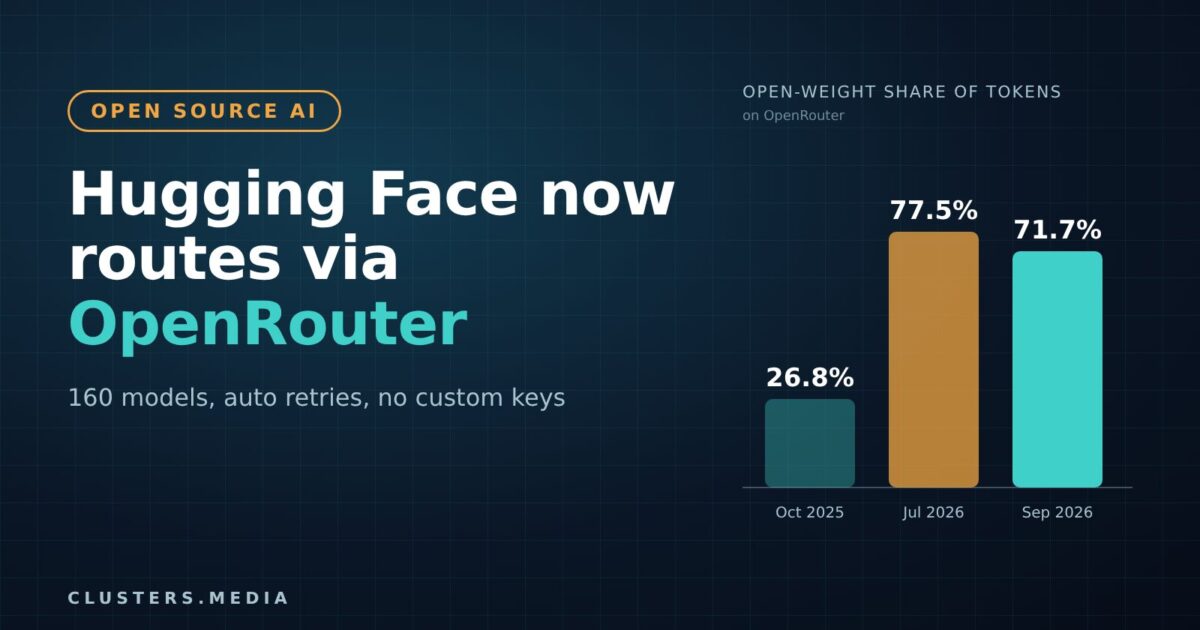
Open-weight models are no longer a side option. According to OpenRouter data cited by Hugging Face, open-weight models went from 26.8% of the tokens OpenRouter served in October 2025 to 71.7% at the end of September 2026, after peaking at 77.5% in July. Over that period weekly open-weight volume grew more than 60-fold, against almost tenfold for closed models.
Cost explains a lot of that. Hugging Face says open-weight models average $0.28 per million input tokens and $1.62 per million output tokens, against $1.27 and $6.36 for closed models: roughly a quarter of the price. The gap in quality has not closed, though. On the Artificial Analysis Intelligence Index, Hugging Face notes, the top open-weight model, Kimi K3.1 Pro, scores 46 against 65 for Claude Fable 5.2, at about a seventh of the cost per task.
An open-weight model can be hosted by many companies at once, which is exactly where a router earns its keep. Two of the best-known names in open-model access, one the default place to find models and the other a popular place to call them, are now one pipeline. That gives builders fewer moving parts, and it gives OpenRouter a large new stream of traffic from inside the Hub.
What it means for developers
Fewer failed calls. Before, a rate-limited or broken provider meant an error in your app. Now the request is retried on the next-best provider inside the same call. OpenRouter says its rebuilt routing, measured in a live experiment in October, cut capacity errors by 46%, improved time to first token by 16.9% and raised throughput by 16.3%. Its own post adds a detail worth noting: cost per request in that experiment rose 6.0%. Those are OpenRouter’s figures from its general traffic, not a benchmark of the Hugging Face integration.
You still control the provider. Add a suffix to the model ID to change the policy. The default balances price, speed and reliability; :fastest picks the highest throughput; :cheapest picks the lowest price; and a provider name such as :novita pins the request to that host. In your Hugging Face settings you can switch off any provider you do not want, and organization settings apply to every request billed to the org. That matters for teams with data-residency or vendor rules.
Keep your prompt cache. Routing is cache-aware: a conversation stays on the provider that holds its prompt cache. To make that explicit, Hugging Face recommends sending a stable UUID per conversation in the X-HF-Session-Id header. If you run long agent sessions, do this. Cache hits are cheaper and faster.
Check your billing setup now. This is the part that can break things. If your team used its own API key with a provider through Hugging Face, for example to spend committed credits or use negotiated rates, that no longer works for language models. Those requests now bill through your Hugging Face account at the provider’s price. Before you assume nothing changed, look at which projects relied on custom keys, move budgets, and update any cost tracking that read from provider dashboards. Hugging Face’s usage overview now breaks spend down by the provider each request went to.
Better visibility. Model pages gain a Providers tab listing every provider OpenRouter can route to, with its input and output price, speed and uptime over the last 24 hours, plus a Metrics tab. OpenRouter also says it can write each request as a JSON trace file, including tokens and cost, into a Hugging Face Storage Bucket you own. That feature is in beta.
For teams building agents on open models (see our coverage of LangChain’s Series C for where that market is heading), the change mostly removes failover code you would otherwise write yourself. The trade-off is less direct control over who you pay.
What to watch next
Hugging Face calls this step one. The next items on its list are letting you connect an existing OpenRouter account to Hugging Face, which could bring back some of the flexibility lost with custom keys, and routing more task types through OpenRouter. Neither has a date yet.
Three things are worth tracking. First, whether the 6.0% higher cost per request OpenRouter saw in its experiment shows up in real Hugging Face bills, given that the default route trades a little price for speed and reliability. Second, how providers react, since being ranked live on price and uptime inside the Hub puts more pressure on margins. Third, whether other model hubs and clouds follow with similar routing partnerships, as open-weight traffic keeps growing.
For now, the practical advice is simple. If you call chat models through Hugging Face, your code will keep running. If you relied on your own provider keys, check your billing today.