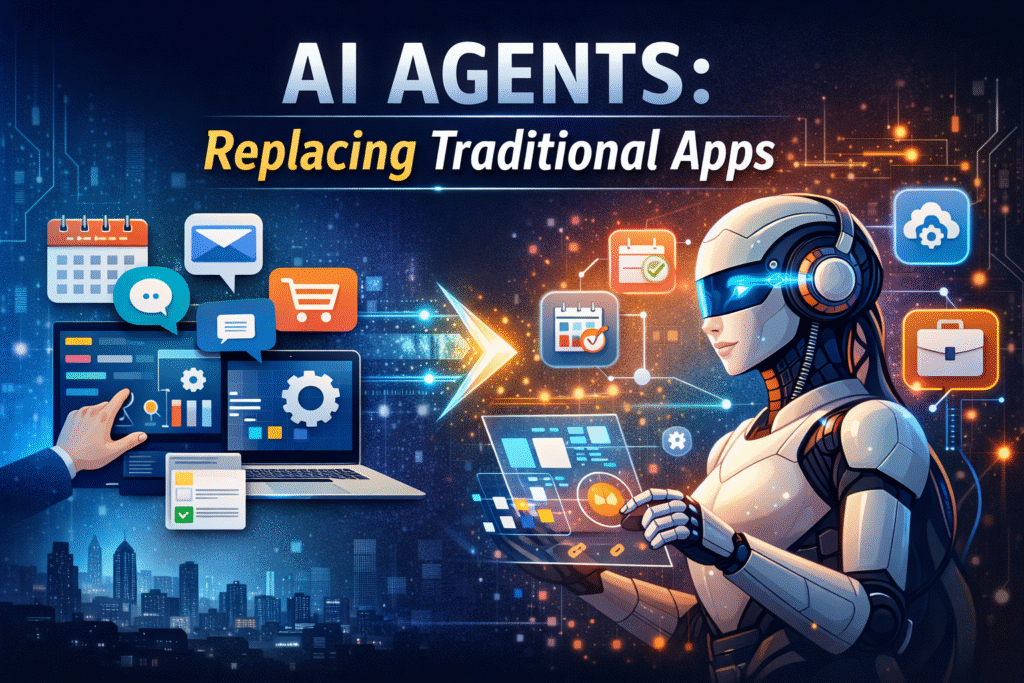
The way we use software is changing faster than ever. For decades, traditional apps followed a simple rule: users click buttons, apps respond. But now, a new paradigm is emerging — AI Agents.
AI agents don’t just respond to commands. They think, decide, plan, and act on behalf of users. From booking meetings to managing entire business workflows, autonomous AI agents are slowly replacing traditional applications.
Let’s explore what AI agents are, how they work, and why they represent the future of software.
What Are AI Agents?
AI agents are autonomous software programs powered by artificial intelligence that can:
- Understand goals instead of fixed commands
- Make decisions without constant user input
- Interact with multiple systems and APIs
- Learn and improve over time
Unlike traditional apps that rely on predefined logic, AI agents adapt dynamically based on context and outcomes.
Simple definition:
An AI agent is a digital worker that completes tasks independently once you define the goal.
Traditional Apps vs AI Agents
| Traditional Apps | AI Agents |
|---|---|
| Button-based UI | Goal-based interaction |
| Manual workflows | Autonomous execution |
| Fixed logic | Adaptive intelligence |
| Single-purpose | Multi-task capable |
| Requires user action | Acts proactively |
Traditional apps ask: “What button should I press?”
AI agents ask: “What outcome do you want?”
How AI Agents Work
AI agents combine multiple technologies:
1. Large Language Models (LLMs)
They understand natural language, context, and intent.
2. Decision Engines
They choose the best action based on available data and goals.
3. Memory & Context
Agents remember past interactions to improve future results.
4. Tool & API Access
They interact with emails, CRMs, calendars, databases, and cloud services.
5. Feedback Loops
Agents refine their behavior based on success or failure.
Together, these components allow AI agents to plan, execute, evaluate, and repeat.
Real-World Examples of AI Agents
🧑💼 Business Operations
- Automatically generating invoices
- Following up on unpaid payments
- Managing customer support tickets
🧑💻 Software Development
- Writing and reviewing code
- Running tests and fixing bugs
- Deploying applications
🛒 E-commerce
- Managing inventory
- Adjusting pricing dynamically
- Handling customer queries
📅 Personal Productivity
- Scheduling meetings
- Booking travel
- Organizing emails and tasks
These are tasks that once required multiple apps — now handled by one intelligent agent.
Why AI Agents Are Replacing Traditional Apps
1. Fewer Interfaces, Better Outcomes
Users don’t want to learn complex dashboards anymore. AI agents remove friction by focusing on results.
2. Automation at Scale
AI agents work 24/7 without fatigue, handling thousands of tasks simultaneously.
3. Lower Operational Costs
Businesses reduce manpower and software licensing costs.
4. Faster Decision Making
Agents analyze data instantly and act in real time.
5. Personalized Experiences
Each user gets a customized experience without manual configuration.
Industries Being Disrupted by AI Agents
- Customer Support
- Finance & Accounting
- Healthcare Administration
- Marketing & Sales
- Logistics & Supply Chain
- Software Development
In many companies, AI agents are already replacing entire software stacks.
Challenges & Risks of AI Agents
Despite their power, AI agents come with challenges:
- Data privacy concerns
- Security vulnerabilities
- Lack of transparency in decision-making
- Over-automation risks
- Dependence on AI models
Responsible design, human oversight, and ethical AI practices are critical.
AI Agents vs SaaS: The Future of Software
We are shifting from:
Software as a Tool → Software as a Teammate
Instead of buying 10 SaaS tools, companies will deploy custom AI agents that integrate everything.
This marks the beginning of “Agent-First Software”.
Will AI Agents Replace Developers?
No — but they will change the role of developers.
Developers will focus more on:
- Designing agent workflows
- Integrating APIs and systems
- Ensuring security and compliance
- Optimizing AI decision logic
The future developer builds intelligent systems, not just UI screens.
Conclusion
AI agents are not just another tech trend — they are a fundamental shift in how software works.
As autonomous AI becomes more reliable, traditional apps will feel slow, rigid, and outdated. Businesses and developers who adapt early will gain a massive competitive advantage.
The question is no longer “Will AI agents replace traditional apps?”
It’s “How fast will it happen?”