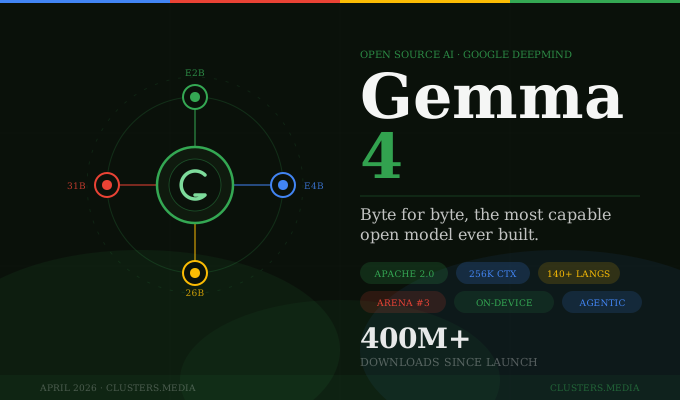
Google Gemma 4:
Byte for Byte,
the Most Capable Open Model Ever
Released April 2, 2026 — Gemma 4 is built from Gemini 3 research, ships in four sizes from phone to datacenter, and is completely free under Apache 2.0. Here’s the complete breakdown.
01 — What Is Gemma 4Google’s Most Ambitious Open Model Yet
On April 2, 2026, Google DeepMind quietly dropped one of the most significant open-source AI releases in the industry’s history. Gemma 4 is not a chatbot product. It is a family of open-weight models — freely downloadable, commercially licensed, and purpose-built to run on everything from a Raspberry Pi to a Google Cloud TPU cluster.
The headline claim from Google is bold: Gemma 4 delivers an unprecedented level of intelligence-per-parameter. That’s not marketing fluff. The 31B dense model claimed third place on Arena AI’s text leaderboard, beating models 20 times its size. The 26B Mixture of Experts variant came in sixth. These are extraordinary benchmark positions for models you can run on your own hardware, for free.
Gemma 4 is built from the same foundational research and technology as Gemini 3 — Google’s flagship proprietary model. For developers, researchers, and enterprises, this means cutting-edge capability without the API dependency, rate limits, or data privacy concerns that come with closed model services.
“Today, we are introducing Gemma 4 — our most intelligent open models to date. Purpose-built for advanced reasoning and agentic workflows, Gemma 4 delivers an unprecedented level of intelligence-per-parameter.”
— Google DeepMind, April 2, 202602 — The ModelsFour Sizes. One Family. Every Device Covered.
Gemma 4 ships in four distinct variants, each optimized for a different hardware profile. The naming convention distinguishes between “Effective” parameter models (designed for edge devices) and traditional Dense/MoE models for more powerful machines.
- Effective Params2 Billion
- Context Window128K tokens
- Target HardwarePhones, Edge
- ModalitiesText + Image + Audio
- LicenseApache 2.0
- Effective Params4 Billion
- Context Window128K tokens
- Target HardwarePhones, Laptops
- ModalitiesText + Image + Audio
- LicenseApache 2.0
- Total Params25.2B (MoE)
- Active Params3.8B per inference
- Context Window256K tokens
- Benchmark88.3% AIME 2026
- LicenseApache 2.0
- Parameters31 Billion (Dense)
- Context Window256K tokens
- Arena AI Rank#3 Text Leaderboard
- Target HardwareServer GPUs / TPUs
- LicenseApache 2.0
03 — CapabilitiesWhat Gemma 4 Can Actually Do
Gemma 4 is the most capable open model Google has ever shipped — and that shows in its feature set. Every model in the family ships with native multimodal support, multilingual fluency, and agentic reasoning capabilities that were previously exclusive to frontier closed models.
- Native multimodal: All four models can natively process images and video. The two edge models additionally support audio input and speech understanding.
- 140+ languages: Natively trained across more than 140 languages — not fine-tuned, but trained from the ground up with multilingual data. Ideal for global product development.
- 256K context window: The two larger models (26B and 31B) support 256,000 token contexts — enabling analysis of very long documents, codebases, and transcripts in a single pass.
- Agentic workflows: Multi-step planning, function calling, tool use, and API interaction. Gemma 4 can reason across multiple steps and execute autonomous workflows without human handholding.
- Offline code generation: Gemma 4 supports complete offline code generation — allowing developers to build and ship AI-powered coding tools without an internet connection.
- Structured output: Native support for returning responses in structured formats like JSON — critical for enterprise integrations and automated pipelines.
- Optical character recognition: All models can process images for OCR tasks — reading documents, labels, receipts, and handwritten content from images.
04 — BenchmarksHow Does Gemma 4 Actually Perform?
Benchmark numbers are only as meaningful as the tasks they represent — but Gemma 4’s results are genuinely striking, particularly when you account for model size. The 26B MoE variant scoring 88.3% on AIME 2026 (a rigorous mathematical reasoning benchmark) while activating only 3.8B parameters during inference is a remarkable feat of engineering.
Arena AI Text Leaderboard — April 2026
The most remarkable aspect of these results is what they reveal about parameter efficiency. The 31B model beating models with 600B+ parameters is not a fluke — it reflects the quality of the Gemini 3 research foundation that Gemma 4 is built upon. For developers, this means a model you can run on a single A100 GPU competes with systems that require entire server clusters.
Gemma 4’s 31B model ranks #3 globally on text benchmarks — beating models 20× its size. This is the most efficient intelligence-per-parameter ratio ever achieved in an open model, and it means enterprise-grade AI is now achievable on a single GPU.
05 — On-Device AIAI That Lives on Your Phone, Not in the Cloud
The E2B and E4B models represent Google’s most ambitious push yet into truly offline, on-device AI. In collaboration with the Google Pixel team, Qualcomm Technologies, and MediaTek, these models are engineered to run completely offline with near-zero latency on consumer hardware.
- E2B model is 3× faster than E4B — the fastest on-device AI model Google has ever released
- 4× faster overall than the previous generation of on-device Gemma models
- Uses up to 60% less battery compared to previous generation — critical for mobile deployment
- Runs on Raspberry Pi, NVIDIA Jetson Orin Nano, Android phones, and laptops — the broadest hardware support ever
- Gemma 4 forms the foundation for Gemini Nano 4 — code written today will automatically run on future Nano-enabled devices
- Android developers can prototype agentic flows today through the AICore Developer Preview
- Supports tool calling, structured output, system prompts, and thinking mode — coming during the preview period
The forward-compatibility guarantee is particularly significant for Android developers. Google has confirmed that code written for Gemma 4 today will work automatically on Gemini Nano 4-enabled devices shipping later this year. This removes one of the biggest friction points in on-device AI development — the fear of building for a model that gets deprecated before your product ships.
06 — EnterpriseCloud & Enterprise Deployment Options
For teams that need to scale beyond what local hardware can offer, Gemma 4 is deeply integrated into Google Cloud’s infrastructure from day one.
| Platform | What You Can Do | Best For |
|---|---|---|
| Vertex AI | Deploy to custom endpoints. Fine-tune with SFT recipes. Full control over serving infrastructure. | Enterprises needing custom, compliant deployments |
| Model Garden | Gemma 4 26B MoE fully managed and serverless. No infrastructure to manage. | Teams wanting fastest time-to-production |
| Cloud Run | Run Gemma 4-31B on NVIDIA RTX PRO 6000 (Blackwell) GPUs with 96GB vGPU memory. Serverless. | Developers who want GPU inference without server management |
| GKE / TPUs | Deploy on Trillium and Ironwood TPUs for massive scale. Highest compliance guarantees. | Regulated industries, sovereign AI requirements |
| Agent Dev Kit (ADK) | Open-source framework for building and deploying AI agents with Gemma 4. Function calling, code generation, structured output built in. | Teams building autonomous AI agents and workflows |
07 — ChoosingWho Should Use Gemma 4?
- You’re building Android apps that need on-device AI — offline, private, and battery-efficient
- You need near-zero latency inference on edge hardware (Raspberry Pi, NVIDIA Jetson, IoT devices)
- Your product serves markets with unreliable internet connectivity
- You need multimodal (text + image + audio) understanding on a phone without cloud costs
- You need high capability at low inference cost — it activates only 3.8B parameters despite 25.2B total
- You want a model that runs like a 4B but reasons like a much larger model
- You’re building agentic systems with function calling and tool use at scale
- You want the serverless, fully managed option on Model Garden with no GPU management
- You need the absolute best open-source performance — #3 on global text benchmarks
- You’re processing 256K+ token documents — contracts, codebases, research, transcripts
- Your enterprise or regulated industry requires data to stay within your own infrastructure
- You want to fine-tune a frontier-class model on your own proprietary data
08 — LicensingThe Apache 2.0 License — A Bigger Deal Than It Sounds
Previous Gemma generations were released under Google’s own Gemma license — a permissive but proprietary license with certain restrictions. Gemma 4’s switch to Apache 2.0 is significant and deliberate.
- Commercial use — fully permitted. You can build and sell products on top of Gemma 4 without paying Google a royalty or seeking permission.
- Modification — permitted. Fine-tune, distill, or remix the model weights however you need. The 100,000+ community variants in the Gemmaverse are now on stronger legal footing.
- Distribution — permitted. You can redistribute Gemma 4 as part of your own product or service.
- Patent protection — included. Apache 2.0 includes an explicit patent grant from Google, protecting you from patent claims related to the model.
- No lock-in. You own your deployment. You control your data. You choose your infrastructure. Google gets no ongoing access to what you build.
This licensing choice signals Google’s strategic intent clearly: Gemma is not a product with hidden commercial strings. It is a genuine attempt to establish an open ecosystem — partly to compete with Meta’s Llama series, and partly because a thriving open developer community ultimately benefits Google’s broader AI platform ambitions.
09 — ComparisonGemma 4 vs Closed Models: The Honest Trade-offs
Gemma 4 is remarkable, but it is not a universal replacement for closed models. Here is an honest assessment of where it wins, where it trails, and what you need to consider.
| Dimension | Gemma 4 (Open) | GPT-4o / Claude (Closed) |
|---|---|---|
| Data Privacy | ✓ 100% on your infrastructure. Zero data exposure. | ✗ Data processed by third-party servers. |
| Cost at Scale | ✓ Fixed infrastructure cost. No per-token fees. | ✗ Per-token API costs compound at high volume. |
| Fine-tuning | ✓ Full access to weights. Fine-tune on proprietary data freely. | ✗ Limited fine-tuning, often expensive, no weight access. |
| Raw Performance (Top End) | ✗ 31B is exceptional but GPT-5 / Claude Opus still lead some benchmarks. | ✓ Best-in-class on the most complex tasks. |
| Offline / Edge Use | ✓ E2B/E4B run completely offline on phones and edge devices. | ✗ Requires internet connectivity. No edge deployment. |
| Ecosystem / Plugins | ✗ Growing but smaller third-party ecosystem than ChatGPT. | ✓ Mature ecosystems with extensive integrations. |
| Commercial Flexibility | ✓ Apache 2.0. Build anything. No restrictions. | ✗ Usage policies, content restrictions, and ToS limits apply. |
10 — FAQFrequently Asked Questions
Gemma 4 was officially released on April 2, 2026, by Google DeepMind. It is available immediately on Hugging Face, Kaggle, Google AI Studio, and Google Cloud.
Yes. Gemma 4 is released under the Apache 2.0 license, which permits commercial use, modification, and distribution without restrictions or royalty payments to Google.
Gemma 4 ships in four sizes: E2B (Effective 2B, for phones and edge devices), E4B (Effective 4B, for balanced edge performance), 26B A4B (Mixture of Experts, runs like 4B), and 31B Dense (the flagship, #3 on global benchmarks).
Yes. The E2B and E4B models are specifically engineered to run completely offline on Android devices with near-zero latency. They use up to 60% less battery than the previous generation and are 4× faster overall. Android developers can prototype today via the AICore Developer Preview.
Gemma 4’s 31B model is competitive with or beats many closed models on standard benchmarks, ranking #3 on Arena AI’s text leaderboard. For data privacy, cost at scale, fine-tuning flexibility, and offline use, Gemma 4 has clear advantages. For absolute top-end performance on the hardest tasks, GPT-5 and Claude Opus still lead some evaluations.
The edge models (E2B and E4B) support 128K token context windows. The larger models (26B MoE and 31B Dense) support 256K token context windows, enabling analysis of very long documents and codebases in a single pass.
Gemma 4 is available on Hugging Face (huggingface.co/google), Kaggle, Google AI Studio (ai.google.dev), and Google Cloud’s Model Garden on Vertex AI. All versions are free to download.