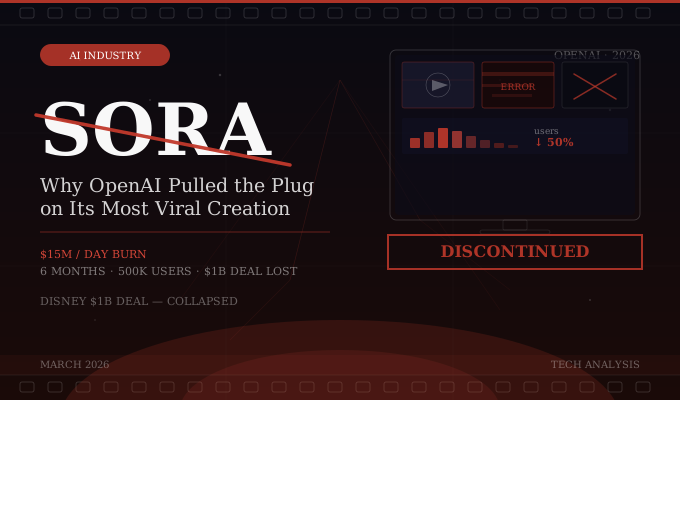
AI Industry · Deep Dive
The internet was told OpenAI killed Sora to “simplify efforts.” The real story is considerably more brutal.
When OpenAI first unveiled Sora in February 2024, the internet collectively lost its mind. The demo videos were extraordinary — photorealistic cityscapes, woolly mammoths trudging through snow, surrealist dreamscapes. CEO Sam Altman wasn’t wrong to be excited. The technology was genuinely unlike anything the public had seen.
Then, on March 25, 2026 — just six months after the standalone app launched — OpenAI posted a quiet farewell on Sora’s official X account. The $1 billion Disney deal died with it. And Disney executives found out less than an hour before the public.
What Was OpenAI Sora?
Sora was OpenAI’s text-to-video AI model, designed to generate high-quality, realistic video clips from simple text prompts. The standalone consumer app launched in September 2025 with a TikTok-style feed, a “Cameo” feature that let users insert their own faces into AI-generated scenes, and ambitious social sharing tools.
It was positioned not just as a product, but as OpenAI’s gateway into Hollywood — a bold pivot from productivity software into popular culture and entertainment.
Sora at a Glance
- First previewed February 2024 with jaw-dropping demo videos
- Standalone consumer app launched September 2025
- Hit 1 million downloads within its first five days
- Disney signed a $1 billion licensing deal in December 2025
- Officially shut down March 2026 — just six months after launch
A Timeline: Rise and Fall
OpenAI previews Sora with staggering demo videos. The internet erupts. Hollywood takes notice.
The consumer Sora app launches with Sora 2. It racks up 1 million downloads in five days.
Sora’s head Bill Peebles publicly warns: “The economics are currently completely unsustainable.” Forbes estimates $15M/day in compute costs.
Disney signs a three-year deal to license 200+ characters — Mickey Mouse, Darth Vader, Iron Man — and commits to a $1 billion investment in OpenAI.
Monthly active users fall to below 500,000. Internal dashboards show the app burning compute with minimal revenue.
Sam Altman shuts down Sora. Disney is notified less than an hour before the public. The $1B deal dies with it.
The Real Reasons Behind the Shutdown
OpenAI’s public statement was vague, citing a need to “simplify efforts.” But reporting from the Wall Street Journal, Forbes, and others paints a far more detailed picture. The shutdown was driven by a convergence of financial, strategic, reputational, and competitive pressures.
1. The Compute Costs Were Catastrophic
Video generation is orders of magnitude more computationally expensive than generating text. Forbes estimated OpenAI was spending as much as $15 million per day on Sora’s inference costs — potentially over $5 billion annually. Sora’s own head, Bill Peebles, acknowledged in October 2025 that the economics were “completely unsustainable.”
For every delightful AI-generated clip a user shared on social media, OpenAI was subsidizing the compute out of its own pocket — with no meaningful revenue flowing back.
2. Users Loved It, But Not Enough to Pay
The app launched to massive fanfare — 1 million downloads in five days — but novelty and retention are very different things. User numbers peaked close to launch and then steadily declined to fewer than 500,000 active users by early 2026, according to Similarweb data. Content was also criticised as producing “more AI slop than AI magic.”
3. Chips Were Being Stolen From the Real Race
Every GPU keeping Sora alive was a GPU not advancing OpenAI’s core mission. While Sora burned through chips making short clips, Anthropic’s Claude Code was quietly winning Silicon Valley’s most lucrative customer segment — software engineers and enterprise developers.
4. Reputational and Legal Risk Was Mounting
The Creative Artists Agency publicly warned Sora posed a “significant risk” to creators’ rights. Copyright liability, deepfake potential, and brand-sensitive misuse were structurally harder to manage in video than in text.
5. OpenAI Was Spread Too Thin
OpenAI’s chief of applications Fidji Simo put it bluntly in an internal note: “We realized we were spreading our efforts across too many apps and stacks, and that we need to simplify our efforts. That fragmentation has been slowing us down.”
The Disney Deal That Died With It
In December 2025, Disney announced a landmark three-year partnership with OpenAI. Disney would license over 200 characters — Iron Man, Mickey Mouse, Buzz Lightyear, Darth Vader — for use in Sora, and committed to a reported $1 billion equity investment.
“Disney executives found out Sora was being shut down less than an hour before the public announcement. The $1 billion deal died with it.”
— Wall Street Journal Investigation, March 2026When OpenAI made the shutdown call, Disney was given less than 60 minutes’ notice before the public announcement. Disney issued a diplomatic statement and confirmed the partnership would not proceed.
OpenAI’s Strategic Pivot
| Area | Sora Era | Post-Sora Focus |
|---|---|---|
| Primary Customer | Consumers / Creators | Enterprise / Developers |
| Key Product | AI Video Generation | Codex / Coding AI |
| Revenue Model | Unclear / Weak | Enterprise SaaS |
| Long-term Bet | Entertainment / Hollywood | Robotics + AI Agents |
5 Key Lessons From Sora’s Failure
Lessons Learned
- Virality ≠ Viability. 1 million downloads in five days means nothing if users don’t return and don’t pay.
- Compute costs are a ceiling, not a detail. AI video is so expensive that even at massive scale, the unit economics may never work.
- Wow factor fades fast. Users were dazzled initially but found real-world outputs inconsistent.
- Legal risk in generative AI is non-trivial. Copyright, deepfakes, and brand-sensitive misuse are structurally harder in video than text.
- The products that survive solve paid work. Entertainment AI, for all its wonder, has to earn its compute.
FAQ
Why did OpenAI shut down Sora?
OpenAI shut down Sora primarily due to unsustainable economics — up to $15 million per day in compute costs while user numbers declined and revenue remained minimal. A strategic pivot to enterprise AI and coding tools made continuing Sora unjustifiable.
What happened to the Disney and OpenAI Sora deal?
The $1 billion Disney-OpenAI partnership, announced December 2025, was cancelled when Sora shut down. Disney was reportedly notified less than an hour before the public announcement.
How much did Sora cost OpenAI?
Forbes reported OpenAI could be spending up to $15 million per day — potentially over $5 billion annually — on Sora’s inference costs.
Is AI video generation dead after Sora?
No — Runway ML, Kling AI, and Google’s Veo remain active. But Sora’s failure highlights the severe economic challenges of AI video at scale.
Sources: Wall Street Journal, Forbes, TechCrunch, Android Authority, Variety, Cybernews · April 2026 · clusters.media