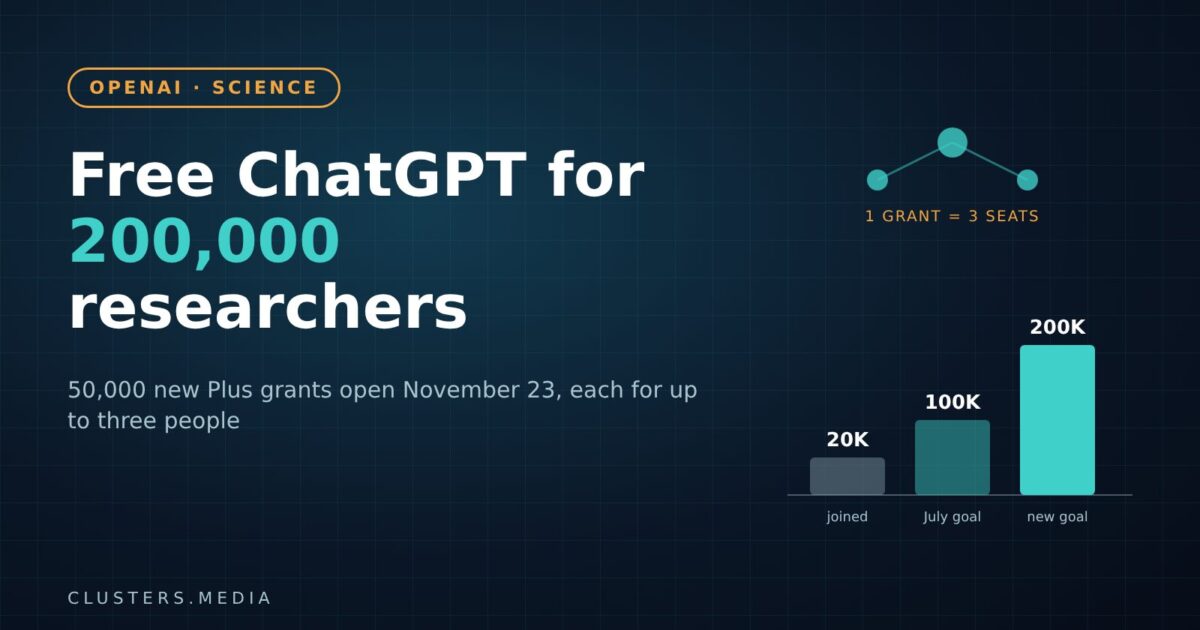
OpenAI is widening ChatGPT for Academic Researchers, its free-access program for scientists, mathematicians and engineers. The company said on November 16 that it now wants to reach 200,000 researchers worldwide, double the goal it set in July, and that a new round of 50,000 grants opens for applications on Monday, November 23.
There is a trade-off built into the bigger number. New grants come with ChatGPT Plus rather than the ChatGPT Pro plan pilot users received, and places will go to the first eligible applicants instead of being drawn by lottery.
Key takeaways
- The program goal doubles from 100,000 to 200,000 researchers.
- 50,000 new grants open on November 23, first come, first served among eligible applicants.
- Each grant covers the recipient plus up to two collaborators, so this round alone can reach up to 150,000 people.
- New grants include ChatGPT Plus, not the Pro tier pilot participants got.
- About 20,000 researchers in 33 countries have joined since the July pilot.
- OpenAI says program data is not used to train its models by default.
What happened
ChatGPT for Academic Researchers started as a pilot in late July. At launch, OpenAI framed it as free frontier-model access for scientists, starting with 10,000 researchers and growing to 100,000 through 2027. On Monday it raised that ceiling to 200,000.
The mechanics of the next round are simple. OpenAI will award 50,000 grants. Each one gives the named researcher free ChatGPT Plus access and lets them bring in up to two collaborators on the same terms. If every grant is used in full, that is 150,000 seats from this round alone. Semafor and Neowin both describe the move as a doubling of the pilot’s original target.
Two things changed from the summer pilot. First, selection: the earlier round used a lottery among eligible applicants, while the new one is first come, first served. Second, the plan: pilot researchers were given ChatGPT Pro, OpenAI’s most expensive consumer tier, and new grants get Plus. Collaborator slots also shrink, from up to four per researcher in the pilot to two now. As The Next Web reports, OpenAI’s reasoning is that most pilot users would have stayed within Plus usage limits anyway, so the cheaper plan lets the same budget stretch across many more teams.
OpenAI also repeated its data commitment: by default, information shared through the program is not used to train its models. Anyone handling unpublished results, sensitive datasets or grant-confidential work should still read the program terms before uploading anything.
The study behind the expansion
Alongside the announcement, OpenAI’s Economic Research team published a study of how pilot participants used ChatGPT. It analysed 580,186 science-related messages from 1,819 scientists, sent between August 20 and September 22, 2026, and surveyed 251 participants. OpenAI says its researchers worked from the outputs of privacy-preserving classifiers rather than reading the messages themselves. Reading and learning made up about 28% of science messages on average, and writing about 27%.
The headline survey finding is that participants believed the same work, at the same quality, would have taken them nearly twice as long without AI. That number needs a clear label: it is self-reported by a small group of people who opted into a free AI program, not a measured productivity gain. OpenAI itself says the study does not prove AI speeds up discovery, and points out that funding, staff and lab capacity still limit how many new ideas researchers can actually test.
Why it matters
Free seats for academics are not new, but the scale is. Two hundred thousand researchers would make this one of the largest programs putting a commercial frontier model into everyday research work. For many labs, especially outside well-funded universities, a paid subscription for every team member is a real budget line, and three free seats per grant removes it.
It is also a competitive move. OpenAI, Anthropic and Google are all courting scientists, because researchers who build habits on a platform tend to carry them into startups, industry jobs and procurement decisions later. OpenAI already runs other science efforts, including institutional Edu plans and a separate Researcher Access Program for API credits. This program is the app-level layer of that strategy.
The switch from Pro to Plus is the detail to watch. Pro carries the highest usage caps and the most compute-heavy options. Plus is generous for reading, writing and analysis, but heavy users running long reasoning sessions or agent workflows may hit limits. OpenAI is betting that breadth matters more than depth for most academics. Its pilot data reportedly supports that, but researchers doing compute-hungry work may feel the difference.
What it means for developers and research teams
If you work in or alongside academia, a few practical points stand out:
- Apply early. With first-come, first-served selection, timing on November 23 matters far more than it did under the lottery.
- Plan your three seats. One grant covers a small team: a lead researcher plus two collaborators. Labs may want to agree in advance who holds the grant.
- Know the boundary with the API. This is ChatGPT app access. Teams building pipelines, scripts or tools on OpenAI models still need API access, which runs through a different program.
- Check data rules locally. “Not used for training by default” helps, but your university, funder or ethics board may have stricter rules about where research data can go.
- Treat outputs as drafts. Frontier models can still be confidently wrong. Results that matter need the same checks you would apply to any other tool, a theme we covered in Stanford’s work on memory for frozen LLMs.
For founders building research tools, the signal is that general-purpose assistants are moving deeper into lab work for free. Products that only wrap a chat model will find academics harder to sell to. Tools that handle domain data, lab systems, reproducibility or verification have a clearer edge. The same pattern shows up across OpenAI’s consumer push, from agents to ChatGPT Wallet: the company keeps folding more workflows into the core app.
What to watch next
- November 23 demand. How fast the 50,000 grants are claimed will show how much pent-up interest exists.
- Eligibility details. OpenAI’s program page sets the requirements; watch how it defines eligible institutions and regions.
- Plus limits in practice. Feedback from heavy users will show whether the move from Pro bites.
- Independent evidence. The “nearly twice as fast” claim is self-reported. Measured studies of research output would be far more convincing.
- Rival responses. Expect Anthropic and Google to keep expanding their own offers for scientists.
Sources: OpenAI announcement, OpenAI study, Semafor, The Next Web, Neowin.