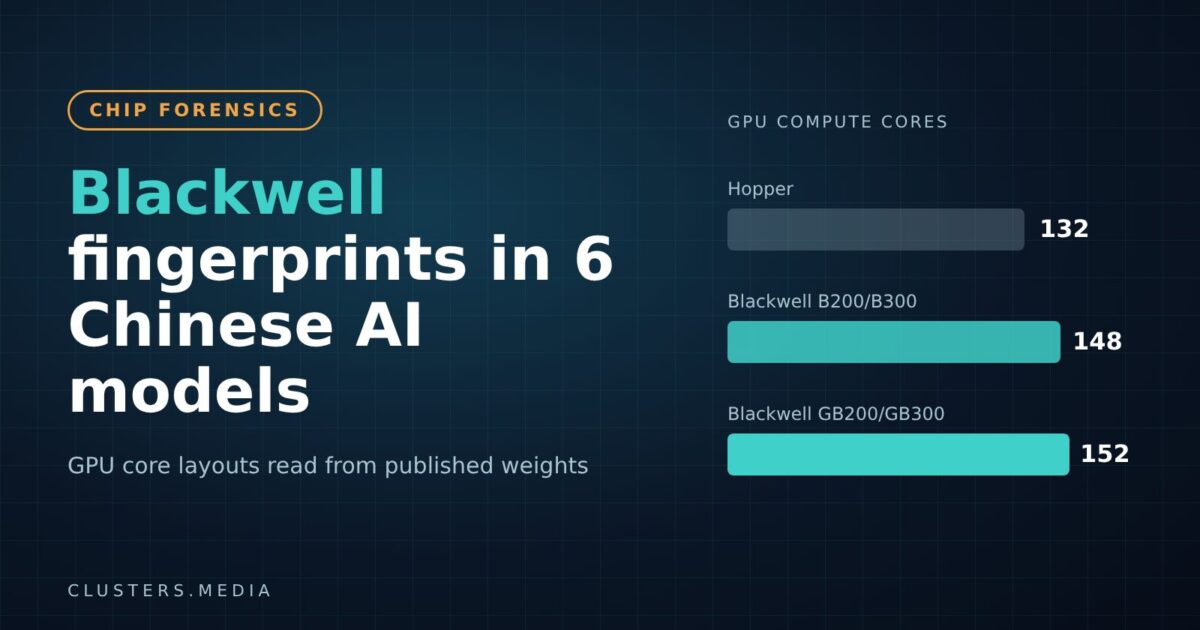
A former OpenAI researcher says he has found Nvidia Blackwell fingerprints inside six of China’s newest open-weight AI models. In a forensic report published on November 12, Will DePue argues that recent models from DeepSeek, Moonshot AI, MiniMax and Ant Group were started on Blackwell-class GPUs, chips the US does not allow to be exported to China. He reads the evidence straight out of the model weights the labs published themselves.
Key takeaways
- Six Chinese models released since April 2026 show patterns matching Nvidia Blackwell hardware, according to the report.
- Older models from the same labs, such as DeepSeek-V3 and Kimi K2.5, match Nvidia’s previous Hopper generation instead.
- The method identifies the hardware that set a model’s starting weights. It does not show where the chips were or who owned them.
- The report itself says the finding alone does not prove smuggling or a breach of US export law.
- The verification code is public, so other researchers can test the claim.
What happened
DePue, who worked on Sora and on the training of GPT-4o and GPT-5 at OpenAI before leaving to start the research group Unemployment Labs, published the analysis on his site and announced it on X. The Decoder and The Register both covered the report on November 13.
The report names six models:
- DeepSeek-V4-Flash and MiniMax-M3: a pattern matching the 148-core layout of Nvidia’s B200 or B300 GPUs.
- DeepSeek-V4-Pro, Kimi K3, Kimi K3.1-Pro and Ant Group’s Ling-3.1-flash: a pattern matching the 152-core layout of the GB200 or GB300, the parts used in Nvidia’s liquid-cooled rack-scale systems.
According to the report, models from other Chinese labs, including Alibaba’s Qwen3.8 and models from Zhipu, Tencent, Xiaomi and StepFun, still show only Hopper patterns, while Meituan’s LongCat-2.0 points to Huawei hardware.
How a GPU leaves a fingerprint in model weights
Before training starts, a framework like PyTorch fills a model’s billions of weights with random numbers generated from a seed. To do that quickly, the GPU splits the job across its compute cores. Hopper chips such as the H100 have 132 of these cores, while Blackwell parts have 148 or 152. Because the work is divided differently on each layout, the same seed produces a slightly different set of starting numbers on each chip family.
Training changes those numbers enormously, but not everywhere. Some rows, for example those tied to tokens that are rarely or never used, keep their original random values, and DePue argues a faint statistical trace survives even in heavily trained parts. He says he searched more than six trillion combinations of seed and chip layout to find the ones that fit the published weights.
Three checks back up the claim, according to the report and the coverage of it:
- The method correctly identified the hardware behind 24 control models whose training chips are publicly known, including Meta’s Llama 3.1 on H100.
- DePue says he reproduced the starting weights of DeepSeek-V4-Flash and Kimi K3 exactly on rented Blackwell machines, but not on an H100.
- He says tiny rounding differences rule out a throttled AMD MI300X, the only other chip he found that could mimic the pattern, for DeepSeek-V4-Flash.
DePue also says senior researchers at OpenAI and Anthropic checked the method. That claim comes from his own post, and reporting on the story notes it has not been independently verified. The code is on GitHub, and the report includes seed values others can use to try to reproduce the results.
What the evidence does and does not prove
This is where careful reading matters. The fingerprint shows which hardware generated a model’s starting weights. It is a strong hint, not proof, that the same machines did the training. A lab could, in theory, initialise on one system and train on another, and a mixed cluster could leave traces of only some of its hardware.
More importantly, the weights say nothing about location or ownership. Blackwell systems can be rented in data centres outside China, and the report itself says its evidence shows access to Nvidia’s top hardware but does not, on its own, establish smuggling or a violation of export rules. Whether renting such capacity abroad is allowed depends on who the customer is and how US rules treat overseas subsidiaries of Chinese firms. That is a legal question the forensics cannot answer.
In the reporting we reviewed, we found no public response yet from Nvidia, DeepSeek, Moonshot AI, MiniMax or Ant Group.
Why it matters
For three years, US policy has tried to keep China’s AI labs away from Nvidia’s most advanced chips. Officials had suspected DeepSeek and Moonshot of using Blackwell hardware, but no technical evidence had been made public. If this report holds up, it is the first time outsiders have pointed to concrete traces of that access, using only files the labs chose to release.
The timing adds pressure. It lands in the same week Nvidia is dealing with a leadership shake-up, which we covered in Jensen Huang’s resignation as Nvidia CEO, after earlier reporting on US claims that China’s MSS targeted him. Expect the findings to feature in the debate over whether export controls should also cover remote access to compute.
There is also a quieter technical point. Open weights reveal more than many people assumed. A file meant to share a model can also carry a record of how it was made.
What it means for developers and businesses
- Nothing breaks today. The models are still published under the same licences. The report does not change how DeepSeek-V4, Kimi K3 or MiniMax-M3 run.
- Procurement questions will grow. Companies that already review where a model comes from may now be asked about the hardware behind it too. If you rely heavily on Chinese open-weight models in regulated settings, track this story with your legal or compliance team.
- Model provenance is becoming a real field. Weight forensics joins watermarking and data audits as a way to check claims about models. Teams that publish their own weights should know that initialisation details can be recovered.
- You can check it yourself. The code is public. Independent replications, or failures to replicate, will matter more than any headline.
What to watch next
Three things will decide how big this becomes. First, independent replication: researchers outside DePue’s circle running the public code on the named models. Second, responses from the four labs and from Nvidia, which have so far stayed quiet. Third, policy: whether the US Commerce Department treats the findings as a reason to look harder at overseas data centres and cloud rentals.
Labs may also adapt. Now that the technique is public, future releases could re-randomise the untouched rows that make the fingerprint readable. That would not erase what is already published, but it could make this kind of check much harder for the next generation of models.
For now, the fairest summary is this: a detailed technical claim, with public code, says China’s top labs reached Blackwell hardware. How they did it, and whether any law was broken, remains open.