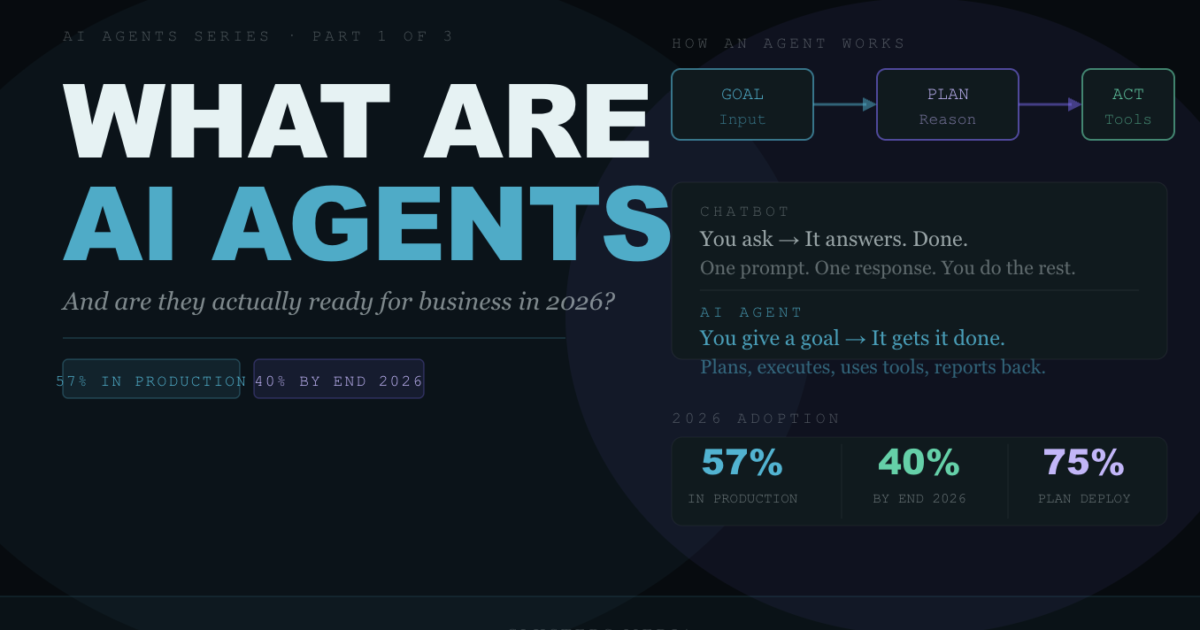
AI Agents Series · Part 1 of 3 · Technology Explainer · April 2026
The most hyped technology in business right now is not ChatGPT. It is not a new AI model. It is AI agents — autonomous systems that can plan, reason, and take action without a human driving every step. And in 2026, they are moving from conference demos into production deployments at a pace that is surprising even their creators.
But the gap between the hype and the reality is still significant. Understanding what AI agents actually are, what they can and cannot do today, and where they genuinely create value is one of the most important things any business leader can do right now.
What Is an AI Agent — The Plain English Definition
An AI agent is a software system that perceives its environment, reasons about a goal, creates a plan to achieve it, executes that plan using available tools, and adjusts its approach when things go wrong — all with minimal human intervention at each step.
The key distinction from what came before:
Chatbot vs AI Agent — What’s Actually Different
- Traditional chatbot: You ask a question → It gives an answer. One turn. One action. No memory. No tools.
- AI assistant (ChatGPT-style): You describe a problem → It generates content or advice. Still reactive. Still requires you to do the next thing.
- AI agent: You give a goal → It breaks that goal into steps, uses tools (email, calendar, databases, APIs), makes decisions along the way, executes end-to-end, and reports back when done. Proactive. Multi-step. Autonomous.
A practical example: Tell a chatbot “find me the cheapest flight to London next Thursday.” It might search and show you results. Tell an AI agent the same thing and it searches flights, cross-references your calendar for conflicts, checks your corporate travel policy, books the best option within budget, sends a confirmation to your assistant, and adds the trip to your expense tracker — without you doing anything after the initial instruction.
How AI Agents Actually Work
Under the hood, modern AI agents combine four capabilities that did not reliably coexist until late 2025:
The Four Layers of an AI Agent
- Perception: The agent reads inputs — natural language, documents, database queries, API responses, sensor data — and understands what they mean in context.
- Reasoning: The agent breaks a complex goal into sub-tasks, evaluates options, and decides what to do next. Modern LLMs make this possible at a level that was not achievable before GPT-4 class models.
- Tool use: The agent calls external tools — search engines, databases, code execution environments, email clients, APIs — to gather information and take action in the real world.
- Memory: The agent maintains context across a multi-step task, remembers what it has done, avoids repeating mistakes, and builds on prior results. Stateful runtime environments (OpenAI is building one with AWS) make this reliable at enterprise scale.
What AI Agents Can Do Today — The Real-World Use Cases
The use cases where agents are delivering measurable results in 2026 are concentrated in structured, rule-dense workflows where the cost of a mistake is measurable and the data is clean.
Finance and Operations
Finance is the single most common first deployment for enterprise agentic AI. Agents handle full invoice reconciliation cycles — ingesting bank statements, cross-referencing purchase orders, flagging mismatches, generating corrective entries, and routing exceptions for human review. Organisations report 70–90% reduction in invoice processing time. Fraud detection agents monitor transactions in real-time across millions of daily events, flagging patterns human analysts would miss.
Customer Support
Support agents interpret customer intent, pull context from CRM and order management systems, resolve standard queries within defined policy rules, and escalate to humans only when genuinely required. The average chatbot resolution rate is around 30%. AI agents in production are achieving 78%+ resolution rates on comparable query sets. Gartner projects agents will resolve 80% of customer service issues with minimal human support by 2029.
Software Development
Claude Code is the most visible example — an agent that writes, reviews, debugs, and tests code autonomously. But the pattern extends beyond coding. Agents are reviewing contracts, identifying cost changes, detecting compliance risks without manual effort. By end of 2026, Gartner expects agents to be embedded in over 40% of enterprise applications.
Data and Reporting
Business users can now ask complex operational questions in plain language — “What was last quarter’s churn by region?” — and get real-time answers without involving data analysts or building dashboards. Agents connect to live data sources, run queries, and deliver formatted reports. The democratisation of data access is arguably the most quietly transformative use case in enterprise AI right now.
Supply Chain and Manufacturing
Inventory agents monitor consumption rates, lead times, and buffer stock levels across complex multi-stage manufacturing processes. Quality control agents review inspection images against specifications and route defective items automatically. Predictive maintenance agents analyse equipment sensor data and recommend specific interventions before failures occur.
The Numbers Behind the Adoption
AI Agent Adoption — 2026 Data
- 57% of companies already have AI agents in production (G2 2025 Enterprise AI Agents Report)
- 78% plan to increase agent autonomy within the year
- 75% of businesses plan to deploy AI agents by end of 2026 (Deloitte State of AI in the Enterprise)
- 40% of enterprise applications will embed role-specific agents by end of 2026 (Gartner)
- 66% of companies that deployed agents report measurable productivity gains
- 191–333% ROI reported by some enterprise deployments over three years
- Agentic AI market: $9 billion in 2026, growing at 61.5% CAGR toward $139B+ by 2034
What AI Agents Cannot Do — The Honest Limits
The hype around agents has outrun the reality in several important ways. Understanding the limits is essential for anyone making deployment decisions.
Where Agents Still Fail in 2026
- Complex reasoning at scale: Gartner analyst Tom Coshow: “We have to give them very simple decisions to get reliable answers. We are nowhere near the point where we can just throw a lot of data at an AI agent and trust its decision.”
- Ambiguous or novel situations: Agents trained on structured workflows break down when inputs are outside their expected range. They still fail on ambiguous language, contextual nuance, and novel edge cases at higher rates than experienced humans.
- High-stakes autonomous action: Experiments by Anthropic and Carnegie Mellon found AI agents make too many mistakes for businesses to rely on them for processes involving significant financial exposure without human oversight checkpoints.
- Multi-system coordination without governance: When agents pass data between multiple systems without proper logging, errors compound silently. A faulty input from Agent A becomes authoritative data for Agent B, C, and D — and by the time a human spots it, the damage can be severe.
- Security and prompt injection: Agents with broad system access are high-value targets. Compromising a single agent with permissions enables lateral movement across an entire enterprise stack. Cybersecurity frameworks for agentic AI are still immature.
How to Deploy Your First AI Agent — The Right Way
The companies generating 191–333% ROI from agents are not the ones who deployed the most agents fastest. They are the ones who identified the right first workflow, deployed carefully, measured rigorously, and expanded methodically.
Use the value/readiness matrix. Map your potential use cases on two axes: strategic value (how much does automating this matter to business outcomes?) and readiness for automation (is the workflow structured, rule-bound, and data-clean?). Start with the top-right quadrant — high value, high readiness. Variance analysis in finance. Routine employee support in HR. Credential validation in compliance. These deliver quick wins and build institutional confidence before tackling harder problems.
Start human-in-the-loop. Every agent deployment should begin with human review of agent actions before they execute. Build confidence progressively. Move to supervised automation. Then — for specific, well-understood workflows — to autonomous operation. Never start fully autonomous for any process involving financial transactions, data writes, or external communications.
Governance before scale. Traditional IT frameworks assume systems behave predictably. Agentic AI upends this. You need logging of every agent action with full context, audit trails for decision chains, clear escalation paths for edge cases, and a framework for tracking how tasks move between agents before you scale to multi-agent systems.
The Verdict — Are They Ready for Your Business?
Yes — for the right workflows. No — as a wholesale replacement for human judgment in complex, ambiguous situations. The distinction matters enormously in practice.
The businesses winning with AI agents in 2026 are treating them as force multipliers for their existing teams, not as replacements. They are deploying them in structured, measurable workflows, maintaining human oversight at high-stakes decision points, and expanding scope deliberately as confidence and governance frameworks mature.
The businesses struggling are the ones who deployed ambitious agents on complex workflows without adequate governance, discovered errors too late, and spent more time managing agent mistakes than the automation saved.
AI agents are the most consequential productivity technology deployed in enterprise software right now. The question is not whether to engage with them — it is whether you will do it carefully enough to capture the upside without the downside.
FAQ
What is an AI agent?
An AI agent is a software system that perceives its environment, reasons about a goal, creates a plan, executes that plan using external tools, and adjusts its approach with minimal human intervention at each step. Unlike chatbots that answer single questions, agents complete multi-step workflows autonomously — booking travel, processing invoices, reviewing code, or monitoring transactions end-to-end.
How are AI agents different from chatbots?
Chatbots respond to single prompts and require humans to drive each next step. AI agents accept a goal, break it into sub-tasks, use tools to gather information and take action, maintain context across multiple steps, and self-correct when things go wrong. The average chatbot resolution rate for support queries is around 30%. AI agents in production are achieving 78%+ on comparable workloads.
Are AI agents ready for enterprise use in 2026?
Yes — for structured, rule-dense workflows with clean data. Finance reconciliation, customer support triage, software development assistance, and data reporting are all delivering strong ROI. For complex, ambiguous, or high-stakes autonomous decision-making, agents still require human oversight checkpoints. 57% of companies already have agents in production, with 66% reporting measurable productivity gains.
What industries benefit most from AI agents in 2026?
Finance (invoice processing, fraud detection, compliance), customer service (query resolution, CRM updates), software development (coding, testing, review), manufacturing (predictive maintenance, quality control, inventory), and healthcare (clinical note generation, prior authorisations, scheduling) are seeing the strongest results. Finance is the most common first deployment due to structured data and measurable outcomes.
What are the biggest risks of deploying AI agents?
The four main risks are: compounding errors in multi-agent systems (bad data from Agent A becomes authoritative for agents downstream), prompt injection and security vulnerabilities (agents with broad access are high-value attack targets), governance gaps (traditional IT frameworks assume predictable systems — agentic AI doesn’t behave predictably), and autonomous action on high-stakes decisions without adequate checkpoints.
Sources: G2 2025 Enterprise AI Agents Report, Gartner, Deloitte State of AI in the Enterprise, McKinsey, IBM, OpenAI Enterprise Blog, NVIDIA GTC 2026, Zemith.com, Sema4.ai · April 2026 · clusters.media · Part 1 of the Clusters Media AI Agents Series