Stanford HAI · AI Research · Released April 13, 2026
Every year, Stanford’s Institute for Human-Centered AI produces the closest thing the field has to a neutral annual audit of artificial intelligence. The 2026 edition — 400 pages, released April 13 — reveals a field hitting genuine breakthroughs while simultaneously losing transparency, governance capacity, and the trust of the public it is reshaping.
The same technology cannot both be stealing millions of jobs and failing to read an analog clock. Yet both claims dominated AI coverage in the past year. The AI Index cuts through that noise with actual data. Here are 12 findings that matter most.
Finding 1: Generative AI Grew Faster Than the Internet — and We’re Not Ready
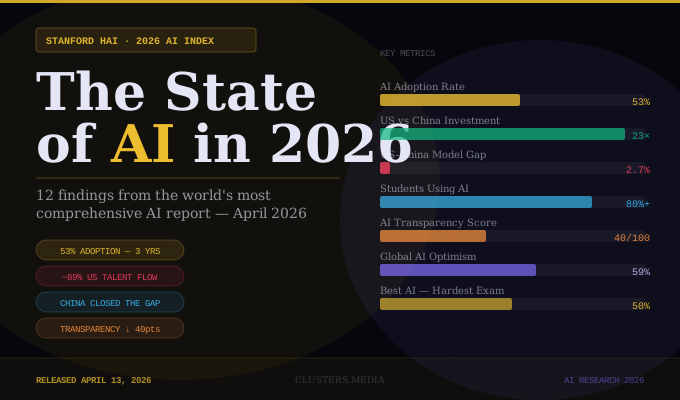
Generative AI reached 53% population adoption within just three years — a rate faster than the personal computer or the internet. The estimated value of generative AI tools to US consumers alone reached $172 billion annually by early 2026, with the median value per user tripling between 2025 and 2026.
But adoption is strikingly uneven. Singapore leads at 61%. The UAE at 54%. The United States ranks 24th globally at just 28.3%. Adoption correlates strongly with GDP per capita, raising significant questions about equitable access.
Finding 2: AI Benchmarks Are Being Saturated Faster Than We Can Replace Them
Frontier models gained 30 percentage points in a single year on Humanity’s Last Exam, a benchmark built to be hard for AI. A year ago, the top model correctly answered just 8.8% of questions. As of April 2026, the best models — including Anthropic’s Claude Opus 4.6 and Google’s Gemini 3.1 Pro — top 50%. Evaluations intended to last years are being saturated in months.
Finding 3: China Has Effectively Closed the AI Performance Gap With the US
US and Chinese models have traded places at the top of performance rankings multiple times since early 2025. As of March 2026, Anthropic, xAI, Google, OpenAI, Alibaba, and DeepSeek all occupy the same top tier — separated by razor-thin margins.
| Country | Leads In | Trails In |
|---|---|---|
| United States | Private investment, model releases, AI researchers | Patents per capita, robot deployment, talent attraction |
| China | Publications, patents, robotics, physical AI | Model performance (marginal gap), private funding |
| South Korea | Innovation density — most patents per capita globally | Total model output, investment scale |
Finding 4: America Is Losing the AI Talent War — Badly
The number of AI researchers and developers moving to the United States has dropped 89% since 2017 — including an 80% decline in just the last year alone. The UAE, Chile, and South Africa are currently learning AI engineering skills fastest globally.
Finding 5: The Most Powerful AI Models Are Now the Least Transparent
The Foundation Model Transparency Index saw average scores drop to 40 points from last year’s 58. Google, Anthropic, and OpenAI have all abandoned disclosing their latest models’ dataset sizes and training duration. 80 of the 95 most notable models launched last year were released without their training code.
“Today’s most capable modern models are now among the least transparent. The most powerful models are concentrated within the largest companies — which are increasingly keeping training code, dataset sizes, and parameter counts to themselves.”
— Stanford HAI 2026 AI Index ReportFinding 6: US AI Investment Hit $285.9 Billion — But Returns Are Uneven
US private AI investment reached $285.9 billion in 2025 — more than 23 times China’s comparable figure. But PwC’s 2026 AI Performance Study reveals that 74% of AI’s economic value is captured by just 20% of organisations. The vast majority of companies remain stuck in pilot mode.
Finding 7: AI’s Impact on Jobs Is Real — But Counterintuitive
Entry-level jobs in software development and customer support have been measurably reduced, with young workers hit first. But the most surprising finding: unemployment among workers least exposed to AI has risen more than unemployment among workers most exposed to AI. The disruption is real but complex.
Finding 8: AI Is Transforming Scientific Discovery
AI-related computer science publications have more than doubled over the past decade: from 102,000 to 258,000. Drug discovery publications using AI have doubled in two years. AI clinical note-generation tools saw widespread adoption in 2025. But Stanford’s research shows AI excels at spotting gaps in research — judgment calls still require humans.
Finding 9: 4 in 5 Students Use AI — and Schools Have No Policy For It
Over 80% of US high school and college students now use AI for school-related tasks. Yet only half of middle and high schools have AI policies in place, and just 6% of teachers say those policies are clear. The education system is encountering AI at every level and is almost entirely unprepared.
Finding 10: The World Is Cautiously Optimistic — America Is the Outlier
Globally, 59% of people say AI benefits outweigh the drawbacks, up from 52% in 2024. But only 33% of Americans expect AI to improve their jobs, compared to a 40% global average. The US public reported the lowest trust in government to regulate AI among all countries surveyed — just 31%.
Finding 11: AI Robotics Is Exploding — But the Simulation-to-Reality Gap Remains Huge
Waymo reached approximately 450,000 weekly trips across five US cities. China’s Apollo Go completed 11 million fully driverless rides — up 175% year-over-year. But in real household environments, robots succeed at only 12% of tasks, versus 89.4% in software simulations.
Finding 12: Regulation Is Accelerating — But Governance Is Falling Behind
The number of nations with state-backed supercomputing clusters has grown to 44. 93% of executives now call AI sovereignty mission-critical. Yet the report’s overarching conclusion is sobering: the frameworks needed to govern AI are falling behind the technology itself. Data transparency is declining. The gap between what AI can do and society’s capacity to manage it is widening.
The Verdict
The 2026 Stanford AI Index paints a portrait of a technology that is genuinely, measurably transforming the world — faster than any technology in modern history — while simultaneously becoming less transparent, less governed, and less understood by the institutions meant to oversee it.
AI is not going to slow down to let society catch up. The question is whether the people building policy, curricula, regulation, and strategy will move fast enough to matter.
FAQ
What is the Stanford AI Index 2026?
The Stanford AI Index is an annual report by Stanford’s Institute for Human-Centered AI (HAI). Now in its ninth year, it tracks AI’s evolution across technical performance, investment, education, workforce, policy, and public perception — the field’s most comprehensive annual data snapshot.
Has China caught up with the US in AI?
Effectively yes, on model performance. US and Chinese models have traded places at the top of performance rankings multiple times since early 2025, separated by just 2.7% as of March 2026. The US still leads in private investment (23× China) and model releases, but China leads in patents, publications, and industrial robotics.
How fast has generative AI been adopted?
Generative AI reached 53% population adoption within three years — faster than the PC or the internet. The estimated value to US consumers reached $172 billion annually by early 2026, with median value per user tripling between 2025 and 2026.
Why is AI transparency declining?
The Foundation Model Transparency Index dropped from 58 to 40 points in one year. Google, Anthropic, and OpenAI have stopped disclosing dataset sizes and training durations. 80 of the 95 most notable models released last year came without training code. The most capable models now disclose the least.
Is AI taking jobs in 2026?
The impact is real but complex. Entry-level jobs in software and customer support have declined, with young workers hit first. However, unemployment among workers least exposed to AI has risen more than among those most exposed — making the picture more nuanced than simple narratives suggest.
Sources: Stanford HAI 2026 AI Index Report (April 13, 2026), IEEE Spectrum, SiliconAngle, KQED, MIT Technology Review, PwC 2026 AI Performance Study · April 14, 2026 · clusters.media