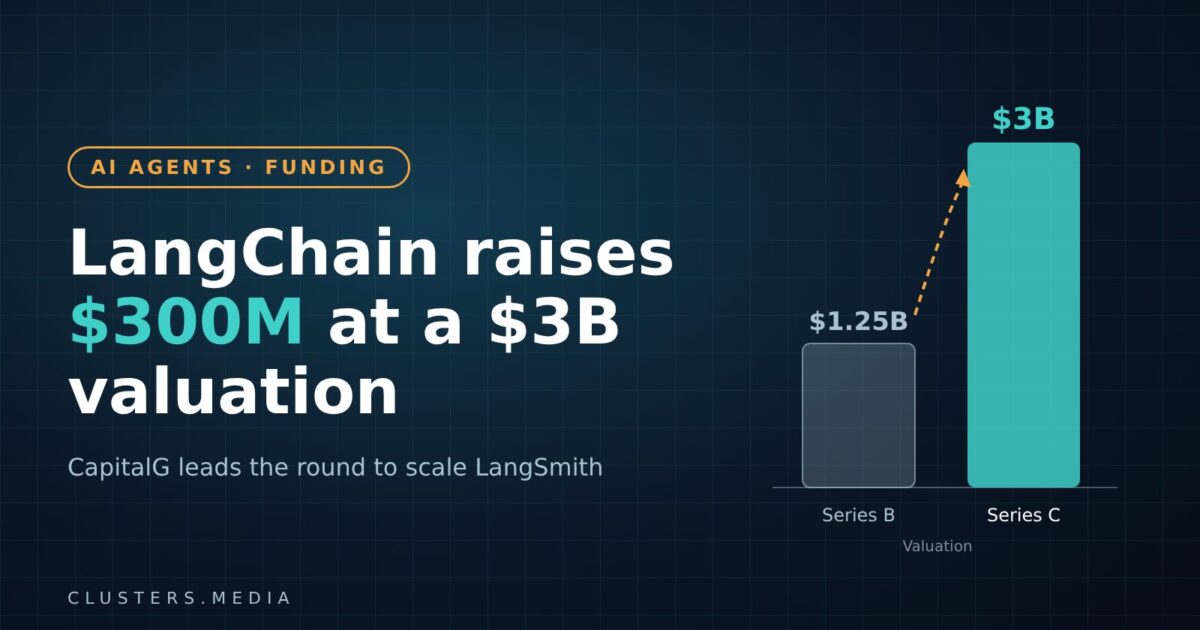
LangChain, the company behind one of the most widely used open-source toolkits for building AI agents, has raised a $300 million Series C at a $3 billion valuation. The round, announced on November 13, 2026, was led by Alphabet’s growth fund CapitalG, and the money is aimed squarely at LangSmith, the company’s paid platform for running, improving and governing agents in production.
For developers who first met LangChain as a Python library in 2022, the deal confirms how far the company has moved: the open-source frameworks are now the on-ramp, and the business is enterprise agent infrastructure.
Key takeaways
- LangChain raised $300M at a $3B valuation, bringing total funding to $460M.
- CapitalG led; GIC and DFJ Growth joined as new investors, with IVP and Sapphire Ventures returning.
- The valuation is more than double the $1.25B it reached in its previous round about a year ago.
- LangChain says over 7,000 organizations use LangSmith, including Nvidia, Toyota, Salesforce, Workday and Harvey.
- New LangSmith features are due at a virtual release event on November 20, 2026.
What happened
According to the official press release, CapitalG led the round with significant participation from Singapore’s sovereign fund GIC and DFJ Growth, both new backers, plus existing investors IVP and Sapphire Ventures. Salesforce Ventures, Insight Venture Partners, QuantumLight and MongoDB Ventures also came in, while Sequoia, Amplify and Benchmark added to their positions. The new capital takes LangChain’s lifetime funding to $460 million.
TechCrunch, which first reported the round, noted that the price is more than twice the $1.25 billion valuation LangChain hit roughly a year earlier, when it raised $125 million in a round led by IVP. LangChain did not disclose revenue, profitability or a detailed breakdown of how the money will be spent.
In his announcement post, co-founder and CEO Harrison Chase framed the company’s mission around the idea that every company should “own its intelligence”: pick whichever models suit it, keep control of its data and infrastructure, keep improving its agents over time, and govern them safely at scale.
What LangSmith actually is now
LangSmith started life as a tracing and debugging tool. Today LangChain pitches it as a framework-agnostic platform organised around three pillars, which helps explain why investors are paying a premium:
- Agent Runtime. The open-source Deep Agents, LangGraph and LangChain frameworks handle agent logic and context, while LangSmith Agent Server and Sandboxes deploy and run agents in the cloud or inside a customer’s own environment. Managed Agents and Fleet offer a fully hosted option.
- Agent Improvement. Observability and Evaluation show what agents are doing and score quality. LangSmith Engine, an agent inside the platform, finds errors, proposes code and prompt fixes and watches production traffic for regressions. A Fine-Tuning feature turns agent traces into training data for specialised models.
- Agent Governance. LLM and Tool Gateways centralise model budgets and fallbacks, protect sensitive data and control which tools agents can reach, and with what credentials.
LangChain shared two customer data points. Clay uses LangSmith to monitor hundreds of millions of agent runs every month, and Workday says it cut the time to deploy a new agent from five months to under a day after standardising on the platform.
Why it matters
The raise lands in a week dominated by agent news. Always-on work agents are arriving from companies like Perplexity with its Teammates product, some airlines and retailers are moving to block personal AI agents from their sites, and security vendors are racing to sell controls for agents running inside corporate networks. The common thread is that agents are leaving the demo stage, and once they touch real systems, companies need a way to see, test and restrict them.
That is the gap LangChain is betting on. The frontier labs all ship their own agent SDKs and hosted tooling, but large enterprises rarely want to tie every workflow to a single model vendor. A model-agnostic layer that can route between providers, log every step and enforce policy across teams is an easier sell to a CIO than rewiring the stack each time a new model tops a benchmark. The investor list, which now includes the venture arms of Salesforce and MongoDB, also hints at possible future partnerships, although none were announced.
There is competitive pressure too. Agent observability has become an acquisition target in 2026, with large security and monitoring companies buying specialist startups. Staying independent and well funded lets LangChain argue that it is the neutral option, not a feature inside someone else’s platform.
What it means for developers and businesses
If you use the open-source libraries: nothing changes today. LangChain, LangGraph and Deep Agents remain open source, and the company describes them as the model-agnostic foundation of its stack. The practical signal is direction: expect new work to focus on long-running agents, context management and tight integration with LangSmith for tracing and evaluation. Teams still on older LangChain abstractions should check that they are on current, supported patterns.
If you are choosing an agent platform: a well-capitalised vendor with a large customer base lowers the risk of building on it. The trade-off is the usual one with any platform that spans runtime, evaluation and governance: the more of the stack you adopt, the harder it is to leave. A sensible approach is to keep agent logic in open frameworks and treat hosted pieces such as the gateways and managed runtime as replaceable layers.
If you run an agency or a small product team: the governance pitch is worth watching even at small scale. Per-team model budgets, automatic fallbacks between providers and a single place to manage tool credentials are exactly the controls that stop an agent experiment from turning into a surprise bill or a leaked API key. Those problems are not limited to big companies, as recent incidents such as the Claude Code secrets leak have shown.
For founders building agent startups: the round shows investors are still willing to pay up for infrastructure that sits between models and applications, despite worries that the big labs will absorb that layer. But a $3 billion price also raises the bar on what LangChain now has to deliver commercially.
What to watch next
- November 20 release event. LangChain says it will reveal several new LangSmith capabilities at a virtual event. The details will show where the new money goes first.
- Pricing. Whether new governance and managed-agent features land in existing plans or as premium add-ons will matter to smaller teams.
- Partnerships. With Salesforce Ventures and MongoDB Ventures now on the cap table, watch for deeper integrations, though none have been confirmed.
- Open-source commitment. Developers will be watching that the free frameworks keep improving as commercial focus shifts to LangSmith.
The bigger picture is simple: the agent stack is consolidating into a few layers, and investors have just put a $3 billion price on the idea that the control layer should stay independent of the model makers. Whether that holds will depend on how well LangSmith keeps pace with the labs’ own tooling over the next year.