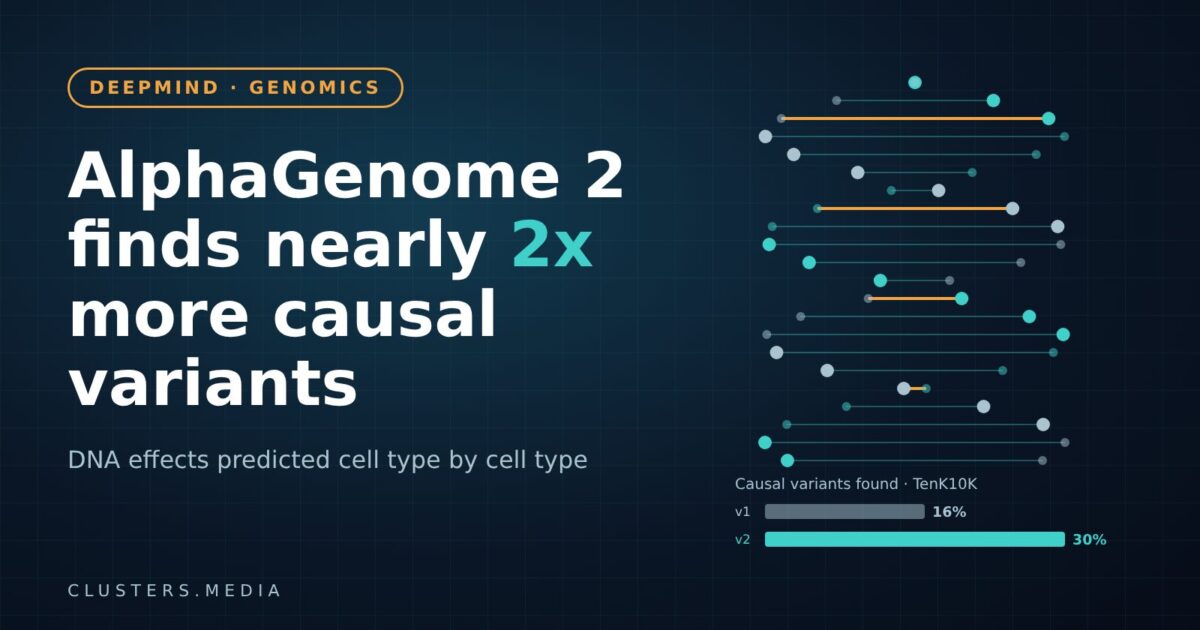
Google DeepMind has released AlphaGenome 2, a new version of its DNA sequence model that predicts how a genetic change affects one specific type of cell rather than a whole tissue on average. Announced on November 11, 2026, it is open now for non-commercial research through the AlphaGenome API, with commercial access in a private preview.
On the benchmark DeepMind highlights, the new model finds nearly twice as many disease-relevant DNA variants as the original AlphaGenome. Here is what changed, what the numbers actually measure, and why it matters for anyone building with scientific AI.
Key takeaways
- AlphaGenome 2 predicts how DNA variants change gene activity in a specific cell type or cell state, not a tissue-wide average.
- It was trained on more than 100 million cell profiles from human and mouse data covering 68 tissues.
- On the TenK10K immune-cell benchmark, it identified 30% of likely causal variants versus 16% for the earlier model, and called the direction of the effect correctly 43% of the time versus 23%.
- Access: free for non-commercial research via the AlphaGenome API; commercial research is in private preview; AlphaGenome 2 Skills for Google Antigravity are coming soon.
- It is a research tool only and is not validated or approved for clinical or diagnostic use.
What happened
Every cell in your body carries essentially the same DNA, yet a heart cell, a neuron and an immune cell behave completely differently. That is because each cell type reads genes and switches them on and off in its own way. A single-letter change in DNA can therefore matter a lot in one cell type and barely at all in another.
The first AlphaGenome, released in 2025, took a long stretch of DNA (around one million letters) and predicted many kinds of molecular activity across broad tissues and cell lines at once. AlphaGenome 2 works differently: it is a conditional model. A researcher chooses the tissue, cell type or cell state they care about, and the prediction is made for that context. According to DeepMind, the condition can even come from a researcher’s own single-cell experiment.
DeepMind says the model was trained on more than 100 million individual cell profiles drawn from human and mouse bulk and single-cell data, spanning 68 tissues. Its official AlphaGenome page positions the model family as a research tool for decoding how DNA controls gene activity, and the company describes the new release as turning static cell atlases into something researchers can query predictively.
One notable claim: the model can make predictions for cell types and biological states it has not seen before without being retrained, according to reporting by Interesting Engineering and others. If that holds up in independent testing, it would make the model far more practical for labs studying unusual cell populations.
The numbers, and what they mean
DeepMind’s headline result comes from TenK10K, a single-cell dataset covering 28 primary immune cell types. On that test:
- AlphaGenome 2 recovered 30% of putatively causal expression-linked variants at 90% precision. The original AlphaGenome, fine-tuned on single-cell data, recovered 16%.
- It predicted the direction of a variant’s effect on a gene (up or down) correctly 43% of the time, compared with 23% for the earlier approach.
Two caveats are worth keeping in mind. First, these are DeepMind’s own reported results on a benchmark it selected; independent replication will take time. Second, these are not “disease prediction accuracy” scores. They measure how well the model ranks which DNA changes are likely to drive changes in gene expression in a given cell type, which is an early step in the research pipeline, not a diagnosis.
DeepMind also showed research examples in which the model was used to trace a genetic signal to a specific cell type and state, the kind of question that is very hard to answer with tissue-level averages. The new model also adds DNA methylation to the readouts it predicts, alongside gene expression, histone modification and chromatin accessibility. As SiliconANGLE notes, the predictions are meant to guide experiments, not replace lab validation.
Why it matters
Large genetic studies routinely find stretches of DNA linked to a disease or trait, but they rarely say which variant in that stretch is responsible, or which cells it acts in. Most of these signals sit in the non-coding part of the genome, the roughly 98% that does not code for proteins but controls when and where genes are used. Narrowing down the right variant and the right cell type is slow, expensive lab work.
A model that can rank candidate variants per cell type lets researchers decide which experiments to run first. That does not cure anything on its own, but it can shrink the search space dramatically, which is exactly where AI has been most useful in biology so far.
AlphaGenome 2 also fits a clear pattern in DeepMind’s strategy. In September the company released AlphaGenome Atlas, precomputed predictions for all roughly 9 billion possible single-letter changes in the human genome, partly because only about 9,000 researchers had used the code-heavy API. AlphaGenome 2 is a separate model, not an update to that Atlas, but both point the same way: package frontier models into tools that scientists, and their AI agents, can use directly. It is the same playbook we saw with DeepMind’s AI-assisted research on legacy RSA-1024: expert-guided models aimed at narrow, high-value problems.
What it means for developers and builders
For most software developers this is not a model you will drop into a product tomorrow. But there are three practical angles:
- API access for research teams. Bioinformatics and computational biology teams in academia can start using AlphaGenome 2 through the existing AlphaGenome API now. Startups and pharma companies need the commercial private preview, so check licensing terms before building anything customer-facing.
- Agent workflows are the next interface. DeepMind says AlphaGenome 2 Skills are coming soon to Google Antigravity, its agentic development platform. That means an AI agent could plan a variant analysis, call the model and summarise results in one session. If you build agent tooling for scientists, this is the integration pattern to watch.
- Respect the “research only” line. DeepMind is explicit that neither AlphaGenome version is validated for clinical or diagnostic use. Any healthtech product that surfaces these predictions to patients or clinicians would be on shaky ground.
The release landed alongside DeepMind’s next-generation Gemini Robotics model, a reminder that Google is pushing on several scientific and physical-world fronts beyond chat, in parallel with API models like Gemini 4 Carbon.
What to watch next
- Independent benchmarks. Watch for outside genomics groups testing AlphaGenome 2 on their own datasets, especially the claim that it works on new cell states without retraining.
- Antigravity Skills launch. DeepMind has not given a date; when it ships, it will show how far Google wants to take agent-driven science.
- Commercial terms. Pricing and availability beyond the private preview will decide whether drug-discovery startups can build on it.
- Peer review. DeepMind has shared technical details, but formal peer-reviewed publication will be the real test of the results.
AlphaGenome 2 is not a medical breakthrough by itself. It is a sharper research instrument: one that asks not just whether a DNA change matters, but where in the body it matters. For a field full of genetic signals it cannot yet explain, that is a meaningful step.