Google has released Gemini 4 Hydrogen, a fast, lower-cost member of the Gemini 4 family built for everyday coding and agent work. Announced on November 12, it replaces the old “Flash” tier, costs $1.50 per million input tokens and $7.50 per million output tokens, and — by Google’s own numbers — edges past the much pricier Gemini 4 Argon on a popular intelligence index. It is rolling out to the Gemini app, Google Search, AI Studio and the Gemini API at the same time.
Key takeaways
- Gemini 4 Hydrogen succeeds Gemini 3.8 Flash and drops the “Flash” name.
- API pricing is flat at $1.50 input / $7.50 output per million tokens across the full 1 million-token context window; output pricing includes thinking tokens.
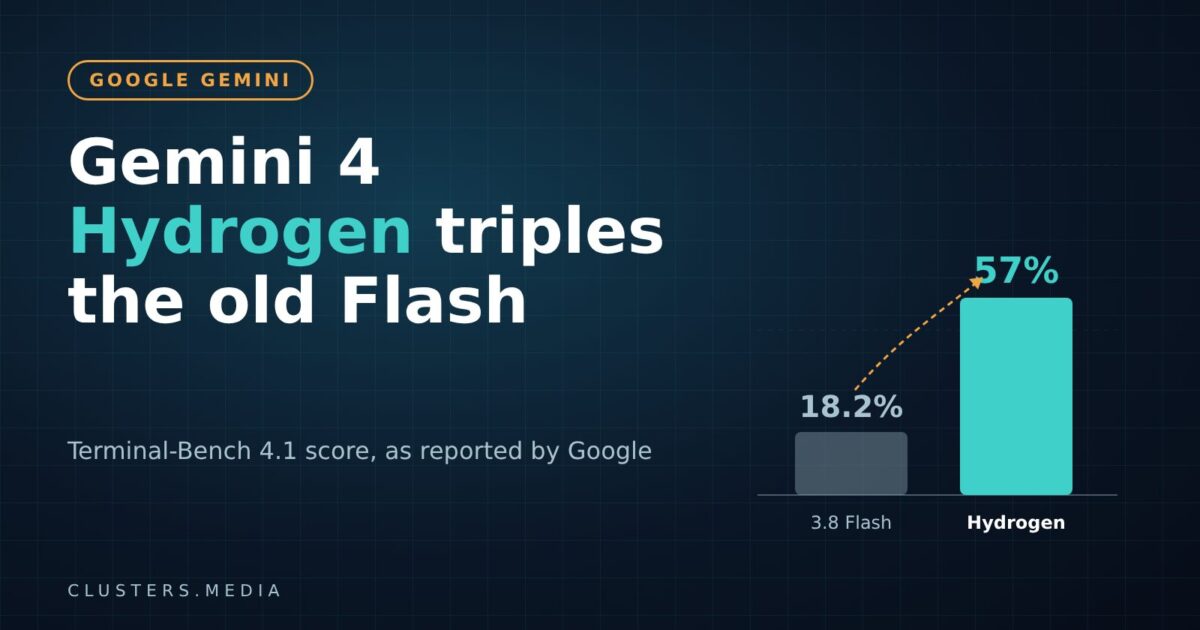
- Google reports 57% on Terminal-Bench 4.1 (vs 18.2% for 3.8 Flash) and tasks finished about 2.5x faster.
- It scores 51 on the Artificial Analysis Intelligence Index at its default setting, one point above Argon’s 50, and 54 at the new “xhigh” level.
- A new Orchestrator mode in Google Antigravity mixes Hydrogen and Carbon in one session.
What happened
Google DeepMind’s Koray Kavukcuoglu introduced Hydrogen as the execution-focused model of the Gemini 4 lineup, sitting below Gemini 4 Carbon and Gemini 4 Argon, which remain Google’s picks for deep, long-running reasoning. As 9to5Google reported, Google chose not to keep the Flash branding even though Hydrogen fills the slot that Gemini 3.8 Flash occupied since September. The element-style name matches Argon and Carbon, and it had circulated for weeks as an unconfirmed codename before this launch made it official.
The model takes up to 1 million tokens of input and, like Argon, supports very long outputs. It ships with four thinking levels — low, medium, high and a new xhigh — so developers can trade quality against speed and cost. High is the default.
The numbers Google is claiming
All headline benchmarks below are vendor-reported, so treat them as Google’s claims until independent testing catches up. Compared with Gemini 3.8 Flash, Google says Hydrogen:
- finishes tasks roughly 2.5 times faster at the default high setting;
- more than triples its Terminal-Bench 4.1 score, from 18.2% to 57%;
- cuts fabricated claims by more than five times;
- recovers more gracefully when a tool call fails or a search comes back empty.
Google also says early partners saw Hydrogen run 2x to 2.8x faster than 3.8 Flash while using 12% to 23% fewer tokens, and that it ranks fifth on arena.ai’s live Agent Arena benchmark for multi-step work like deep research and codebase navigation. MarkTechPost’s rundown lists further claimed results, including 58.8% on HLE-Diamond and a first-place 52.3% on the Vals Tax Agent Bench.
The most eye-catching claim is the Artificial Analysis Intelligence Index: 51 for Hydrogen at high versus 50 for Argon, the bigger model Google launched only weeks earlier. The Decoder notes that the xhigh level lifts the score to 54 but uses nearly twice as many output tokens as high, pushing average cost per task from about $1.87 to $3.16 in that testing. In other words, xhigh is a dial you should turn deliberately, not by default.
Orchestrator: two models, one session
Alongside the model, Google added Orchestrator to Google Antigravity, its agent-first coding environment. Instead of running one model from start to finish, Orchestrator switches between Carbon and Hydrogen inside the same session: Carbon handles planning and re-planning, while Hydrogen does the edits and tests. For parallel workflows, Google describes Carbon acting as the coordinator while Hydrogen powers worker and verifier agents in isolated workspaces.
Google says that on Terminal-Bench, Orchestrator reached close to Carbon’s task success rate while using 24% less quota and finishing 19% faster on average. That is a result for the model mix, not Hydrogen alone, and it depends on the router sending the right steps to the right model. Orchestrator is starting with Google AI Ultra subscribers and Gemini for business; AI Pro users get Hydrogen in Antigravity but not Orchestrator yet.
Who can use it
- Everyone: rolling out globally in the Gemini app and Google Search, where it is picked automatically when it fits the prompt.
- Developers: available across Google AI Studio and Gemini API tiers, plus paid Android Studio.
- Businesses: available in Gemini for business.
- Antigravity: paid Google AI Pro and Ultra subscribers.
Why it matters
Most production AI traffic is not frontier-grade reasoning. It is classification, extraction, routine code edits, test runs and tool calls — work where latency and price matter more than the last few points of accuracy. Hydrogen is Google’s bet that a fast model can now cover far more of that work, and its benchmark claims suggest the gap between “cheap tier” and “flagship” is shrinking quickly. If a model priced like Hydrogen really matches Argon on general intelligence, many teams will question why they pay flagship rates for everyday agent loops.
It also shows how labs are splitting their lineups by job rather than just by size. Google now pitches Carbon and Argon for long-horizon reasoning and Hydrogen as the workhorse, the same pattern we saw with its Gemini Omni 1.2 Flash video model, and the same price pressure visible in Anthropic’s recent Claude Fable 5.2 cut.
What it means for developers and businesses
- Re-test your Flash workloads. If you run Gemini 3.8 Flash today, compare quality, latency and total token spend on your own tasks, not just list price. Fewer tokens per task can offset a higher per-token rate.
- Watch the thinking level. Output pricing includes thinking tokens, so xhigh can roughly double spend. Start at low or medium for simple jobs and reserve xhigh for hard ones.
- Try a two-model setup. Even outside Antigravity, the planner/worker split — a stronger model planning, Hydrogen executing — is a pattern worth testing in your own agent stack.
- Don’t skip your own evals. Vendor benchmarks are a starting point. Early independent reporting suggests Hydrogen rarely hallucinates but is less dominant on some terminal-style work than Google’s headline figure implies.
What to watch next
Three things will decide how big this launch really is. First, independent benchmarks from Artificial Analysis and others over the coming weeks, especially on coding and terminal tasks. Second, how Orchestrator performs on real projects and when it reaches AI Pro users. Third, how OpenAI and Anthropic respond on price for their own fast tiers. With Carbon and Hydrogen landing within weeks of each other, Google is clearly shipping the Gemini 4 family at speed — and developers are the ones who benefit from the price war.