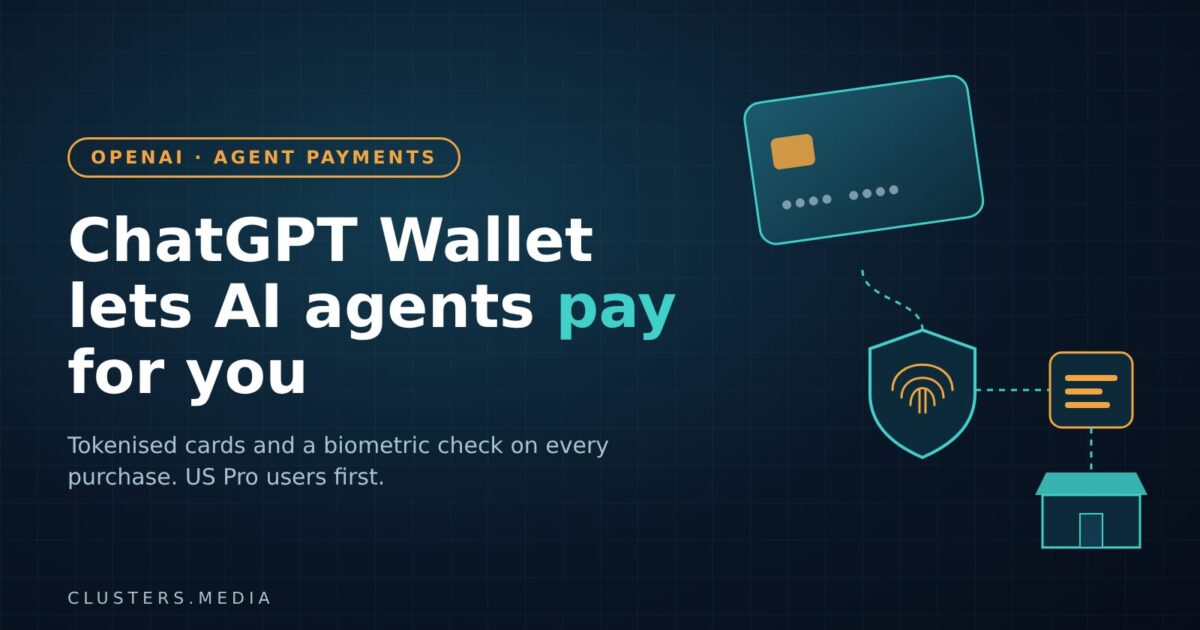
OpenAI has launched ChatGPT Wallet, a payment layer that lets its always-on “dots” agents finish a purchase on a website for you. You add a card once, the agent does the shopping, and you approve each order with Face ID or a fingerprint. The card network then hands the merchant a stand-in card number, so neither the agent nor the shop ever sees your real one.
The rollout started on November 13, 2026, and it is deliberately small: only US ChatGPT Pro subscribers aged 18 and over, with eligible US-issued cards, inside dots. But the bigger story is for builders and merchants, because OpenAI also published a Commerce Partner Playbook that tells websites how to let these agents in.
Key takeaways
- ChatGPT Wallet lets OpenAI’s dots agents check out on ordinary merchant websites on a user’s behalf.
- Every purchase needs a biometric approval, and the merchant receives a network payment token instead of the real card number.
- It was built with American Express, Mastercard and Visa; card rewards and dispute protections stay in place.
- Launch is limited to US ChatGPT Pro users 18+, and OpenAI says it is not taking a cut of transactions for now.
- Merchants are asked to stop blocking signed agent traffic (Web Bot Auth) and tune fraud systems so legitimate agent orders are not declined.
What happened
OpenAI introduced dots at DevDay on September 29 as personal agents that run in the background, learn your preferences and keep working on tasks across apps and websites. Until now, those agents could research a product or plan a trip, but the final step still needed a human to type in card details. ChatGPT Wallet closes that gap.
According to CNBC’s report on the launch, OpenAI built the wallet with American Express, Mastercard and Visa, and says the agents never get access to the user’s actual card details. The flow, as OpenAI describes it and as The Next Web and GSMArena also report, works like this:
- You save a card in ChatGPT Wallet one time.
- You ask your dot to find something, such as a sweater or a hotel.
- Before checkout, you see the items, the total and the card that will be charged.
- You approve with a security check like Face ID or a fingerprint scan, which also creates a record of what you authorised.
- The card network issues a payment token (a stand-in card number, security code and expiry date), and the agent uses it to pay on the merchant’s normal checkout page.
After the sale, you deal with the shop directly. The merchant keeps control of pricing, delivery, returns and customer service. The feature only works inside dots conversations, not in regular ChatGPT chats, ChatGPT Work or standalone Codex threads. OpenAI also warns that agents can make mistakes and that some websites or fraud systems may still block or reject agent purchases.
Why it matters
This is OpenAI’s second attempt at commerce inside ChatGPT, and it takes the opposite route from the first. Instant Checkout, launched with Stripe in September 2025, pulled the transaction into ChatGPT and needed merchants to plug in their catalogues. Wallet does the reverse: the agent travels to the merchant’s existing website and pays with a credential that fits a normal card form. That means no plugin or product feed is required for a basic purchase.
The design choices are aimed squarely at trust. Tokenised cards mean a leaked agent session does not leak your card number. Per-purchase biometric approval keeps a human in the loop for every payment. Keeping existing card rewards and dispute rights removes a reason for people to avoid the feature. OpenAI says it wants to go further later, letting users pre-approve purchases inside limits such as spending caps, categories or time windows, but it has given no date for that.
There is also a business angle. OpenAI says it is not taking a share of transactions at launch, but a payment layer sitting between ChatGPT’s very large user base and online stores is an obvious future revenue line. It also puts OpenAI in direct competition with agent shopping efforts from Google, Microsoft and Meta. We covered a similar shift toward background agents with Perplexity Teammates, and OpenAI’s push to own more of the developer workflow with its acquisition of Pierre.
What it means for developers and businesses
If you run an online store, or build one for clients, the practical work is in OpenAI’s Commerce Partner Playbook. It groups the preparation into four areas, and businesses can start with whichever matters most to them:
- Product information: claim your business listing in ChatGPT and upload a product feed with current prices and stock through Business Hub.
- Agent access: configure your CDN or firewall to recognise signed requests using Web Bot Auth, and check that bot protection is not quietly blocking ChatGPT agents.
- Payments and risk: the tokens work with existing checkout flows, but fraud tools may still flag agent orders. OpenAI names Forter, Riskified, Sardine and Signifyd, plus Adyen, Checkout.com and Stripe, as partners working on recognising legitimate agent purchases.
- Deeper integration: build a plugin so agents can check availability or manage carts through your systems, or expose WebMCP tools on your site.
For developers, the most important line is the one about blocking. Many sites run aggressive bot protection by default. If your checkout treats every automated session as hostile, agent purchases will simply fail, and you will never see the lost sale in your analytics. Reviewing CDN rules for Web Bot Auth signatures is a small change compared with rebuilding a checkout.
It is also worth thinking about what an agent-friendly checkout looks like: stable form fields, clear error messages, predictable shipping options and no surprise pop-ups. Those same choices make sites easier for people using assistive technology, so the work is not wasted even if agent traffic stays small. Teams building their own agents should note the pattern OpenAI chose, tokenised credentials plus explicit per-action approval, as a reasonable template for any agent that spends money.
For Indian builders, the direct impact is limited for now because the launch is US-only and tied to US-issued cards. But the playbook signals where global commerce platforms are heading, and the same checklist will matter if and when the feature expands.
What we don’t know yet
OpenAI has not published fees for users or merchants, a date for wider availability, or a full list of eligible card issuers. It has not said whether each payment token is single-use, which specific card network programmes sit behind it, or exactly how fraud systems will identify a ChatGPT Wallet purchase. It is also unclear who absorbs the cost when an agent buys the wrong item, beyond the card’s normal dispute protections.
What to watch next
- Expansion beyond US Pro: a move to Plus users or other countries would turn this from an experiment into a real channel.
- A fee model: any transaction fee or revenue share with the card networks would make Wallet a payments business, not just a feature.
- Delegated spending: pre-approved purchases within limits are the step that makes agents truly autonomous, and the one regulators will watch most closely.
- Merchant response: whether large retailers open their sites to signed agents or keep blocking them will decide how useful Wallet actually is.
For now, ChatGPT Wallet is a small launch with a big signal: AI agents are moving from recommending purchases to completing them. If your business sells online, the time to check whether your site lets them in is before the traffic arrives, not after.