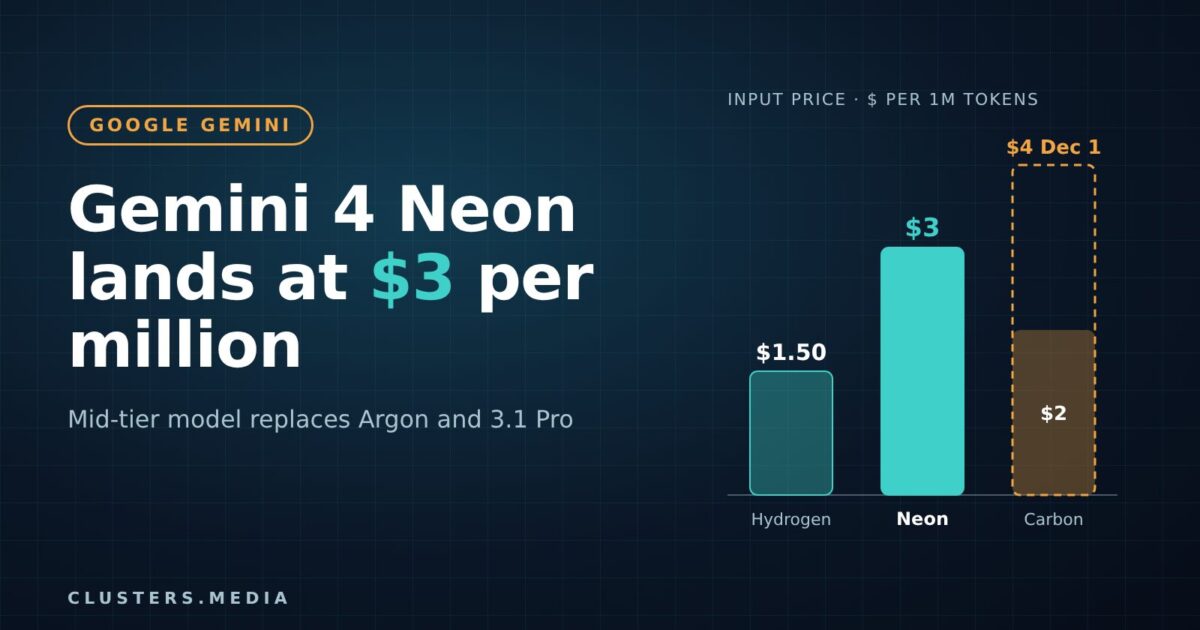
Google has released Gemini 4 Neon, a new mid-tier model that slots between the fast Gemini 4 Hydrogen and the heavyweight Gemini 4 Carbon. Announced on November 18, it costs $3 per million input tokens and $15 per million output tokens, carries a 1 million-token context window, and replaces Gemini 4 Argon and the older Gemini 3.1 Pro for Google AI Pro subscribers in the Gemini app.
It is the fourth Gemini 4 model in roughly a month, and for many teams it is likely to become the default choice for coding agents and analysis work.
Key takeaways
- Price: $3 input / $15 output per million tokens, with cached input at $0.15. There is no free API tier.
- Position: sits between Hydrogen (everyday speed) and Carbon (hardest long-horizon work), and takes over Argon’s slot.
- Score: 61 on the Artificial Analysis Intelligence Index at its highest thinking level, which Google says ranks third overall.
- Deadline to watch: Carbon and Argon API prices rise from $2/$10 to $4/$20 on December 1, which makes Neon the cheaper option.
- Model ID:
gemini-4-neon, available now in the paid Gemini API, Google AI Studio, Android Studio and Google Antigravity.
What happened
In a post written by Google DeepMind’s Koray Kavukcuoglu, Google pitched Neon as a model that brings near-frontier reasoning to work that has to run often and finish quickly: multi-file coding, enterprise analysis and science workloads. Rather than chasing the very top of every leaderboard, Neon is designed to deliver most of Carbon’s capability at lower cost and latency.
The rollout covers several surfaces at once. Developers can call it through the paid tier of the Gemini API in Google AI Studio and Android Studio. Paid AI Pro and Ultra subscribers get it in Google Antigravity, Google’s agentic coding environment, across the desktop app, CLI and IDE extensions. Businesses can pick it through Gemini for business, and consumers on AI Pro or Ultra can select it from the model menu in the Gemini app.
That app change matters for subscribers. According to 9to5Google and Notebookcheck, the AI Pro model picker now offers Auto, Hydrogen and Neon, while Argon and Gemini 3.1 Pro have been removed. Carbon stays reserved for AI Ultra. Free users and Google AI Plus subscribers do not get Neon.
How Neon fits in the Gemini 4 family
Google’s lineup now reads like a ladder. Gemini 4 Hydrogen is the fast everyday model at $1.50/$7.50 per million tokens. Neon is the middle rung at exactly twice Hydrogen’s price. Gemini 4 Carbon remains the model for the longest, hardest projects.
The pricing detail that will catch many teams off guard is the end of Carbon’s launch offer. Carbon and Argon cost $2 input and $10 output per million tokens only until November 30. From December 1 they move to $4 and $20, which leaves Neon 25% cheaper than Carbon on both input and output. Anyone running Argon in production has less than two weeks to test whether Neon handles their workload.
Like Hydrogen, Neon offers four thinking levels (low, medium, high and extra high), letting developers trade depth of reasoning against speed and token spend per request. Google says the default high setting delivers a cost per task about 32% lower than Carbon on the Artificial Analysis index.
The benchmark claims, and how to read them
Google’s headline number is a score of 61 on the Artificial Analysis Intelligence Index at Neon’s highest thinking level. In a comparison table Google published, that places Neon ahead of Anthropic’s Claude Opus 5.5 (59) and OpenAI’s GPT-6.2 Sol (57), as Digital Trends reported, and behind only larger, slower models.
For developers, the coding numbers are more relevant. Google reports a 65.2% score on Terminal-Bench 4.1 and says Neon ranks first on the Artificial Analysis Coding Agent Index with 58.6. It also cites second place on the Vals Index (70.9%) and on steerability in Arena’s new Agent Arena Index, a measure of how cleanly a model adjusts when a user corrects it mid-task.
A word of caution: Google chose the comparisons and the settings, and several of these figures come from its own testing. Independent results on your own prompts, repositories and tool chains will tell you more than any vendor chart. Treat the numbers as a reason to test, not a reason to switch blindly.
Why it matters
Most production AI spend does not go to the single hardest problem a team has. It goes to thousands of routine but non-trivial calls: reviewing pull requests, refactoring modules, summarising contracts, pulling numbers out of spreadsheets. A model that gets close to flagship quality at a lower price per task changes the economics of those workloads more than another record on a niche benchmark.
Neon also arrives during a crowded week. OpenAI’s GPT-6.2 Astra and Sol landed on November 17, and Anthropic’s Claude models remain a key reference point for agentic coding. Google is clearly competing on value and breadth of distribution rather than on one flagship alone.
What it means for developers and businesses
Agent builders get a new pattern to try. Antigravity’s Orchestrator can now pair Neon as the planner with Hydrogen as the executor inside one session, so the more expensive model does the thinking while the cheaper one handles the many smaller steps. The same planner-executor split can be copied in your own agent frameworks through the API.
Teams handling untrusted content should look at Google’s prompt-injection claims. On Gray Swan’s indirect prompt injection benchmark, Google says no attack succeeded against Neon at its highest thinking level with real-time safeguards on. That is Google’s own result, not a guarantee, so keep sandboxing and permission checks in place for agents that read email, web pages or documents.
Enterprises on Google Cloud should note that, per Google’s developer guide, Neon is offered to verified enterprise customers in select regions, and Google lists it as the migration target for Gemini 3.1 Pro and for most Argon workloads.
Gemini app users have one setting to watch. Notebookcheck points out that Google’s help page says a manually chosen model defaults to the low thinking level, so harder tasks may need medium or high selected by hand.
Security teams may get a specialised version: Google says a “Neon for cyber” variant is rolling out to vetted defenders through its Fairwind Program over the coming days.
What to watch next
- December 1 price change: whether teams migrate from Argon and Carbon to Neon before the higher rates kick in.
- Independent evaluations: third-party coding and agent tests over the next few weeks will show whether the Carbon-level claims hold outside Google’s harness.
- Free-tier access: Neon currently has no free API tier and is absent from the free and AI Plus app plans; any change would widen its reach.
- Competitor responses: OpenAI and Anthropic have both shipped recently, and mid-tier pricing is now a main battleground.
The short version: if you build on Gemini, Neon is the model to benchmark this week, and the December 1 price change gives you a concrete reason not to wait.