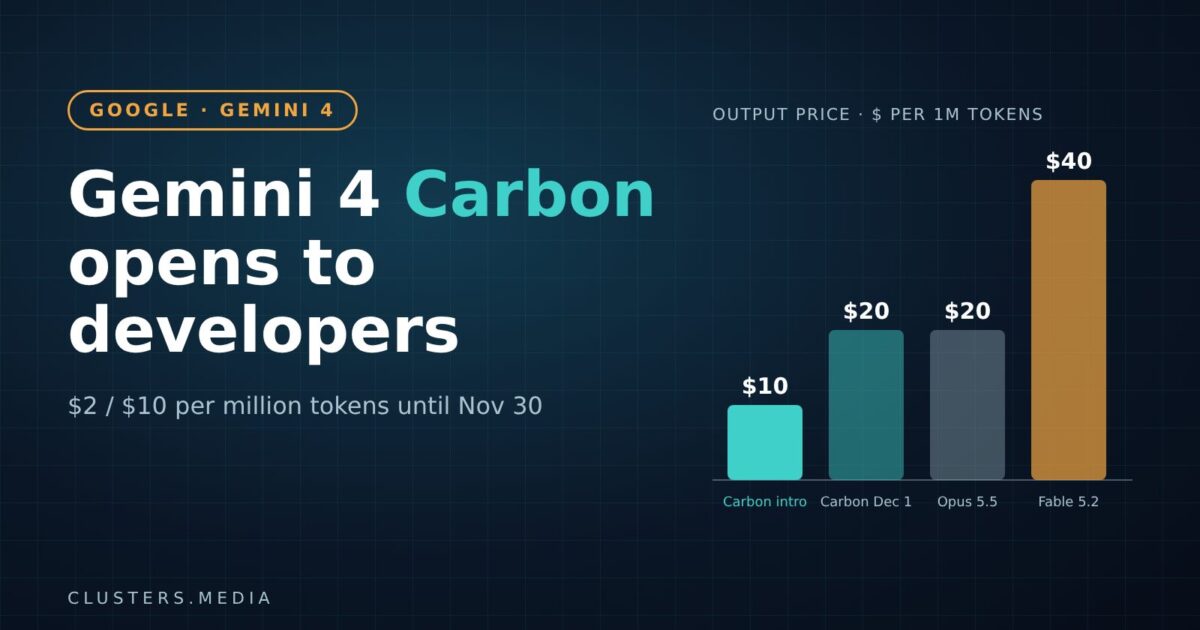
Google has opened up Gemini 4 Carbon, its most capable model, to paying developers, enterprises and Google AI Ultra subscribers. On November 10, two weeks after first announcing the model and giving it only to vetted cyber defenders, Google made Carbon available through the paid Gemini API at an introductory price of $2 per million input tokens and $10 per million output tokens. That rate runs until November 30, so teams have a short window to test it cheaply.
Key takeaways
- Who can use it: all paying Gemini API developers (AI Studio, Android Studio), Gemini for business customers, and Google AI Ultra subscribers in the Gemini app, AI Mode in Search and Antigravity.
- Price: $2 / $10 per million input/output tokens through November 30, 2026, then $4 / $20.
- Positioning: Google still recommends Gemini 4 Argon for most coding and knowledge work. Carbon is for the hardest, longest tasks and uses more tokens to get there.
- Benchmarks are mixed: Carbon leads Zapier’s AutomationBench and Terminal-Bench 4.0 in published tests, but Claude Fable 5.2 leads the broad Artificial Analysis index and some real-repository coding tests.
- New tool: a preview of
/swarmin Google Antigravity splits one prompt across a coordinated team of agents.
What happened
Google introduced Gemini 4 Carbon on October 28 as the second frontier model in the Gemini 4 family, following Gemini 4 Argon. At first, access was limited to security teams in Google DeepMind’s Fairwind Program, which still offers a separate “Carbon for cyber” version with fewer guardrails.
The November 10 release is the general-use model. In Google’s announcement, Koray Kavukcuoglu, SVP of Google DeepMind and Google’s Chief AI Architect, describes Carbon as Google’s strongest model for long-horizon agent work across software engineering, knowledge work and scientific reasoning. Developers call it with the model ID gemini-4-carbon, and Google’s developer guide lists a 1 million token context window with low, medium and high thinking levels.
Access breaks down like this:
- Developers: paid tier of the Gemini API in Google AI Studio and Android Studio. Ultra subscribers can also try it in AI Studio and Antigravity.
- Enterprises: Gemini for business via API or the model picker, plus Antigravity and CodeMender.
- Consumers: Google AI Ultra subscribers in the Gemini app and AI Mode in Search. VentureBeat reports US Ultra plans cost $99.99 a month (Ultra 5x) and $199.99 a month (Ultra 20x).
- Scientists: Google’s program offering selected researchers six months of free Antigravity access at its highest usage tier now includes Carbon as well as Argon.
Carbon is a hosted, proprietary model. No downloadable weights or self-hosting option has been announced, and Google’s launch materials don’t spell out Vertex AI regions or a country-by-country rollout.
Why it matters
The main story here is price. Carbon arrived one day after Anthropic shipped Claude Fable 5.2 at $8 / $40 per million tokens. At its introductory rate, Carbon’s token prices are a quarter of Fable 5.2’s. At the standard $4 / $20 rate they are half, which matches Claude Opus 5.5’s list price.
Token prices don’t tell you the whole cost, though. Carbon is built to think longer, so it can use more tokens per job. Google says Carbon ranks first on CursorBench 4.0, Perplexity’s WANDR and Zapier’s AutomationBench “at more than 2X lower cost per task compared to the next best external model.” VentureBeat checked the public numbers:
- AutomationBench (Zapier): Carbon on high scored 53.88% at about $2.12 per task, ahead of Fable 5.2 on max at 51.45% and $4.64. This is the strongest public support for Google’s cost claim.
- Artificial Analysis Intelligence Index: Fable 5.2 (max) scores 65, Carbon (high) 60, Claude Opus 5.5 59 and GPT-6 Astra 57.
- Terminal-Bench 4.0: Carbon high reached 65.2%, compared with 61.6% for Fable’s best listed run.
- FrontierCode 2.0 (real repository changes graded to a merge standard): Fable leads at 49.1% to Carbon’s 40.6%.
The public CursorBench and WANDR tables VentureBeat reviewed had no Carbon results, so Google’s top rankings on those two tests haven’t been independently confirmed yet. So no single model wins everywhere. Carbon looks strong at agent workflows across business apps and terminal-heavy tasks, while Fable keeps an edge on getting real code changes merged.
What it means for developers and businesses
Use Carbon as a specialist, not a default. Google itself says Argon “remains the ideal choice for the majority of software engineering and knowledge work.” Carbon is aimed at multi-step debugging, multi-package migrations, cross-system root-cause analysis and open-ended research. Because it runs longer verification loops, a simple task can cost more on Carbon than on Argon even though the token price is identical for now.
Mix models with /swarm. The new Antigravity preview turns one prompt into a team of agents you can track in real time. Google suggests giving Carbon the roles that need the deepest reasoning (architecture, coordination, auditing) and pairing it with lighter models working in parallel, isolated workspaces, plus adversarial verifiers that test every change. Anthropic describes a similar setup with Fable as an orchestrator over Opus, so this “big model plans, smaller models build” pattern is becoming standard practice.
Benchmark it on your own work before December. The cheap window closes November 30. A practical pilot:
- Choose 10 to 20 real tasks that currently eat engineering time, such as a tricky migration or a flaky-test investigation.
- Run them on your current model and on Carbon at medium and high thinking.
- Track pass rate, retries, elapsed time, reviewer time and total spend, not just price per token.
- Re-price each run at the $4 / $20 rate so you know what it costs from December 1.
Plan for caching. Google previously announced a 95% discount on cached input for Carbon. If you send the same repository or policy documents over and over, your real input cost depends on how often requests actually hit the cache, so measure it.
Check the safety story yourself. Google reports that in simulated cyberattack tests Carbon blocked 99% of attack attempts from an adaptive red-teaming agent, cutting the per-attempt breach rate to 0.8% from 3.1% on Argon. It also says Carbon passed 92% of a 375-task agentic honesty benchmark, compared with 70% for Argon. These are Google’s own evaluations. They point the right way for agent builders, but you should still sandbox agents, limit their permissions and log their actions.
What to watch next
- December 1 pricing. Carbon and Argon both double to $4 / $20. Watch whether Google extends the promotion or adds volume discounts.
- Independent results. Whether Carbon shows up on the public CursorBench and WANDR leaderboards with numbers that back Google’s claims.
- Cloud availability. Vertex AI regions and enterprise support details are still unclear, which matters for teams buying through a Google Cloud contract.
- The response. With Anthropic, OpenAI and Google shipping frontier models weeks apart, expect more price moves soon. Google’s recent Gemini Omni 1.2 Flash price cut shows it is willing to compete on cost.
Bottom line: Gemini 4 Carbon gives builders another frontier model at a mid-tier price, but the right choice depends on the job. Test it on your hardest tasks this month, while testing is cheap, and keep your current model as the baseline.