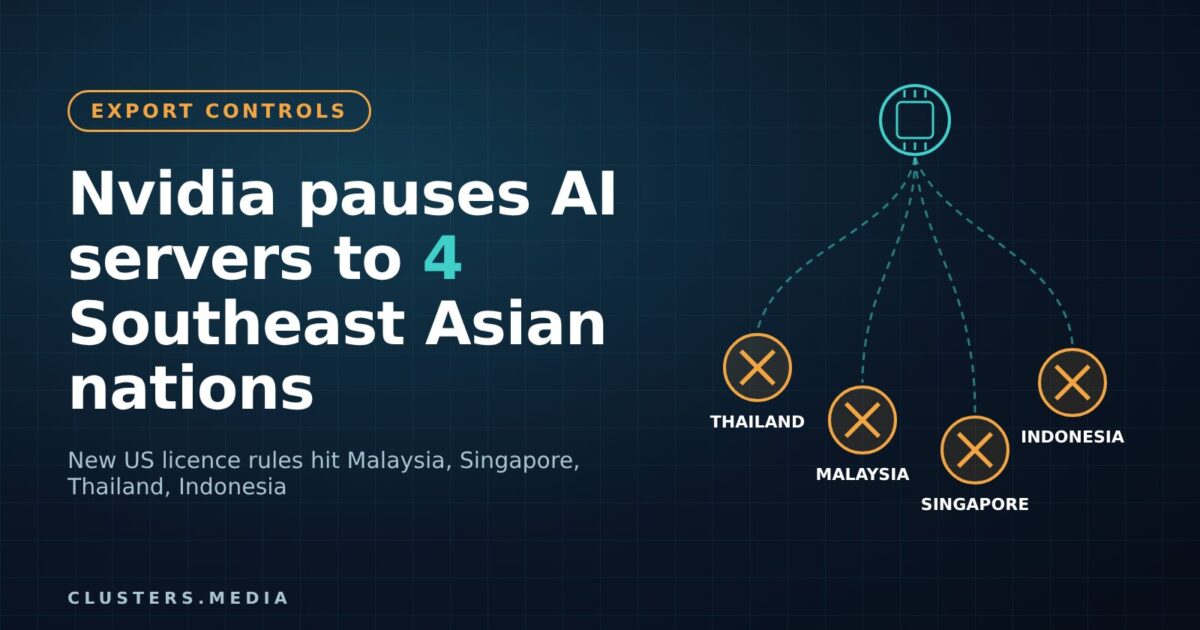
Nvidia has told the companies that build servers around its chips to stop shipping AI servers to Malaysia, Singapore, Thailand and Indonesia, according to a Financial Times report carried by Reuters. Partners including Dell and Supermicro have reportedly told buyers in the four countries that Nvidia will not authorise their orders. The pause follows a new US Commerce Department rule that now requires export licences for advanced AI chips going to the region.
Key takeaways
- Nvidia AI server shipments to Malaysia, Singapore, Thailand and Indonesia are on hold, per the FT, citing three people familiar with the matter.
- The halt follows a US interim final rule that requires licences for advanced AI chips sent to those four countries plus Brazil.
- The same rule targets data centers anywhere that sell large amounts of compute to companies headquartered in China.
- It is not yet clear whether the pause is temporary while Nvidia and its partners work through compliance.
- Nvidia booked $104 billion in 2025 revenue through its Singapore subsidiary, so the region matters to its business.
What happened
On Thursday, the Financial Times reported that Nvidia had asked its manufacturing partners to stop shipping servers that contain its AI chips to four Southeast Asian countries. Server makers such as Dell and Supermicro, which package Nvidia GPUs into complete systems, have told customers in those markets that their orders will not ship. The story was quickly picked up by Reuters, Business Standard and The National.
Nvidia has not publicly explained the move, and the reports say it is unclear how long the pause will last. The most likely reading, based on the reporting so far, is that Nvidia and its partners are holding shipments while they work out what the new US licence requirements mean for each buyer.
The rule behind the pause
The trigger is an interim final rule from the Commerce Department’s Bureau of Industry and Security (BIS), announced on November 16. It deals with what officials call remote access: the practice of renting time on advanced chips in a data center outside China instead of buying the chips directly. Chinese companies have been barred from buying top Nvidia chips since 2022, but renting compute abroad was not covered by those controls. NBC News and CBS News both describe the rule as closing that gap.
The rule does three main things:
- New licence countries. Exports of advanced AI chips to Indonesia, Malaysia, Singapore, Thailand and Brazil now need a licence. BIS says these countries present a “higher-than-normal risk of diversion.”
- Data centers serving China. Facilities anywhere in the world that supply significant computing power to China-headquartered companies need a licence. Those already serving such customers get 90 days to apply, according to CNBC and Fortune.
- A carve-out for US companies. Buyers that are, or are owned by, US-headquartered companies are excluded from the new country licence requirement, provided the exporter meets reporting rules.
The rule also formally rescinds the Biden-era AI Diffusion Rule, which was never enforced. Because it is an “interim final” rule, it took effect without the usual comment period that most federal rules go through.
Why it matters
Southeast Asia has seen a surge in data center construction, and much of that demand has come from Chinese AI developers looking for access to Nvidia’s best hardware. The four countries named in the halt became, in the words of several reports, favoured destinations for Chinese firms seeking to work around US export limits.
The money involved is large. Nvidia recorded $104 billion in revenue through its Singapore subsidiary in 2025, up 72% from the year before, according to the FT figures cited by The National and Benzinga. That figure overstates sales that physically land in Singapore, because Nvidia also books some Taiwan and China revenue through the same unit. Still, it shows how central the region has become to Nvidia’s sales.
The timing also matters. Reuters notes the rule was published days after Jensen Huang’s brief resignation from Nvidia, which we covered when Nvidia reinstated Huang as CEO. Scrutiny of Megaspeed, a Singapore-based Nvidia partner that rents computing power, over possible diversion of chips to China has added pressure on the whole regional supply chain.
How the region is responding
Governments in the region are not pushing back hard. Malaysia’s trade minister, Johari Abdul Ghani, said Kuala Lumpur does not plan to negotiate with Washington over the rule and expects data center operators to follow it, Quartz reported, citing Reuters. Thailand’s vice minister for commerce told CNBC the country would scrutinise data centers that import high-end chips and crack down on any that re-export them. Singapore has said it is studying the measure and plans to negotiate “trusted access” to advanced chips for its companies.
What it means for developers and businesses
For most developers, the immediate effect will be indirect. But a few groups should pay close attention:
- Teams renting GPUs in Southeast Asia. If you buy compute from a regional cloud or colocation provider, new capacity built on fresh Nvidia hardware may arrive later than planned. Ask your provider whether its expansion depends on orders now on hold.
- Companies with Chinese parents or customers. The data center provisions are about who the end customer is, not just where the chips sit. Providers will need to know more about their customers, so expect stricter know-your-customer checks and more paperwork.
- Startups choosing a region. Because US-headquartered buyers are carved out, large US cloud providers operating in the region may be better placed to keep adding capacity than local operators. That could shift where teams in India, the Gulf and Southeast Asia choose to run training and inference.
- Anyone planning around compute supply. The halt is another sign that GPU availability now depends on policy as much as on manufacturing. Build some slack into hardware timelines and keep a second region or provider in mind. Some companies are already looking well beyond the ground, as our story on SpaceX’s orbital AI data center plans shows.
What to watch next
- How long the pause lasts. If Nvidia resumes shipments to buyers that clearly qualify, such as US-owned operators, the halt may turn out to be a short compliance step.
- The first licence decisions. How quickly BIS approves licences, and for whom, will decide how much the region’s data center build-out slows.
- The 90-day window. Data centers already serving Chinese customers must apply for licences within 90 days of the rule taking effect, which puts the deadline around February 2027.
- Singapore’s “trusted access” talks. A deal there could become a template for other countries that want US chips without the strictest checks.
- Nvidia’s own comments. The company has not publicly detailed the pause. Its next statements to investors should show how much revenue it expects to be affected.
The bigger picture is clear: the US is moving export controls from physical chips to the compute services built on them. For builders, that means where your GPUs live, and who else uses the same data center, is now a policy question as well as a technical one.