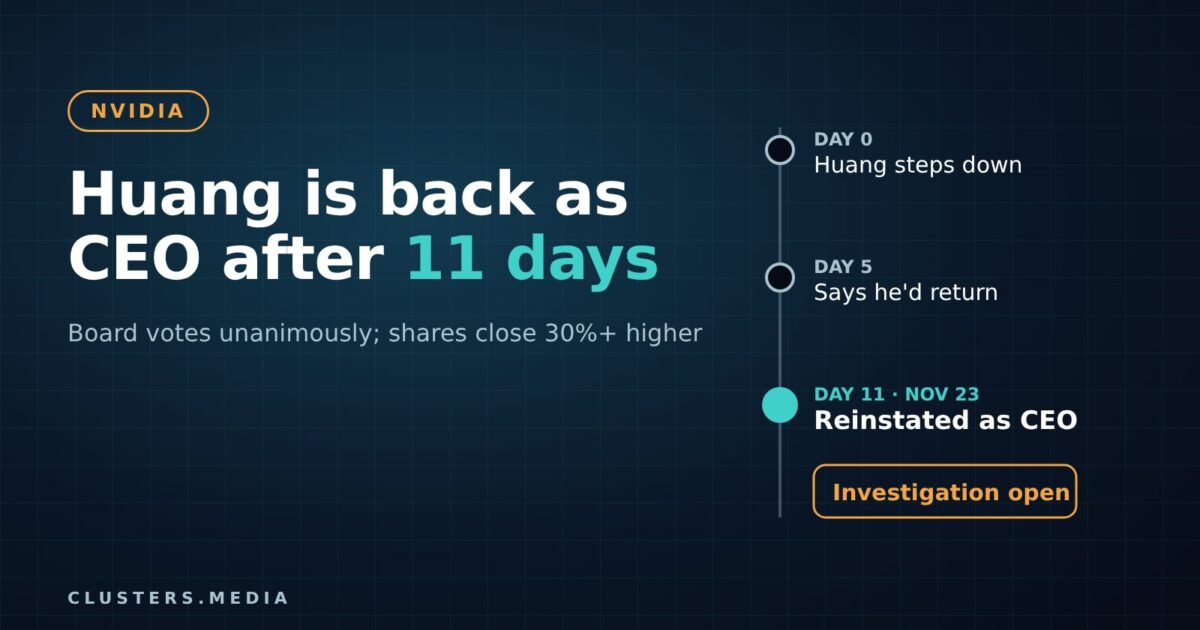
Nvidia has reinstated Jensen Huang as president, CEO and board director, effective immediately, just 11 days after he resigned. The board said in a statement filed with the SEC on November 23 that it voted unanimously to bring him back after meetings with Huang and input from senior levels of the US government. Nvidia shares closed more than 30% higher on the news, while the board’s own investigation into reports that Huang was targeted by a foreign intelligence effort continues.
Key takeaways
- Nvidia’s board voted unanimously to reinstate Jensen Huang as president, CEO and director, effective November 23.
- The board says input from senior US government officials left it confident his return poses no national security risk.
- Shares rose as much as 33% during the session and closed more than 30% higher.
- An independent directors’ committee is still investigating reports that Huang was the target of a foreign intelligence effort.
- Nvidia has also formed a National Security and Export Control Committee and is hiring its first Chief Compliance Officer.
What happened
Huang, who co-founded Nvidia and ran it for more than three decades, stepped down earlier this month after reports of extramarital affairs, including one that reportedly involved a suspected Chinese intelligence operative. Chief financial officer Colette Kress took over as interim CEO, and former Synopsys chief Harvey C. Jones became the company’s first board chair, as The Globe and Mail recounts.
The return was not a straight line. On November 17 Huang said publicly that he would be willing to come back if the board decided it was in the company’s interest, and Jones responded the same day that the board did not intend to reinstate him, according to reporting that cited The Wall Street Journal and The Verge. Six days later the board reversed course.
In its official statement, Nvidia says the directors held a series of discussions and meetings with Huang and came away satisfied with his candour and his ability to lead. It also says the board received input from senior levels of the US government and, based on that input, is confident that his return does not create a national security risk. Jones stays on as chair, and Kress returns to focusing on her role as CFO. Huang thanked the board, staff and partners and said he can’t wait to get back to work.
The political backdrop
The White House played a visible part. The Hill reports that President Donald Trump said his administration has no reason to believe Huang’s return poses a national security risk, and that Attorney General Todd Blanche confirmed the administration has no evidence of unlawful conduct by Huang. Trump has also said he played a key role in persuading the board, and CNN reported that he turned to Vice President JD Vance to work with the directors.
Not everyone in Washington agrees. CNN notes criticism from members of both parties: Republican Representative Don Bacon argued the board should have moved on without Huang, and Democratic Representative Raja Krishnamoorthi said it is still unknown what information may have been obtained, since neither the government nor Nvidia’s board has finished investigating. Supporters, including several tech executives and an open letter with more than 170,000 signatures reported by ITdaily, argued Nvidia needed its founder back.
Why it matters
Nvidia sits under almost every large AI project in the world. Its GPUs train and serve most frontier models, and its CUDA software stack is the default target for AI frameworks. A sudden leadership vacuum at that company is not just a stock story; it raises questions about product roadmaps, supply deals and how US export rules on advanced chips will be handled.
Markets read the reversal as a relief. According to Yahoo Finance, citing Reuters, Nvidia stock jumped as much as 33% on Monday, and the Nasdaq rose more than 6% as investors moved back into AI-related shares after a heavy sell-off the previous week. The company had lost roughly $700 billion in market value after the scandal broke, AFP reported last week.
That swing in both directions shows how much of the AI trade still rests on confidence in a handful of companies and the people who run them. The same concentration showed up around Anthropic’s IPO pricing last week.
What has not been resolved
The reinstatement does not close the underlying matter. The committee of independent directors set up to look into reports that Huang was the target of a foreign intelligence effort has retained independent counsel, and the board says that investigation will run to conclusion. Huang says he supports it and will cooperate. Nvidia also says it will keep cooperating with ongoing government investigations and inquiries.
The company gave no timetable for finishing the probe, and it has not named candidates for the new compliance role. Those gaps matter: until the committee reports, the board’s confidence rests on the government input it received rather than on a completed internal review.
What it means for developers and businesses
For most builders, the short-term effect is continuity. Huang has set Nvidia’s product direction for years, from data center GPUs to the CUDA ecosystem, and his return removes the risk of an abrupt strategy change at the company that supplies most AI compute. Teams planning GPU purchases or long cloud commitments can treat the leadership question as settled for now.
The new governance pieces are worth watching more closely. The National Security and Export Control Committee, made up only of independent directors, will oversee trade compliance and national security risk, and a new Chief Compliance Officer will report to the board’s Nominating and Corporate Governance Committee. That points to tighter checks on where Nvidia chips go, which matters for anyone selling into or sourcing hardware from markets covered by US export controls. It also connects to earlier questions about advanced chips reaching China, such as the Blackwell fingerprints found in Chinese AI models.
For businesses, the lesson is about concentration risk. A single executive story wiped out hundreds of billions in value and then restored much of it in one day. If your AI roadmap depends on one hardware vendor, one cloud or one model provider, this is a good moment to check how exposed you are and what a fallback would look like.
What to watch next
- The independent investigation. Any findings from the directors’ committee could reopen the leadership question.
- Government inquiries. Nvidia says separate government investigations are ongoing, and lawmakers from both parties want more answers.
- Export control oversight. How the new committee and compliance chief change chip sales policy, especially for China-linked customers.
- Market stability. Whether the one-day rally holds once the news cycle moves on.
Nvidia has its founder back, but with more oversight around him than before. For the AI industry, the practical outcome is stability at the top of its most important supplier, with open questions that will keep coming back until the investigations are done.