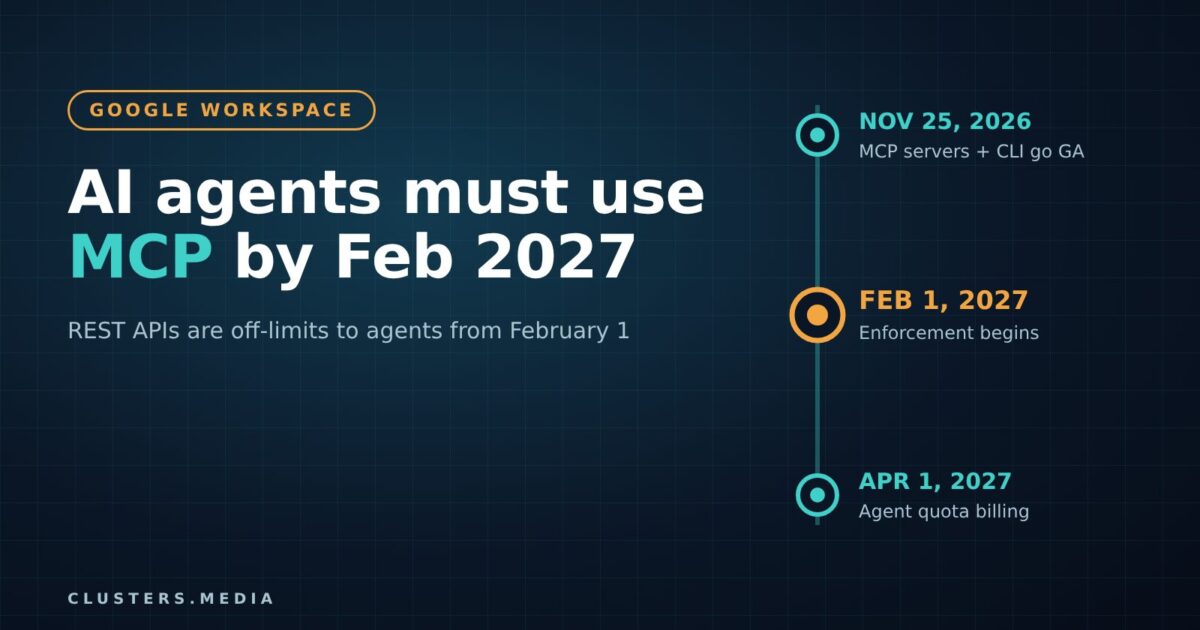
Google is giving AI agents their own front door into Gmail, Drive and the rest of Workspace, and it is closing the old side entrance. On November 25, Google made its Workspace MCP servers and Workspace CLI generally available and said that, under a new Workspace AI Tools Addendum, AI agents must use them instead of the traditional REST APIs. Technical enforcement starts on February 1, 2027.
For anyone building an assistant, copilot or automation that reads mail, edits Docs or touches Drive files, this is a hard deadline with real engineering work attached.
Key takeaways
- Workspace MCP servers (Gmail, Drive, Docs, Sheets, Slides, Calendar, Chat and Tasks) and the Workspace CLI are now generally available.
- From February 1, 2027, AI agents must reach Workspace data through those interfaces, not the REST APIs. Ordinary apps can keep using REST.
- External agents need a dedicated OAuth client ID marked for agent use, least-privilege scopes and usage quotas, with quota billing starting April 1, 2027.
- The addendum bans permanent raw storage of Workspace data, training models on it and scraping the APIs.
- Sending external email, changing Drive sharing and bulk edits will require a user’s confirmation.
What happened
Google announced the change in two coordinated posts, one on the Workspace blog from product VP Yulie Kwon Kim and one on the Google Cloud blog from Workspace engineering VP Chandu Thota and Google Cloud Platform president Brad Calder.
Three pieces shipped together. The Workspace MCP servers are Google-run remote servers built on the open Model Context Protocol, covering eight Workspace apps, with Keep listed as coming soon. The Workspace CLI targets local and desktop agents, terminal workflows and automation, and returns structured JSON with scoped OAuth sign-in. On the Cloud side, Google Cloud Agent Gateway sits in front of LLM, MCP and Agent2Agent (A2A) traffic, checks each agent against an Agent Registry, applies IAM and default-deny outbound rules, and screens requests with Model Armor, Google’s prompt-injection filter.
The policy shift is the part that will make headlines in engineering channels. The new Workspace AI Tools Addendum requires agents to use the MCP servers or CLI rather than the REST APIs, with enforcement from February 1, 2027. Infosecurity Magazine and Unite.AI both reported the same deadline and requirements.
Why Google is doing this
Google’s argument is simple: REST APIs were designed for apps that move at human speed, where holding a valid OAuth token was a decent sign that a person meant to do something. An agent can hold the same token and read, forward or rewrite data far faster than any admin can react, and if it is hijacked through a malicious prompt it becomes an insider threat.
The scale is large. Google says Workspace APIs handle more than 2.8 trillion calls a month, public Drive API traffic is more than two and a half times its 2022 level, and over 18 billion Drive reads a day come from API callers. Google does not say how much of that is agent traffic, but it clearly wants that share to flow through interfaces it can police.
Routing agents through MCP and the CLI lets Google put checks in the request path: every call is tested against the organisation’s Workspace permissions, data loss prevention (DLP) rules and classification labels. The MCP servers also refuse OAuth clients that are not registered for agent use. It is the same direction other platforms are taking; Cloudflare recently gave sites a dedicated search endpoint for AI agents rather than leaving them to scrape pages.
The six new protections
- Policy checks on every request through the mandated MCP and CLI paths.
- Separate agent identities: consent screens and the admin console show whether a tool is an app or an AI agent. Time-limited approvals are listed as coming soon.
- Human sign-off for high-impact actions such as external email, Drive sharing changes and bulk edits, following rules set by IT.
- Visibility and revocation in the admin console today; a user-facing view of agent activity is coming soon.
- AI access restrictions (coming soon) to block external agents from specific Gmail messages and Drive files or folders.
- Data rules after access: no permanent raw storage, no model training, derived data deleted within a set window and all data deleted when a user disconnects.
What it means for developers
If your product is a traditional app, such as a CRM sync, a backup tool or a reporting dashboard that uses the Drive or Gmail APIs, Google says it can keep running on REST. The rules target AI agents and other AI-driven tools.
If your product lets a model decide what to read or do in a user’s Workspace, plan the migration now. Practical steps based on Google’s guidance:
- Create a dedicated agent OAuth client. Keep your existing client for non-agent features and register a separate one marked for AI-agent use, with the narrowest scopes you can manage.
- Move agent calls to MCP or the CLI. Cloud and web agents fit the Workspace MCP servers; local and desktop agents fit the CLI.
- Design for confirmations. Google’s MCP servers can pause and ask the user before sensitive actions, so your agent flow needs to handle a “waiting for approval” state gracefully.
- Audit your data handling. If you cache raw email or file content indefinitely, or use it for fine-tuning, that conflicts with the addendum.
- Budget for quotas. Usage quota billing begins April 1, 2027. Google has published quota tiers, but teams should model what heavy agent workloads will cost.
There is an upside. Instead of pulling whole mailboxes or files line by line and filtering them yourself, Google says the MCP tools return relevant context while data stays inside Workspace’s security boundary. That can mean less data to store, fewer tokens to send to a model and a cleaner security story for enterprise buyers. Prompt leakage is a live risk, as a recent canary study of AI providers showed, so less raw data leaving the tenant is a real gain.
What it means for businesses and IT teams
Workspace admins get a clearer view of which tools are agents and what they are doing. Google recommends reviewing connected apps and agents in the admin console, setting user confirmation rules for sensitive actions and checking agent activity logs. Companies already on Google Cloud can register agents in Agent Registry and place Agent Gateway and Model Armor in front of agents and MCP servers, with policies that can require multi-factor authentication or human approval before agents touch sensitive storage, IAM or production systems.
For buyers, this also gives a simple question to ask any AI vendor between now and February: does your agent use the Workspace MCP servers or CLI, and has it registered a dedicated agent OAuth client?
What to watch next
- February 1, 2027: technical enforcement begins. Watch for how Google detects agent traffic that still goes through REST, and whether it offers extensions for slower migrators.
- April 1, 2027: usage quota billing for agents starts. Pricing pressure could shape which agent features vendors keep.
- “Coming soon” features: time-limited approvals, user-level agent activity views and AI access restrictions for Gmail and Drive have no dates yet.
- Other suites: whether Microsoft 365 and other platforms follow with similar agent-only interfaces. We also expect Google’s own agents, like Gemini computer use, to be held to the same rules.
The bottom line: Google is treating AI agents as a distinct class of user, with their own identities, limits and audit trail. Builders have roughly two months to move agent traffic off the Workspace REST APIs.