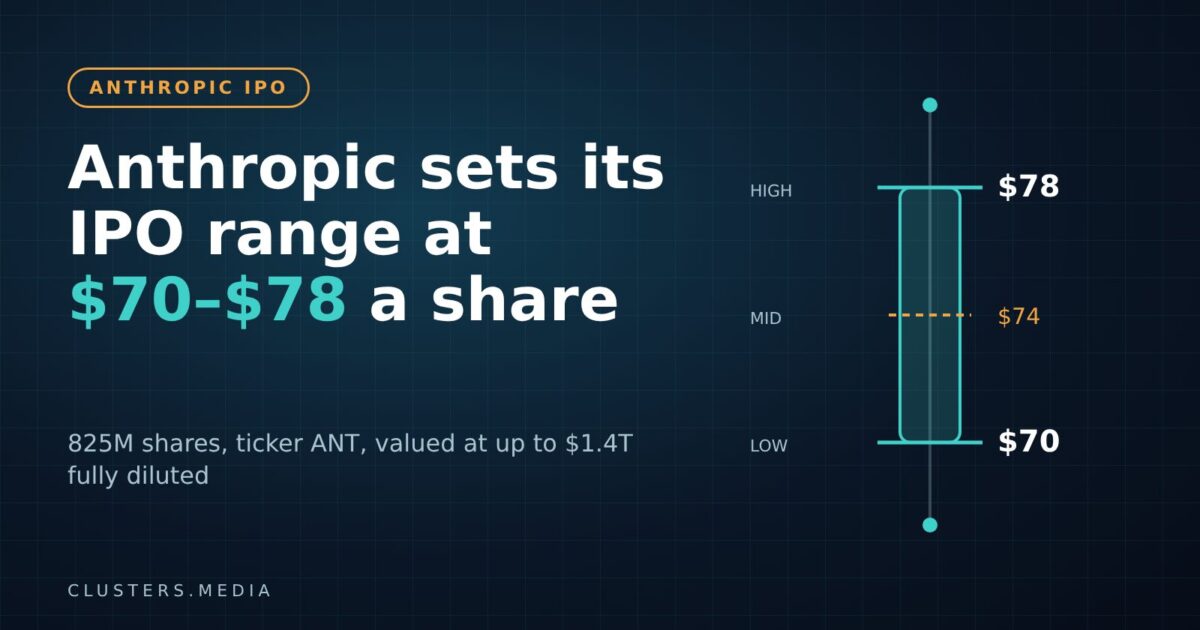
Anthropic has put a price on its long-awaited stock market debut. In an amended S-1 filed with the SEC on November 10, the Claude maker set an IPO price range of $70 to $78 per share for 825 million Class A shares, to be listed on the Nasdaq under the ticker “ANT”. The same day, it launched the investor roadshow that comes right before a listing.
At the top of the range, the offering would raise about $64.35 billion and value the company at roughly $1.4 trillion on a fully diluted basis, according to TechCrunch and Fortune. That is a big step up from its last private round, but well below the $2 trillion figure that was floating around only weeks ago.
Key takeaways
- Price range: $70–$78 per share for 825 million Class A shares, ticker ANT on Nasdaq.
- Money raised: about $57.75 billion to $64.35 billion from the public offering alone.
- Strategic buyers: seven partners, including Google and Nvidia, agreed to buy $26 billion of non-voting stock at the IPO price.
- Valuation: up to about $1.4 trillion fully diluted; closer to $1 trillion on a basic share count.
- Timing: trading is reported to start around November 19, though the company has not confirmed a date.
What happened
Anthropic made its prospectus public in late October after filing confidentially in June. Tuesday’s update filled in the missing pieces that investors need before they place orders: how many shares are for sale and at what price.
The company is offering 825 million Class A shares. Multiply that by the range and you get gross proceeds of roughly $57.75 billion at $70 and $64.35 billion at $78. CNBC reported, citing people familiar with the deal, that the order book was already covered across the range and that shares could begin trading on November 19. Gizmodo, citing The Wall Street Journal, put the start at November 19 or 20. Until the deal is priced, treat those dates as expected rather than final.
Alongside the public sale, Anthropic agreed to sell $26 billion of non-voting Class N stock privately at the IPO price to seven strategic partners: AMD, Broadcom, Google, Micron, Microsoft, Nvidia and TSMC. TechCrunch reports that Google and Nvidia are putting in $10 billion each. Goldman Sachs and Morgan Stanley are among the banks underwriting the offering.
Why the valuation numbers don’t match
If you have seen headlines quoting anything from about $1 trillion to $1.4 trillion, you are not imagining it. The gap comes down to which shares get counted.
A fully diluted valuation counts every share that could exist, including employee options and other equity that has not yet been converted. On that basis, the top of the range works out to roughly $1.4 trillion, the figure used by TechCrunch, Fortune and The New York Times. A basic count only includes shares expected to be outstanding after the deal. Reuters used that method and arrived at about $1.02 trillion at $78.
Either way, the number is higher than the $965 billion Anthropic was valued at in its $65 billion private round in May. But it is clearly below the $2 trillion that some reports had floated, and it lands in a nervous market. Fortune framed the launch against a broader sell-off in AI stocks, and CNBC had reported days earlier that $1 trillion to $1.25 trillion looked like a more likely outcome.
Why it matters
This would be one of the largest IPOs ever, arriving about five months after SpaceX’s record listing in June. It is also the first time public-market investors get to buy directly into a frontier AI lab, which makes it a live test of how much Wall Street is willing to pay for AI growth that comes with enormous costs.
Those costs are the heart of the story. Anthropic’s filings show revenue climbing fast, with third-quarter revenue of about $17 billion, but they also show losses and long-term compute and infrastructure commitments that run into the hundreds of billions of dollars. The IPO cash is largely about paying for that capacity: chips, data centres and the power to run them.
The $26 billion private placement tells a similar story from the other side. Most of the seven buyers are companies that sell Anthropic the hardware and cloud capacity it runs on. Their investment ties the lab’s supply chain even more closely to its balance sheet.
There is also a governance angle. Anthropic is a public benefit corporation, and according to TechCrunch’s reading of the filing, a founder-held Class F share carries 50.1% of the voting power while the company’s Long-Term Benefit Trust elects a board majority. In plain terms, people buying ANT shares will own a slice of the economics but will have little say over how the company is run.
What it means for developers and businesses
For most teams building on Claude, nothing changes on day one. The API, pricing and models stay as they are. But a listing does shift a few things worth keeping in mind.
- More capacity, sooner. Tens of billions of dollars in fresh capital is mostly earmarked for compute. If it lands, that should ease the rate limits and capacity crunches that have hit heavy API users in the past.
- More visibility. As a public company, Anthropic will publish quarterly results and disclose material risks. That gives enterprise buyers far better insight into the health of a vendor they may depend on.
- More pressure on margins. Public investors watch profitability closely. Over time that can influence pricing, product bundling and which features get priority. Recent moves such as the 20% price cut on Claude Fable 5.2 show the company still competing hard on price, but that balance will now be judged every quarter.
- More scrutiny of incidents. Security and reliability issues, like the recent enterprise data notice, carry extra weight for a listed company and may lead to faster, more formal disclosure.
If your product relies heavily on a single model provider, this is a good moment to review your setup. Keep an abstraction layer between your app and any one API, track your usage costs closely, and make sure you could switch or mix providers if pricing or terms change.
What to watch next
- Final pricing. Whether the shares price at the top, middle or bottom of the range, or outside it, will be the clearest read on investor demand.
- The first trading day. Reported for around November 19. A strong debut could reopen the window for other AI listings; a weak one would hit late-stage AI valuations across the board.
- OpenAI’s response. Anthropic’s biggest rival has not announced a listing of its own, and a public price for Anthropic gives the market a fresh benchmark to compare against.
- The first earnings report. Investors will want proof that revenue growth can keep pace with the cost of compute.
The filing is preliminary, and the final price, size and date can still change. We will update this story when Anthropic prices the offering.