AI Agents Series · Part 3 of 3 · Business Strategy · April 2026
Sam Altman has a bet in a group chat with fellow tech CEOs. The bet is on the first year a one-person company reaches a billion dollars in revenue — powered entirely by AI agents. Dario Amodei, CEO of Anthropic, was asked directly when the first billion-dollar company run by a single human would appear. He said “2026” with 70–80% confidence. So: is it actually happening?
The honest answer is yes — at the $1 million level. The billion-dollar version is still ahead of us, probably. But the trajectory is real, the early examples are emerging, and the business model being pioneered right now will define a new category of company that did not exist three years ago.
Why the Idea Is No Longer Ridiculous
The concept of a tiny team running a large business with AI agents was science fiction in 2022. In 2026 it is engineering — a question of which workflows can be reliably automated, not whether automation is possible in principle.
What changed? Four capabilities matured simultaneously:
The Four Capabilities That Make It Possible
- Reliable multi-step reasoning: LLMs can now break complex goals into sub-tasks, execute them sequentially, and recover from failures — the core requirement for autonomous business operations.
- Tool use and API integration: Agents can now connect to CRM systems, payment processors, email platforms, ad networks, databases, and virtually any business software with an API — which is most software built since 2015.
- Long-context memory: Modern agents can maintain business context across thousands of interactions — customer histories, vendor relationships, internal policies — without losing the thread.
- Compound agent frameworks: Multi-agent systems where specialised agents collaborate — one gathering market data, another modelling it, a third compiling a report — can now coordinate at a level that handles genuinely complex business workflows.
The result: what previously took 50 to 200 employees can now be executed by one visionary founder and a suite of AI agents. Instagram was valued at $1 billion in 2012 with 13 people. The question for 2026 is whether that team size can shrink to one — or near one.
Where It Is Already Happening — The $1M Threshold
The billion-dollar version may be aspirational. The $1 million version is already a reality in multiple business models. The patterns are becoming clear.
Proprietary Trading and Finance
Amodei specifically cited proprietary trading as one of the first business types where a single human plus AI agents could reach enormous revenue. The logic is sound: trading is high-frequency, data-driven, rule-amenable, and scalable without proportional headcount. AI agents that monitor markets, execute strategies, manage risk, and report performance can operate continuously at a scale no human team could match. The “quant fund of one” is not a future concept — it is already being tested.
Developer Tools and SaaS
A developer builds a specialised tool that solves a specific problem. AI agents handle customer onboarding, technical support, billing management, marketing content, SEO optimisation, and performance monitoring. The developer focuses on product decisions and engineering direction. This model has already produced multiple solo founders crossing $1 million ARR in 2025–2026. The pattern: narrow enough use case to avoid needing human expertise at every tier, broad enough to serve a market willing to pay.
Content and Media Operations
AI agents handle research, drafting, editing, SEO optimisation, social distribution, email sequencing, and advertiser relationship management. A solo operator runs what would previously have required a ten-person editorial team. The human provides editorial judgement, relationship management for high-value partnerships, and creative direction. Revenue from advertising, sponsorships, and subscriptions. Several creators crossed $1M in 2025 using this model — Clusters Media is building in exactly this direction.
Autonomous Sales Pipelines
Companies like Adcore are already live with fully autonomous lead-to-revenue pipelines — agents that capture leads, qualify them, send proposals, manage follow-up, execute contracts, and collect payment without human intervention at any stage. The Inbound Agent is live. The Outreach and Deal agents arrive by Q2 2026. This is not a demo. It is a production system with real customers and real revenue.
What a One-Person AI Business Actually Looks Like in 2026
The architecture of a functioning minimal-human AI business in 2026 follows a recognisable pattern:
The One-Person AI Business Stack
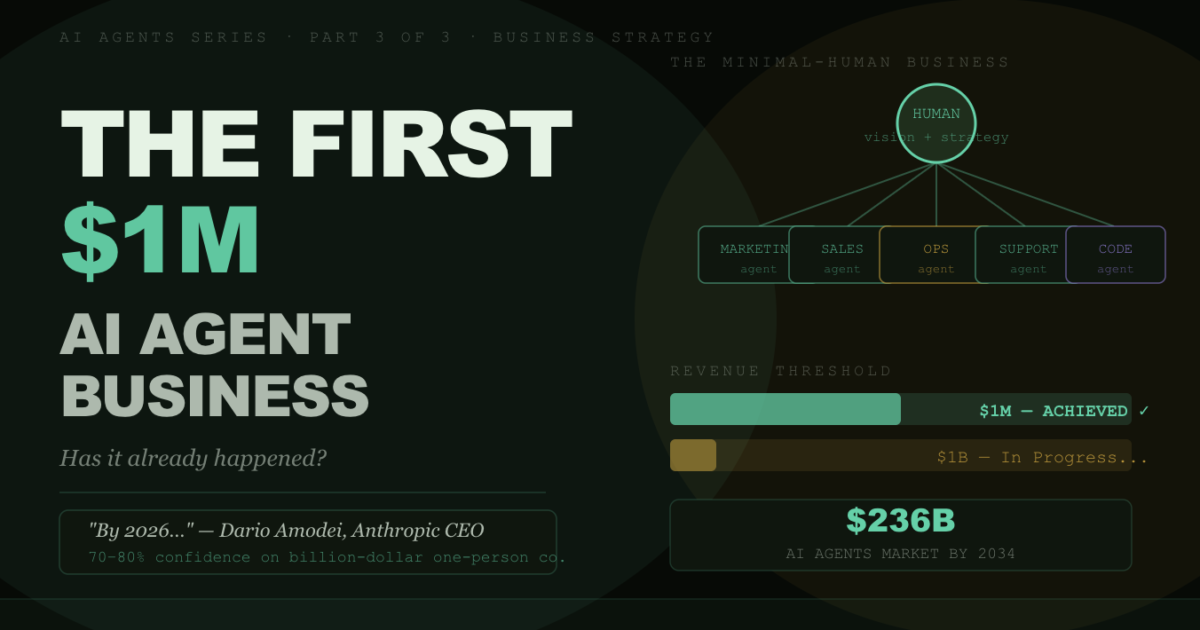
- The human role: Strategic direction, relationship management for high-value accounts, creative decisions that require genuine taste and judgement, exception handling for situations outside the agent framework, and the brand identity that differentiates the business.
- Marketing agents: Content creation and SEO, social media distribution, email sequence management, ad campaign optimisation, competitive monitoring.
- Sales agents: Lead qualification, personalised outreach, CRM updates, proposal generation, follow-up sequencing, pipeline reporting.
- Operations agents: Invoice processing, supplier communication, compliance monitoring, inventory management, financial reporting.
- Customer success agents: Onboarding, support triage, renewal management, feedback collection and routing.
- Development agents: Code review, testing, documentation, bug triage — Claude Code and its equivalents are already doing this in production.
The key structural insight: the human is the Chief Visionary Officer and exception handler, not the executor. Every routine task that can be defined clearly enough to be systematised is handed to an agent. The human’s time is reserved exclusively for things that require genuine human judgement — relationship trust, creative vision, ethical oversight, and high-stakes decisions.
The Honest Limitations — Why the Billion-Dollar Version Is Still Ahead
Scaling from $1M to $1B with one human is where the current technology runs into genuine limits. The challenges are not theoretical — they are practical and currently unsolved.
Why the Billion-Dollar Version Is Still Hard
- Reliability at edge cases: AI agents still fail on novel situations outside their training distribution. At $1M revenue, a few failures per month is manageable. At $1B, compounding failures at scale become existential.
- Regulatory and accountability requirements: Most billion-dollar businesses operate in regulated environments. Regulated industries require human accountability structures — you cannot contractually delegate liability to an agent.
- High-stakes negotiation and trust: Enterprise sales, strategic partnerships, investor relations, board governance — these require human credibility that cannot be delegated to an agent in 2026.
- Governance at scale: Multi-agent systems that work reliably at small scale become fragile as complexity grows. The governance frameworks to run hundreds of agents securely at enterprise scale do not yet exist in mature form.
- Legal entity and liability: When an AI-driven business makes a mistake, who is legally responsible? The regulatory frameworks for this are still being written.
The Right Frame: This Is a New Business Category
The most useful way to think about this is not “can AI agents replace all the humans in a business?” The more useful question is: “what does the optimal business design look like when AI agents can do most execution reliably?”
The answer is a new organisational form that does not map cleanly onto previous categories. It is not a startup (too few humans). It is not a SaaS company (revenue does not depend on software subscriptions). It is not a services firm (delivery does not depend on human labour). It is something new — a business where competitive advantage derives from the quality of the agent infrastructure, the proprietary data that trains and improves it, and the human judgement applied at the strategic layer.
The companies pioneering this form right now — even at the $1M level — are building the template for a business category that will be enormous by the end of the decade.
How to Start Building Toward It
You do not need to be building a $1B one-person company to benefit from this model. The principles apply at every scale.
Audit for agent-amenable workflows. Map every repetitive process in your business that has clear inputs, defined rules, and measurable outputs. These are your first deployment candidates. Finance reconciliation. Support triage. Content distribution. Lead follow-up. The goal is to progressively free your highest-judgement humans from execution tasks.
Build proprietary data advantages. AI agents trained on your proprietary customer data, interaction history, and domain knowledge are more valuable than generic agents. Every customer interaction should make your system smarter in ways competitors cannot replicate from outside.
Use open-source models where you can. API dependency on frontier model providers creates cost and strategic risk. Llama, DeepSeek, and Qwen as bases for specialised agents reduce costs and improve margins while maintaining capability.
Design for human oversight at the right altitude. The human role in a well-designed agent business is not eliminated — it is elevated. Invest in making your own strategic thinking, creative vision, and relationship trust the irreplaceable core of the business. Everything else should progressively become agent-operated.
The Verdict — Is It Happening?
Yes, at $1 million. The examples are real, the business models are working, and the number of operators crossing this threshold with minimal human teams is growing every month in 2026.
At $1 billion with a single human, we are not there yet. The technology, the governance frameworks, and the regulatory clarity are not ready for reliable operation at that scale with one person in the loop. But the trajectory is real. Dario Amodei’s 70–80% confidence for 2026 may have been slightly optimistic on timing, but the direction is unambiguous.
The first $1 million AI agent business has already happened. The first $1 billion is a matter of when, not if. The more interesting question for most businesses is not when someone else achieves it — but how much of your own execution can be systematised while preserving the human judgement that actually makes you different.
FAQ
Is there already a $1 million business run by AI agents?
Yes, at the $1 million ARR level, multiple examples exist. Solo founders in developer tools, content operations, and automated sales have crossed this threshold with minimal human teams using AI agent infrastructure. The billion-dollar version with a single human operator has not yet been publicly documented, though Dario Amodei predicted 2026 as the year for the billion-dollar version with 70–80% confidence.
What types of businesses are best suited to the AI agent model?
Businesses with high transaction volume, structured data, and rule-amenable workflows are best suited: proprietary trading, developer tools, content and media, automated sales pipelines, and compliance services. The common thread is workflows where most execution can be defined clearly enough to be systematised, leaving a human to handle strategic direction and exception cases.
Why hasn’t a billion-dollar one-person company happened yet?
Four challenges at billion-dollar scale: agent reliability at edge cases (failures that are manageable at $1M become existential at $1B), regulatory accountability requirements in most large markets, the irreducibility of human trust in enterprise sales and investor relations, and immature governance frameworks for running hundreds of agents securely at enterprise scale.
What is the human’s role in a minimal-team AI agent business?
The human functions as Chief Visionary Officer and exception handler — providing strategic direction, handling high-value relationships, making creative decisions requiring genuine taste, and managing situations outside the agent framework. All routine execution that can be systematised is delegated to agents. The human’s time is reserved exclusively for irreplaceable human judgement.
How do you start building an AI agent business today?
Four steps: audit your workflows for agent-amenable processes (clear inputs, defined rules, measurable outputs); build proprietary data advantages that make your agents more valuable than generic ones; use open-source models where possible to reduce API costs and dependencies; and design explicitly for human oversight at the strategic layer while systematising execution progressively.
Sources: Solo Founders (orbilontech.com), Rorycallaghan.com, Adcore Press Release (April 15, 2026), Deloitte State of AI, Raconteur, Presta AI, McKinsey, Gartner, NVIDIA GTC 2026 · April 2026 · clusters.media · Part 3 of the Clusters Media AI Agents Series