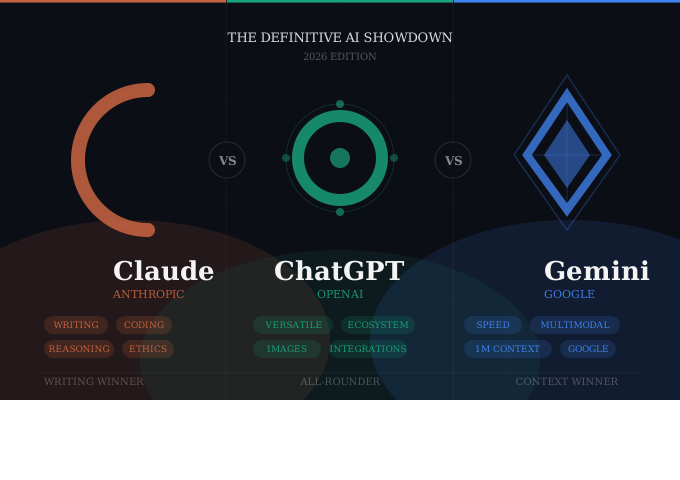
The Definitive AI Showdown of 2026
We tested all three across writing, coding, research, and business tasks. Here’s the honest, no-hype verdict on which AI actually wins — and when.
The AI arms race of 2026 has produced three giants that are genuinely excellent — and genuinely different. Picking the wrong one for your workflow is a real cost.
Two years ago, “ChatGPT” was practically synonymous with AI. Today, that monoculture is over. Claude, ChatGPT, and Gemini have each matured into distinct platforms with real strengths and real blind spots — and the gap between choosing the right one versus the wrong one for your specific work has never been wider.
This isn’t a benchmark-number comparison. Benchmarks matter, but they don’t tell you which AI writes better emails, catches more bugs in your code, or handles a 150-page contract without losing the thread. This is a real-world test across the dimensions that professionals, students, and businesses actually care about in 2026.
01 — OverviewWho Is Each AI Built For?
Before diving into the tests, it helps to understand each platform’s identity — because each one has a genuinely different design philosophy.
- Writers, editors, and researchers
- Teams doing long-form document work
- Developers needing reliable code reasoning
- Anyone who values nuance over speed
- Enterprise users with large document workflows
- General productivity and mixed workflows
- Developers who need broad language support
- Users who need tools, plugins, and integrations
- Teams already in the OpenAI / Microsoft ecosystem
- Creative tasks that need image generation too
- Google Workspace users (Docs, Gmail, Drive)
- Teams processing very large files or codebases
- Multimodal workflows (text, image, audio, video)
- Users who need fast responses and a free tier
- Android and Google Cloud developers
02 — WritingWriting Quality: Who Crafts the Best Prose?
This is the category where the differences are most viscerally felt. We tested blog posts, LinkedIn content, email copy, and creative writing across all three. The results were consistent.
Claude: The Craft Writer
Claude consistently produced the most polished, nuanced prose. In blind user tests conducted earlier this year with 134 participants, Claude won 4 out of 8 rounds — often by margins of 35 to 54 points. It excels at following tone instructions, preserving the author’s voice during editing, and producing writing that feels genuinely human rather than formulaic. For LinkedIn content, Claude was rated best for prioritizing user benefits and maintaining concise messaging. For long documents, it sustains consistency across tone and argument in a way competitors struggle with.
ChatGPT: Technically Accurate, Occasionally Flat
ChatGPT produces correct, well-structured content — but it can drift toward the generic. In blog writing tests, it excelled at creating relatable customer stories and practical examples, making it valuable for content marketers who need authenticity. However, for creative nuance or preserving a personal writing style, it trails Claude noticeably. Instruction-following on long, multi-part prompts is also inconsistent — a meaningful issue for precision work.
Gemini: Wordy but Improving
Gemini has made substantial strides. It’s strong at highlighting customer pain points and identifying key themes in documents. However, its writing outputs have been criticized for wordiness and overuse of bullet points — outputting “excessive structure” when flowing prose would serve better. It’s a capable writer, but not a refined one — yet.
In a blind test of 134 participants, Claude won 4 out of 8 rounds. ChatGPT won just 1. “No labels. No hints. Just the writing.” — The margins weren’t close.
— Blind Test Study, February 2026Writing winner: Claude. It’s not a contest for sustained, high-quality prose.
03 — CodingCoding & Technical Tasks: Who Writes Better Code?
All three are capable coding assistants in 2026. But they occupy clearly different niches.
Claude Opus 4.6 scored 65.4% on the Terminal-Bench coding evaluation, outperforming Gemini 3 Pro and ranking top in several enterprise benchmarks including legal and financial coding tasks. In practical tests, Claude produced cleaner, more type-safe code — particularly in TypeScript — while ChatGPT was faster to produce a “good enough” working solution. Gemini’s massive 1 million token context makes it uniquely suited to reviewing entire repositories or large codebases in one pass.
Coding winner: Claude for quality and reasoning. ChatGPT for breadth and speed. Gemini for large codebase context.
04 — ContextContext Window & Document Processing
The context window — how much text an AI can “see” and reason over at once — is one of the most practically important specs for professional users.
- Claude Enterprise: 500,000 tokens standard (equivalent to hundreds of thousands of words, or dozens of 100-page documents). Opus 4.6 in beta research mode reaches 1 million tokens.
- ChatGPT Enterprise: Approximately 128,000–250,000 tokens — significantly less than Claude Enterprise. GPT-4o is capped at 128K.
- Gemini 3: 1 million tokens in the consumer product — the largest context window available to general users. Best for processing enormous files, entire codebases, or long audio/video transcripts.
For most users, context window differences won’t matter in daily tasks. But for professionals processing contracts, research papers, full codebases, or lengthy meeting transcripts, this spec becomes the deciding factor. Claude’s 500K window and Gemini’s 1M window both dramatically outclass what was available even 18 months ago.
Context winner: Gemini (1M tokens for consumers). Claude (500K enterprise, with strong actual utilization). ChatGPT trails.
05 — ResearchResearch, Analysis & Reasoning
AI assistants are increasingly used as research and analysis partners — not just text generators. This is where reasoning quality, intellectual depth, and honesty about uncertainty matter most.
Claude: Deep Thinker, Careful Reasoner
Claude’s hybrid extended thinking mode — introduced in Claude 4 — allows it to switch between fast responses and deep multi-step reasoning. For legal and financial analysis, it consistently outperforms competitors in enterprise benchmarks. It is also notably honest about the limits of its knowledge — a quality that matters enormously when the stakes are high. Claude’s ethical guardrails are more extensive than either competitor, which can be a feature or a friction point depending on the task.
ChatGPT: Broad and Practical
ChatGPT’s deep research mode (available on paid plans) produces structured, multi-source reports and can take 5–30 minutes to compile. For competitive intelligence, trend analysis, and market research, it is a capable tool. Its Atlas browser sidebar also enables it to interact with paywalled content — a genuine productivity advantage for researchers.
Gemini: Google-Native Intelligence
Gemini’s tight integration with Google Search gives it a native advantage for real-time research. For users in the Google ecosystem, the “copy and paste tax” — the time lost moving documents between apps and an AI — is dramatically reduced. Gemini can sit directly inside Google Docs, Gmail, and Drive, analyzing content where it lives.
Research winner: Claude for depth and precision. Gemini for Google-native research flows. ChatGPT for broad multi-source structured reports.
06 — MultimodalMultimodal & Agentic Capabilities
All three platforms now offer agentic modes — the ability to control a browser, take actions, fill forms, and complete multi-step tasks autonomously. But the implementations differ meaningfully.
- Browser agent via Claude in Chrome extension
- Claude Cowork: controls desktop folders (unique)
- Strong image understanding and analysis
- Claude Code: top-rated CLI coding agent
- No native image generation (yet)
- Native image generation (DALL·E / GPT-4o)
- Code Interpreter: runs Python in-session
- Atlas browser sidebar with paywall access
- Agent mode for browser actions
- Widest third-party plugin ecosystem
- Best image generation (Nano Banana model)
- Native audio and video analysis
- Deep Google Workspace integration
- Agent mode (Google AI Ultra tier)
- Google Cloud and Firebase development
Gemini leads on raw multimodal capability — it handles text, image, audio, and video natively, making it the strongest platform for media-heavy workflows. ChatGPT’s image generation is a close second. Claude’s unique advantage is its Cowork tool, which is the only AI assistant capable of performing actions on your computer’s local file system — a meaningful capability for desktop power users.
07 — PricingPricing & Plans: What Do You Actually Pay?
At the consumer level, all three platforms have converged on similar pricing — roughly $20/month for the pro tier. The differences emerge at the team and enterprise level.
| Plan | Claude | ChatGPT | Gemini |
|---|---|---|---|
| Free | Limited (Sonnet model) | Limited (GPT-4o mini) | Yes (capable free tier) |
| Pro / Plus | $20 / month | $20 / month | $19.99 / month |
| Team | $30 / user / mo | $30 / user / mo | Workspace add-on |
| Enterprise | Custom (500K context) | Custom (128K–250K) | Custom (Google Cloud) |
| API Value | Sonnet 4.6 = ~98% of Opus quality at lower cost | GPT-4o mini for budget use | Gemini 3.1 Pro = cheapest API output |
For developers building on top of these APIs, Gemini 3.1 Pro currently offers the most competitive output pricing. Claude Sonnet 4.6 is widely cited as delivering approximately 98% of Opus-level quality at a significantly lower cost — making it the best value API choice for enterprise-grade quality. For budget-conscious API users, Gemini wins on raw price.
08 — ChoosingWhich AI Should You Choose in 2026?
The honest answer is: it depends on what you’re building, writing, or solving. Here’s a practical decision guide.
- Your work is writing-intensive: long-form content, editing, drafting, or documents that need multiple refinement passes
- You need the highest quality code reasoning, debugging, or TypeScript work
- You process large documents — contracts, research papers, full reports — and need consistent analysis across hundreds of pages
- You want the most powerful CLI coding agent (Claude Code)
- You care about nuanced instruction-following and ethical guardrails
- You need a single all-purpose AI that handles writing, coding, image generation, and data analysis in one session
- You work across many programming languages and need broad framework knowledge
- You want to run code (Python) directly inside the AI interface
- You’re embedded in the Microsoft / Azure ecosystem
- You need the widest range of third-party integrations and plugins
- You live in Google Workspace — Docs, Gmail, Drive, Sheets — and want AI that works where your content already lives
- You need to process enormous codebases, datasets, or files (1M token context)
- Your work involves audio, video, or rich image generation
- Speed is a priority — Gemini Flash is noticeably faster than competitors
- You want the best free tier of the three
For most teams in 2026, the optimal approach isn’t to pick just one. Many organizations use Claude for deep work, ChatGPT for general workflows, and Gemini for Google-ecosystem tasks. The AI platforms themselves have become less like single tools and more like specialized departments.
09 — VerdictThe Final Verdict
After extensive real-world testing, the 2026 AI landscape is defined by specialization. Each model has earned its place — and its strengths are real.
10 — FAQFrequently Asked Questions
For writing quality, long-document processing, and complex reasoning, Claude is widely regarded as the stronger performer in 2026. However, ChatGPT remains the better all-rounder with a broader ecosystem, image generation, and code execution features Claude lacks natively.
Gemini 3 offers 1 million tokens to consumer users — the largest of the three. Claude Enterprise provides 500,000 tokens standard, with Opus 4.6 reaching 1 million tokens in research beta. ChatGPT Enterprise sits around 128,000–250,000 tokens.
Gemini offers the strongest free tier of the three, with access to capable models and Google Workspace integration. Claude and ChatGPT both offer free tiers with usage caps and access to smaller models.
Claude leads for complex reasoning, debugging, and TypeScript quality. ChatGPT is best for breadth across languages and quick practical solutions — and is the only one that can run code directly in-session. Gemini’s 1M token context makes it best for reviewing large codebases.
All three converge at approximately $20/month for the pro consumer tier. Team plans are around $25–$30 per user per month. Enterprise plans are custom-priced. For API use, Gemini 3.1 Pro offers the lowest output costs, while Claude Sonnet 4.6 delivers the best quality-to-price ratio.
Yes — and for teams, this is increasingly the optimal strategy. Many professionals use Claude for writing and document-heavy tasks, ChatGPT for general workflows and integrations, and Gemini for Google Workspace tasks. Third-party platforms allow access to all three from a single interface.