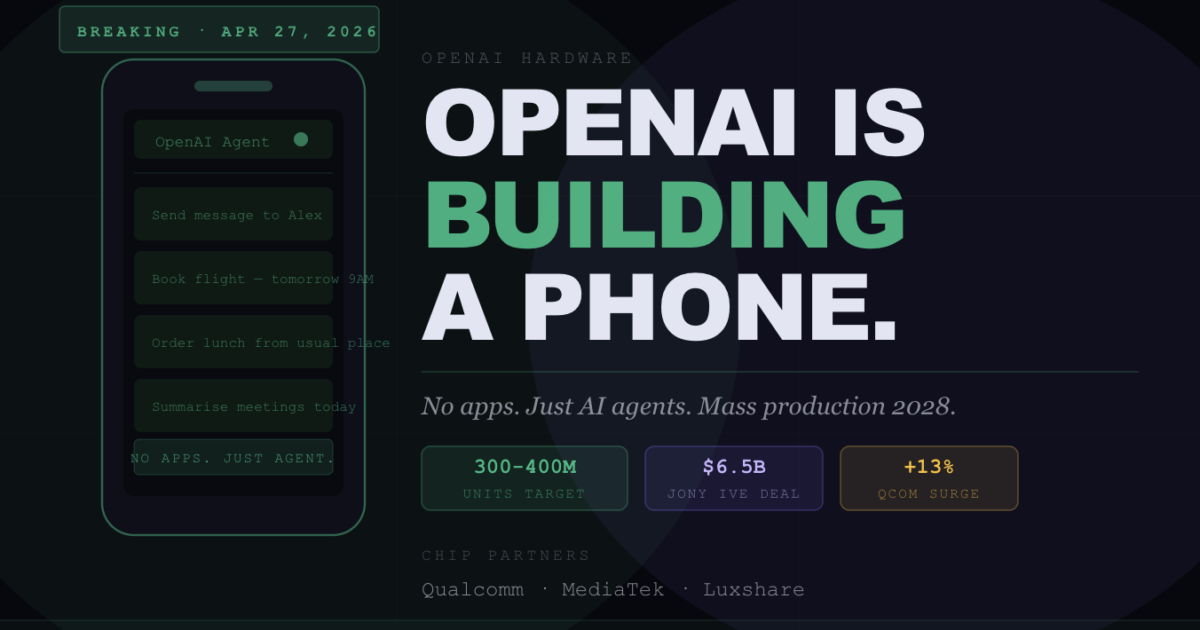
Breaking · Hardware · OpenAI · April 2026
On April 27, 2026, analyst Ming-Chi Kuo dropped a report that sent Qualcomm’s stock surging 13% in a single session. OpenAI is building a smartphone. Not a ChatGPT feature. Not an AI-enhanced iPhone. A ground-up, app-free, agent-first device designed to replace the operating system paradigm that has governed mobile computing since 2007. The smartphone industry has not seen a challenge like this since Android.
This is not an announcement. OpenAI, Qualcomm, MediaTek, and Luxshare have all declined to comment. But Kuo — whose supply chain intelligence has made him the most closely followed hardware analyst in the industry — has identified the chip partners, the manufacturer, the production timeline, and the core architecture. The market reacted immediately. Here is everything we know.
What OpenAI Is Actually Building
The device is not a smartphone with a chatbot icon in the corner. The concept, as described by Kuo, is something far more radical: a phone where the AI agent is the operating system. No app drawer. No home screen grid. Instead, a unified AI layer that handles everything — scheduling, messaging, browsing, shopping, navigation, productivity — through a single agent that understands your context, your history, and your intent.
“Users are not trying to use a pile of apps. They are trying to get tasks done and fulfill needs through the phone. This fundamentally changes how people think about smartphones.”
— Ming-Chi Kuo, TF International Securities · April 27, 2026The architecture to support this is a hybrid model: lighter tasks — context awareness, memory management, smaller inference — run on-device using the custom chip. Complex reasoning offloads to OpenAI’s cloud. The device would maintain what Kuo calls “full real-time state” — continuously capturing location, activity, communication, and environmental context to feed the agents.
This is a fundamentally different approach from what Apple, Google, and Samsung have built with AI integration. Those companies bolted AI features onto existing app-based operating systems. OpenAI is proposing to eliminate the app layer entirely.
The Hardware Partners
The Supply Chain — What We Know
- Qualcomm: Custom processor development partner. Shares surged 13% on the news. The company’s Snapdragon architecture underpins most premium Android devices — OpenAI would be getting both expertise and a direct challenge to Apple Silicon’s dominance in custom mobile chips.
- MediaTek: Co-developer on the custom chip alongside Qualcomm. MediaTek has been gaining ground in premium Android segments and brings manufacturing efficiency advantages.
- Luxshare Precision Industry: Exclusive system co-design and manufacturing partner. The same company that co-manufactures iPhone with Foxconn — Apple itself trained Luxshare to compete with Foxconn. OpenAI is deploying the same supply chain strategy Apple used.
- Timeline: Specifications and suppliers finalised by late 2026 or early Q1 2027. Mass production targeted for 2028.
The Qualcomm relationship is particularly notable — and awkward. Qualcomm would be helping build a device designed to challenge the iPhone while continuing to supply Apple with modem chips through at least 2027 — a business relationship that embodies the contradictions of the semiconductor supply chain. Welcome to the AI hardware era.
The Jony Ive Project — And Why There Are Two Devices
The smartphone is actually OpenAI’s second hardware track — and the one that Kuo’s report caught the industry off-guard on. The first, and better-known, track is the Jony Ive project.
OpenAI acquired Apple’s design chief Jony Ive’s startup io for $6.4 billion in equity to design new AI devices. Altman said the devices will be different from smartphones — an addition to phones and laptops rather than a substitute for either. The io product roadmap reportedly includes a smart speaker with a camera as the first release, followed by glasses, a lamp, and earbuds. OpenAI’s “Sweetpea” earbuds are reportedly scheduled for September 2026 — the first physical consumer product OpenAI will ever ship.
The smartphone — Kuo’s revelation — is separate, larger in ambition, and targeting mass market scale that the io devices do not. At 300 to 400 million annual units, the planned shipment target would place OpenAI in direct competition with Apple’s iPhone volumes. Reaching that scale would require not just competitive hardware but a global distribution network, carrier partnerships, and manufacturing capacity that OpenAI has not operated.
The Numbers Are Extraordinary — and Unrealistic
Kuo’s projection of 300 to 400 million annual shipments demands context. Apple ships approximately 230 million iPhones per year. Samsung ships approximately 220 million Galaxy devices. A new entrant reaching those volumes has no precedent in the smartphone era.
These are not projections for Year 1, or Year 3. They are a vision of what success looks like — and they reflect OpenAI’s ambition, not a reasonable base case for a first-generation device. The realistic scenario for a 2028 launch is a premium device with early adopter appeal, sold initially through OpenAI’s existing consumer base of ChatGPT users, priced as a flagship, and requiring years to build the carrier relationships and distribution infrastructure that Apple and Samsung have spent decades constructing.
The Real Strategic Logic — Why OpenAI Needs Hardware
To understand why OpenAI is doing this, understand Qualcomm CEO Cristiano Amon’s thesis: AI agents will replace the mobile operating system and apps as the primary interaction layer, and the hardware must be designed from scratch to support continuous, power-efficient AI inference rather than retrofitting existing chipsets with neural processing units bolted on.
Kuo puts it even more directly: “Only by fully controlling both the operating system and hardware can OpenAI deliver a comprehensive AI agent service.”
This is the Apple Silicon argument applied to AI. When Apple designed its own chips, it was not just about performance benchmarks. It was about building hardware that could serve software goals that a generic chipset could never prioritise. Custom silicon enabled features — Neural Engine, unified memory architecture, on-device ML — that required hardware-software co-design to exist at all.
OpenAI’s logic is identical. The AI agent vision requires continuous, low-power, contextually aware inference running constantly in the background. A Snapdragon designed for general-purpose Android apps is not the right hardware for this. A chip designed specifically for continuous agent inference — from the memory architecture up — is.
And critically: no other device category matches the smartphone’s ability to capture what a user is doing in the moment, making it the most valuable source of data for real-time AI inference. The smartphone is where you live. It knows where you are, who you talk to, what you read, what you buy, what route you take to work. If you are building a truly contextual AI agent, the smartphone is the only device that can feed it.
The Risks Are As Large As the Ambition
The history of standalone AI hardware is not encouraging. The Humane Ai Pin failed. Rabbit R1 disappointed. Google Glass was discontinued. Each product discovered the same problem: AI capabilities alone are not sufficient to build a consumer product. Distribution, carrier relationships, after-sales service, app ecosystems, developer communities — these are the moats that took Apple and Google decades to construct.
The Execution Risks
- Hardware inexperience: OpenAI has never shipped consumer hardware at any scale. The gap between running a language model and manufacturing, distributing, and supporting 300 million phones per year is enormous.
- Carrier relationships: Apple and Samsung spend years building direct relationships with hundreds of mobile carriers worldwide. OpenAI has none. A device without carrier partnerships struggles to reach mainstream consumers.
- App ecosystem: The smartphone paradigm OpenAI wants to replace — apps — is also the reason people buy smartphones. Users have years of data, preferences, and workflows tied to existing apps. Getting them to abandon that for an agent layer requires the agent to be dramatically better, not marginally better.
- Competition is not standing still: Apple ships Apple Intelligence across its iPhone lineup. Google embeds Gemini into Pixel. Samsung bundles Galaxy AI. All three control their own silicon and ecosystems. They will not wait for 2028.
- Leadership instability: OpenAI’s recent leadership reshuffle in April 2026 saw Kevin Weil depart and Greg Brockman take interim oversight of products — adding execution risk to an already ambitious multi-year hardware programme.
The Verdict — Ambitious, Risky, and Potentially World-Changing
OpenAI building a smartphone is the most ambitious hardware bet since Amazon launched Alexa without a screen and Steve Jobs unveiled a phone without a keyboard. Both of those bets were widely dismissed at the time.
The strategic logic is airtight. The execution challenge is enormous. The timeline — 2028 for mass production — gives OpenAI two years to build manufacturing capacity, carrier relationships, and a device compelling enough to make hundreds of millions of people abandon the smartphone paradigm they have used for two decades.
Whether it succeeds or fails, the fact that OpenAI is attempting it changes the competitive landscape immediately. Apple, Google, and Samsung now know that the company reshaping enterprise AI is coming for the device category that generates their largest consumer revenues. That knowledge will accelerate their own AI hardware investments — which means the smartphone you buy in 2028, regardless of brand, will be fundamentally more AI-native than anything available today.
OpenAI building a phone may not kill the iPhone. But it will change what the iPhone becomes.
FAQ
Is OpenAI actually building a smartphone?
According to analyst Ming-Chi Kuo’s April 27, 2026 report, yes — OpenAI is co-developing a smartphone chip with Qualcomm and MediaTek, with Luxshare handling manufacturing. None of the companies have officially confirmed. Mass production is targeted for 2028, with specifications to be finalised by late 2026 or early 2027. This is separate from the Jony Ive io project, which targets a non-phone form factor.
What makes the OpenAI phone different from existing AI phones?
Existing AI phones add AI features to traditional app-based operating systems. The OpenAI device is reportedly designed to eliminate the app layer entirely — replacing it with an AI agent as the primary interface. No app drawer, no home screen grid. Instead, a single agent layer handles all tasks through context-aware AI inference, processing lighter tasks on-device and complex reasoning in the cloud.
What are the target shipment numbers?
Kuo projects 300 to 400 million annual shipments if the device succeeds — which would exceed Apple’s iPhone volumes of approximately 230 million per year. This represents OpenAI’s ambition ceiling, not a realistic base case for launch. No new smartphone platform has achieved that scale since Android.
What is the Jony Ive device — and how is it different?
OpenAI acquired designer Jony Ive’s startup io for $6.5 billion to develop AI hardware with a non-phone form factor. The io roadmap reportedly includes a smart speaker with camera, glasses, a lamp, and earbuds — the first being “Sweetpea” earbuds expected in September 2026. Sam Altman has described the io device as a complement to phones rather than a replacement.
Why does OpenAI need its own hardware?
The core argument is control. To deliver a comprehensive AI agent service — one that runs continuously, captures real-time context, and handles all device interactions — OpenAI needs hardware specifically designed for continuous AI inference. A generic chip designed for app-based computing is architecturally the wrong tool. Custom silicon, like Apple’s approach with Apple Intelligence, enables capabilities that cannot be achieved by bolting AI onto existing chipsets.
Sources: Ming-Chi Kuo / TF International Securities (April 27, 2026), CNBC, The Next Web, Decrypt, WinBuzzer, Capacity, IndexBox, Digitimes · May 2, 2026 · clusters.media