Artificial Intelligence · Deep Dive · AGI · May 2026
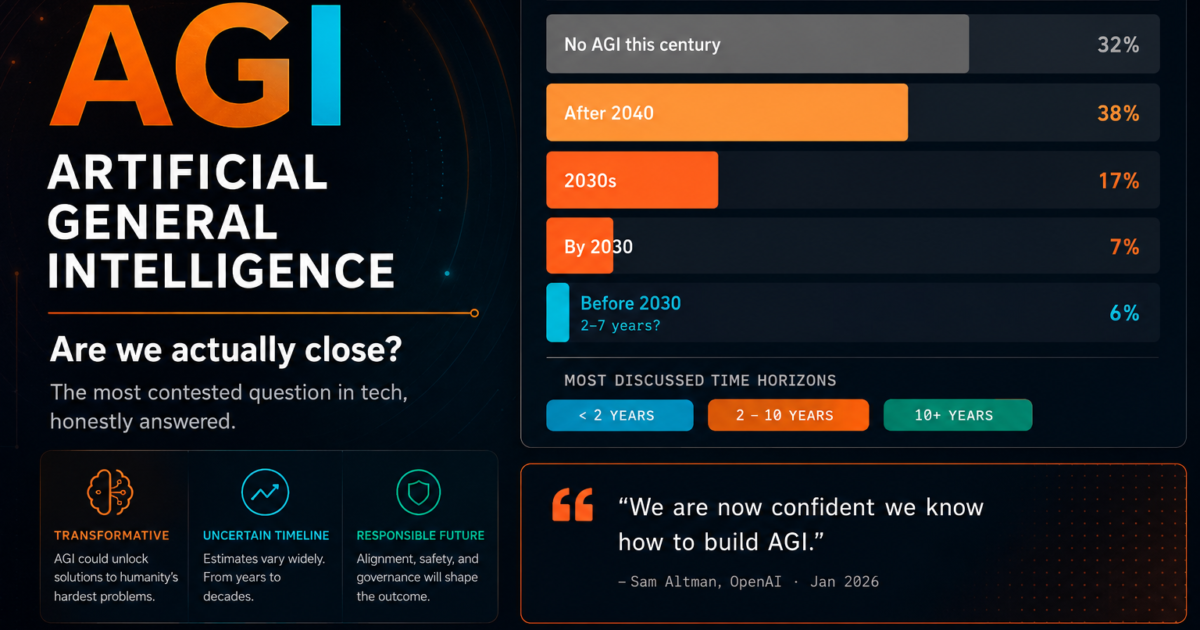
In December 2025, Sam Altman declared: “We built AGIs.” Dario Amodei says it could arrive by 2026–27. Demis Hassabis gives it 50% odds by 2030. The Metaculus forecasting community has watched the median AGI estimate collapse from 50 years away in 2020 to just 5 years. Something has clearly changed. But does anyone actually agree on what AGI is — and are the most optimistic predictions grounded in reality, or the most expensive hype in the history of technology?
This is the question sitting at the centre of every major AI investment decision, every policy debate, every career pivot, and every existential risk discussion happening right now. The answer is messier, more contested, and more genuinely uncertain than either the optimists or the skeptics want to admit.
What Is AGI — And Why Nobody Can Agree
Artificial General Intelligence is usually defined in contrast to what we have today: not a system that is world-class at one narrow task, but a system that can learn, adapt, and perform across a wide range of domains — something closer to the flexibility associated with human intelligence.
That sounds clear. It isn’t. The moment you try to make it precise, it fractures into at least four distinct definitions that different leading researchers are actually arguing about:
The 4 Competing Definitions of AGI in 2026
- The “Remote Worker” definition (Alexandr Wang, Scale AI): AGI is an AI system that can use a computer like a human — browsing the web, writing code, managing email, making decisions — and do so reliably enough to replace a white-collar knowledge worker. This definition may already be partially satisfied by Claude Code and similar tools.
- The “Any Cognitive Task” definition (Shane Legg, DeepMind): Minimal AGI is an artificial agent that can reliably perform the full range of cognitive tasks that an average human can do, without failing in ways that would surprise us if a person were given the same task. Legg gives this a 50% chance by 2028.
- The “Scientific Discovery” definition (Demis Hassabis, Google DeepMind): True AGI requires the ability to generate genuinely new scientific questions and theories — not just synthesise existing knowledge. This is the hardest bar. Hassabis gives it 50% odds by 2030, but emphasises that this creative reasoning remains deeply unresolved.
- The “Smarter Than Any Human” definition (Elon Musk, xAI): AGI means a system that surpasses the smartest humans across all domains. Musk predicted this by 2026, though his track record on AI timelines has been optimistic. This definition, if met, immediately leads to questions about what comes next.
These are not minor definitional quibbles. They describe fundamentally different capabilities — and the difference between the first and fourth definitions is the difference between “tools that make workers more productive” and “systems that permanently restructure civilisation.” The fact that leading researchers cannot agree on the definition makes every AGI prediction immediately ambiguous.
What the Forecasters Actually Say in 2026
Setting aside the definitional problem, the shift in forecasted timelines over the past five years is genuinely remarkable.
The AGI Timeline Collapse — How Fast Predictions Changed
- 2020: Metaculus median estimate — AGI is 50 years away
- 2023: Most AGI research community surveys place median at 2040–2050
- 2025 (January): Sam Altman shifts to “we are now confident we know how to build AGI”
- 2025 (January): Dario Amodei — “more confident than ever, within 2–3 years”
- 2025 (January): Demis Hassabis shifts from “10 years” to “three to five years”
- 2026 (February): Metaculus community — 25% chance of AGI by 2029, 50% by 2033
- 2026 (January): Shane Legg, DeepMind co-founder — 50% chance of minimal AGI by 2028
- 2026 (February): Mustafa Suleyman, Microsoft AI — “human-level performance” on most professional tasks within 12–18 months
In four years, the mean Metaculus estimate collapsed from 50 years to 5 years. That is not a small revision. That is a complete reversal of expert consensus — driven by genuine capability jumps, not just narrative shifting.
But it is also worth noting: the same Metaculus metric has recently moved slightly in the other direction, with both the 25% and 50% figures increasing by two years in 2026. The timeline is not uniformly accelerating. It oscillates as new evidence arrives.
What Sam Altman Actually Said — And What He Meant
In December 2025, Sam Altman made one of the most discussed statements in AI history: “We built AGIs.” He added that “AGI kinda went whooshing by” with less societal impact than expected.
This deserves careful interpretation. Altman was not claiming that OpenAI’s models are superintelligent, or that they can replace all human workers, or that the sci-fi version of AGI had arrived. He was making a narrower — but still significant — point: that OpenAI has built systems capable of performing across a wide range of cognitive tasks at professional level, and that the world has absorbed this without the dramatic rupture that AGI discussions had predicted.
“We are now confident we know how to build AGI. We are close to powerful AI capabilities… this will happen in the next 2–3 years.”
— Sam Altman, OpenAI · January 2026What Altman’s statement actually reflects is the definitional problem in sharp focus. If AGI means “a system that can do most professional cognitive tasks,” then arguably several current systems are already past that bar for many tasks. If AGI means “a system with general-purpose autonomous agency at human level across all domains,” we are clearly not there yet. If AGI means “a system that can generate Nobel Prize–worthy scientific insights independently,” we are likely years away at minimum.
What Has Actually Changed — The Real Capability Jumps
The shift in AGI timelines is not pure hype. Specific capabilities have genuinely moved in ways that no serious researcher predicted on the timelines they arrived.
Reasoning and Mathematics
Frontier models went from struggling with multi-step mathematical reasoning in 2022 to achieving expert-level performance on competition mathematics in 2025. On Humanity’s Last Exam — a benchmark explicitly designed to be hard — the best models jumped from 8.8% to over 50% in a single year. These are not incremental improvements. They represent qualitative capability jumps.
Code Generation and Autonomous Agency
Claude Code generating over $2.5 billion in annualised revenue, writing 4% of all public GitHub commits, and completing complex multi-file development tasks autonomously — this was not in any mainstream 2022 forecast for 2026. The “remote worker” definition of AGI is being partially satisfied in software development right now.
Scientific Discovery (Partial)
AI is contributing to drug discovery, protein folding, materials science, and clinical research at a pace that is meaningfully accelerating human scientific output. But contributing to existing research programmes is not the same as independently generating new scientific theories. The distinction matters enormously for the harder AGI definitions.
The Honest Case Against Short Timelines
The optimism is not unopposed. A substantial and serious cohort of researchers maintains that the most confident AGI predictions are overfit to recent progress in specific domains.
The Bear Case — Why AGI May Be Further Than It Looks
- The autonomy problem isn’t solved: Current AI systems fail unpredictably on novel situations outside their training distribution. Genuine general intelligence requires handling genuinely new problems — not just recombining training patterns at scale. This failure mode is qualitatively different from getting a benchmark wrong.
- Compute scaling is hitting real limits: The “scaling laws” that drove capability gains by adding more compute are showing diminishing returns. We don’t have enough chips in the world to scale reinforcement learning another thousandfold and get the same size capability leap we got the first time.
- Continuous learning remains unsolved: Current models don’t learn from experience between sessions the way humans do. A system that cannot improve from its own deployment is missing a core property of general intelligence.
- The benchmark saturation problem: Every time a benchmark gets saturated, we discover the model hasn’t actually learned the underlying capability — it has learned the benchmark. The history of AI is littered with moments where benchmark performance did not transfer to real-world generalisation.
- Sentiment swings don’t track reality: In mid-2025, AGI timelines blew out dramatically — then reversed just as quickly in early 2026. These oscillations suggest that expert predictions are being driven by narrative and sentiment as much as evidence.
The Predictions — Where Each Major Figure Stands in 2026
| Who | Prediction | Definition Used |
|---|---|---|
| Sam Altman (OpenAI) | “We built AGIs” — Dec 2025. Confident we know how to build more. | Broad cognitive task performance |
| Dario Amodei (Anthropic) | AGI by 2026–27. Most confident he’s ever been. | Human-level software automation |
| Demis Hassabis (Google DeepMind) | 50% chance by 2030. Cautious on scientific creativity. | Scientific discovery capability |
| Shane Legg (DeepMind co-founder) | 50% chance of minimal AGI by 2028. | Full range of average human cognitive tasks |
| Mustafa Suleyman (Microsoft AI) | Human-level professional performance within 12–18 months (from Feb 2026). | White-collar task automation |
| Elon Musk (xAI) | AGI by 2026. Smarter-than-human AI by 2030. | Surpasses smartest human |
| Eric Schmidt (ex-Google) | Within 3–5 years (from April 2025). | Reasoning + programming + maths |
| Metaculus community (2026) | 25% by 2029. 50% by 2033. | Four-condition test including robotics |
| Ege Erdil & Tamay Besiroglu | AGI is still 30 years away. | Full economic equivalence to humans |
What Happens After AGI — The Questions Nobody Has Answered
The AGI debate often treats arrival as an endpoint. It isn’t. The more serious discussion is about what follows — and this is where the stakes become genuinely civilisational.
The Intelligence Explosion Scenario
If an AGI system can perform AI research better than human researchers, it can accelerate the development of even more capable systems. This positive feedback loop — often called an “intelligence explosion” or “recursive self-improvement” — is the scenario that keeps many AI safety researchers awake at night. The Metaculus community gives roughly a 50% chance of an intelligence explosion once AGI is achieved. The timescale of such an explosion, if it occurred, is deeply uncertain — ranging from years to days.
The Labour Market Disruption
Musk’s prediction that “white-collar jobs will be the first to go” is not a fringe view. It is the mainstream position among short-timeline AGI believers. If systems capable of performing most professional cognitive tasks at human level become widely available, the economic disruption would be faster than any previous technological transition — because, unlike the Industrial Revolution, AGI affects knowledge work rather than physical labour, which is where the largest share of developed-world employment currently sits.
The Governance Problem
No government has a credible plan for governing an AGI system. The EU AI Act covers existing AI applications. The US executive orders address current AI deployment. Neither framework addresses what happens when a system is capable of performing every professional task better than the best human experts. The governance gap is arguably more concerning than the technology itself.
What This Actually Means for You — Right Now
You do not need to resolve the AGI debate to act on its implications. The useful frame is not “when does AGI arrive?” but “what capabilities are coming in the next 2–3 years regardless of whether we call them AGI?”
Those capabilities are clear: continued improvement in autonomous agent systems, deeper integration of AI into scientific research, more powerful code generation and software development automation, and gradual but accelerating encroachment on tasks previously assumed to be exclusively human.
Whether the systems delivering those capabilities cross an arbitrary definitional threshold called “AGI” is less important than whether your skills, your organisation’s workflows, and your sector’s business models are adapted to a world where AI can perform most cognitive tasks at professional level for a fraction of the cost.
The Verdict — Honest, Uncertain, Important
The honest summary of the AGI situation in May 2026: we are witnessing genuine, measurable capability jumps that have repeatedly exceeded the timelines of expert consensus. The people building these systems are more confident about what they know how to build than at any point in the history of AI. And there are serious, unresolved technical challenges that the most optimistic timelines do not adequately account for.
AGI may arrive in 2027 as Dario Amodei predicts, in 2033 as Metaculus forecasts, in 2030 as Demis Hassabis estimates, or in 2050 as the most cautious researchers suggest. Nobody knows. What is knowable is that the race is real, the progress is measurable, the stakes are enormous — and the gap between the most and least prepared organisations is already widening.
FAQ
What is AGI?
Artificial General Intelligence (AGI) refers to an AI system capable of performing any intellectual task that a human can do — not just narrow tasks it was specifically trained for. There is no consensus definition. Common versions range from “can do most professional cognitive tasks” (already partially achieved) to “can generate genuinely new scientific theories” (not yet achieved) to “surpasses the smartest humans across all domains” (significantly beyond current capabilities).
When will AGI arrive?
Predictions vary enormously. Sam Altman says “we’ve built AGIs.” Dario Amodei predicts 2026–27. Shane Legg gives 50% odds by 2028. Demis Hassabis 50% by 2030. The Metaculus forecasting community (as of February 2026) gives 25% odds by 2029 and 50% by 2033. Some researchers still put it 30+ years away. The median estimate has collapsed from 50 years to 5 years since 2020, but no single timeline is reliable.
Has AGI already been achieved?
Sam Altman declared “we built AGIs” in December 2025. Under broad definitions — systems that can perform a wide range of cognitive tasks at professional level — there is a reasonable case that current systems satisfy the bar for some domains, particularly software development. Under stricter definitions requiring genuine scientific creativity or full economic equivalence to humans, AGI has not been achieved.
What is the difference between AGI and superintelligence?
AGI typically means AI that matches human-level performance across cognitive domains. Superintelligence means AI that surpasses the best humans across all intellectually relevant domains — including scientific creativity, strategic reasoning, and social intelligence. Most AGI definitions are a stepping stone to superintelligence, not the same thing as it.
Should I be worried about AGI?
The most important near-term implications are economic rather than existential. If systems capable of most professional cognitive tasks become widely available, the labour market disruption will be faster than any previous technological transition. The governance gap — no credible framework for managing AGI systems — is arguably more immediately concerning than the existential risk scenarios, which are real but more distant.
What is the difference between current AI and AGI?
Current AI systems excel at specific, well-defined tasks they were trained on but fail unpredictably on novel situations outside their training distribution. They don’t learn continuously between sessions. They cannot independently generate new scientific theories. AGI, by most definitions, would handle genuinely new problems, improve from experience, and generalise across domains in ways current systems cannot reliably do.
Sources: 80,000 Hours (Feb 2026), Metaculus AGI Forecast (Feb 2026), Medium/Tim Ventura (Feb 2026), AIMultiple AGI Research, TradingKey (Jan 2026), 80,000 Hours Substack (Mar 2026), Wikipedia AGI, Jakob Nielsen Substack (Jan 2026) · May 2026 · clusters.media