Digital Marketing · Search Strategy · 2026
For fifteen years, SEO was the undisputed king of organic traffic. Then ChatGPT arrived. Then Perplexity. Then Google’s AI Overviews. Now, millions of people are getting answers without ever clicking a link — and everything you thought you knew about search just changed.
Your rankings look fine. Your keywords are in order. Your backlinks are solid. And yet — traffic is slipping. Quietly. Consistently. Month after month.
This isn’t an algorithm update. It’s something far more fundamental. The way humans find information has changed — and SEO, as you know it, was built for a world that is rapidly disappearing.
Welcome to the era of GEO: Generative Engine Optimization. This is not a trend. It is the single biggest shift in digital marketing since Google PageRank.
What SEO Actually Is — And Why It Worked So Well
Search Engine Optimization is the practice of making your website rank higher in search engine results pages (SERPs). For decades, the formula was relatively simple: find the keywords your audience searches, create content that matches their intent, build backlinks to prove authority, and make sure your site is technically sound.
The reward? A blue link near the top of Google. Users see it, click it, land on your site. Traffic flows. Business grows.
This model worked spectacularly well because Google’s job was to be a librarian — it pointed you toward the best books on the shelf. SEO was the art of getting your book shelved at eye level.
“If SEO is about securing the best shelf space in the vast library of the internet, GEO is about having your content selected and read aloud by the librarian — who is now an AI.”
— Colling Media, March 2026That metaphor captures exactly what has changed. The librarian isn’t pointing to shelves anymore. The librarian is synthesising everything it has ever read and giving you the answer directly. No shelf. No click. No visit to your site.
What Is GEO — Generative Engine Optimization?
Generative Engine Optimization (GEO) is the practice of optimising your content to appear as authoritative sources or direct citations within AI-generated responses from platforms like ChatGPT, Claude, Gemini, Perplexity, and Google’s AI Overviews.
Unlike traditional SEO, which focuses on ranking in search engine results pages to earn clicks, GEO aims to position your content as the primary source that AI engines reference when generating answers.
GEO goes by several names across the industry — you may see it called:
GEO By Other Names
- AEO — Answer Engine Optimization: Optimising for platforms that answer questions directly
- LLMO — Large Language Model Optimization: Making content digestible and citable by AI models
- AIO — AI Optimization: Broader term covering all AI-driven search surfaces
- GSO — Generative Search Optimization: Specifically targeting generative search outputs
They all describe the same discipline: structuring your content so that AI-powered systems surface and cite it when answering user queries.
The Numbers Don’t Lie — Search Is Shifting Fast
This isn’t theoretical. The data is already here, and it is striking.
The Hard Data on AI Search in 2026
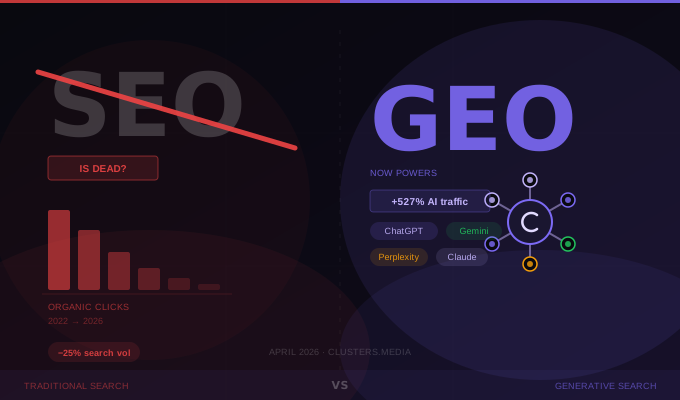
- AI-referred sessions jumped 527% year-over-year in the first five months of 2025, according to Previsible’s AI Traffic Report
- Gartner predicts a 25% drop in traditional search volume by 2026 due to AI chatbots and virtual agents
- Perplexity now processes over 780 million queries monthly — and that number is accelerating
- Princeton and IIT Delhi research found GEO strategies can increase AI visibility by up to 40%
- 43% of professionals reported using ChatGPT for work-related research as early as 2023 — that figure has only grown
- Google’s own AI Overviews now appear at the top of results for millions of queries per day — reducing clicks to the results below
The clearest signal of all? Brands with strong traditional SEO are reporting organic traffic declines — even as their rankings remain unchanged. Users are finding the answer before they ever scroll down to the blue links.
SEO vs GEO — The 7 Critical Differences
| Dimension | Traditional SEO | GEO |
|---|---|---|
| Goal | Rank in search results, earn clicks | Be cited in AI-generated answers |
| Output | A list of blue links on a SERP | A synthesised AI answer with source citations |
| Traffic model | Click → Visit → Convert | Citation → Brand authority → Direct search |
| Key signals | Backlinks, keywords, page authority | Content clarity, structure, entity authority |
| Success metric | Keyword rankings, organic traffic, CTR | AI mentions, brand citations, share of voice |
| Content format | Keyword-targeted pages, meta descriptions | Authoritative, structured, fact-dense content |
| Ranking stability | Relatively stable positions | Dynamic — same query can return different answers |
The most important difference is in the traffic model. With SEO, you earn a click. With GEO, you earn a citation. The user may never visit your site — but they now associate your brand with the answer to their question. That is a different kind of value, and it requires a different kind of strategy.
So — Is SEO Actually Dead?
No. But the honest answer is more complicated than a simple no.
Traditional SEO is not dead — but it is being displaced from its position as the primary driver of organic discovery. Google still processes billions of queries per day. High-intent transactional searches — “buy running shoes near me,” “best mortgage rates today” — still heavily favour traditional search results. Local SEO is as important as ever.
What is dying is the assumption that SEO alone is enough. The era of SEO as your complete digital discovery strategy is over.
“GEO is not a replacement for SEO, but an essential evolution that adapts to the changing realities of how users discover and consume information.”
— Colling Media, 2026Think of it this way: SEO without GEO in 2026 is like having a perfect Google Maps listing in 2010 and ignoring that people were starting to use Yelp, TripAdvisor, and Instagram to discover places. You didn’t need to abandon Google Maps — but you needed to show up everywhere your audience was looking.
Google dominates search. Keywords, backlinks, and page authority determine visibility. Blue links drive the internet economy.
ChatGPT launches. 100 million users in two months. People start asking AI questions instead of Googling them. The shift begins.
Google launches AI Overviews at scale. Zero-click searches accelerate. Perplexity crosses 500M monthly queries. AI-referred traffic surges 527% year-over-year.
Gartner projects 25% drop in traditional search volume. Brands with GEO strategies begin capturing AI citations. Traffic drops reported even for top-ranked sites. The hybrid era begins.
AI-native search becomes the default for complex research queries. GEO-optimised brands dominate. SEO alone becomes insufficient for full-funnel visibility.
How GEO Actually Works — What AI Looks For
When an AI system processes your content to generate an answer, it goes through three distinct phases that are fundamentally different from how Google crawls and ranks pages.
How AI Systems Process Your Content
- Retrieval: The AI identifies potentially relevant content from its training data or real-time retrieval systems. Accessibility, crawlability, and clear attribution matter here — just like in SEO.
- Interpretation: The AI reads your content to understand what claim it makes, how authoritative the source is, and how clearly the information is structured. Keyword density is irrelevant. Conceptual clarity is everything.
- Attribution: The AI decides whether to cite your brand as the source of a claim. This depends on your entity authority, cross-platform presence, and whether your content is the clearest, most trustworthy expression of the answer.
The critical insight here: a page can rank #1 in Google and never be cited by ChatGPT. Conversely, a page that ranks nowhere near the top of Google can be the AI’s go-to citation for a topic — if it is structured, authoritative, and clear enough for AI interpretation.
A Practical GEO Strategy for 2026
1. Build Deep Topical Authority
Stop writing surface-level keyword content. AI systems recognise depth. Build comprehensive knowledge hubs on your core topics — interconnected articles that cover a subject from every angle. This satisfies both traditional search algorithms and gives generative AI the depth it requires to trust your brand as a citation source.
2. Publish Original Data and Research
This is the single most powerful GEO signal available to content creators. AI cannot generate new, original data — it can only summarise what already exists. By publishing original research, surveys, case studies, and unique expert insights, you force both search engines and AI models to cite your content as a primary source. There is no substitute for this.
3. Structure Content for AI Comprehension
Traditional keyword-stuffed content fails in AI retrieval environments because semantic search identifies concepts, not keyword density. Use clear headings, structured sections, FAQ formats, and defined claims. Write as if you are explaining something to a highly intelligent person who will use your explanation to teach others.
4. Optimise Technical Architecture
Schema markup, clean HTML, and well-labelled content sections give AI systems clearer context, making your content easier to interpret and surface. Both SEO and GEO rely on AI crawlers efficiently accessing your site — technical health remains a shared foundation.
5. Build Brand Presence Across Platforms
AI models don’t just pull from your website. They synthesise information from across the entire digital ecosystem — Wikipedia, Reddit, LinkedIn, news mentions, podcast transcripts, YouTube descriptions. Your brand’s authority in AI eyes is the sum of your presence everywhere, not just on your own domain.
6. Develop New GEO Metrics
Traditional SEO metrics — keyword rankings, organic traffic, click-through rate — are insufficient to measure GEO success. You need a new measurement framework that includes brand mentions in AI responses, share of voice in AI answers, and citation frequency across ChatGPT, Perplexity, Gemini, and Claude.
What SEO Tactics Still Work in a GEO World
SEO Fundamentals That GEO Also Rewards
- E-E-A-T (Experience, Expertise, Authoritativeness, Trustworthiness) — Both Google and AI models reward credible, expert-authored content. Showcasing real expertise is more important than ever.
- Technical site health — Fast, crawlable, well-structured sites get indexed by both search engines and AI retrieval systems.
- High-quality backlinks — Still a strong authority signal, though AI weights entity authority across platforms more broadly than link count alone.
- Long-form, comprehensive content — Depth signals expertise to both Google and AI systems. Thin content fails in both worlds.
- Clear content structure — Proper heading hierarchy, schema markup, and FAQ sections help both SERP ranking and AI comprehension.
The Verdict: GEO Is Not Optional in 2026
The brands winning in 2026 are not choosing between SEO and GEO. They are running both in parallel — maintaining their traditional search presence while simultaneously building the authority signals, content depth, and cross-platform presence that AI systems require to cite them.
The brands losing are the ones still running the 2019 SEO playbook while wondering why traffic is quietly declining despite stable rankings.
“The future of search is not about choosing between traditional SEO and GEO — it’s about creating an integrated strategy that ensures visibility regardless of how people seek information.”
— WordStream, March 2026Here is the uncomfortable truth: if ChatGPT, Gemini, or Perplexity are answering questions in your space and your brand isn’t being cited, you are invisible to a rapidly growing segment of your potential audience. That gap will only widen.
The question is not whether GEO matters. The question is whether you will build your GEO strategy before your competitors do.
Your GEO Readiness Checklist
Start Here — GEO Foundation Checklist
- Do you have comprehensive, expert-authored content on your core topics — not just keyword pages?
- Have you published any original research, surveys, or proprietary data that AI must cite you for?
- Is your content structured with clear headings, FAQ sections, and schema markup?
- Do you have a strong brand presence beyond your website — news mentions, social profiles, Wikipedia, community forums?
- Are you tracking brand mentions in AI responses from ChatGPT, Perplexity, Gemini, and Claude?
- Have you updated your content marketing KPIs to include AI citation share of voice?
- Is your technical site architecture clean enough for AI crawlers — fast, crawlable, properly labelled?
FAQ
Is SEO dead in 2026?
No — but SEO alone is no longer sufficient as a complete digital discovery strategy. Traditional search still handles billions of queries daily, particularly high-intent transactional searches. However, with AI-referred traffic growing 527% year-over-year and Gartner projecting a 25% drop in traditional search volume, brands that rely exclusively on SEO are increasingly invisible to AI-powered search users.
What is GEO — Generative Engine Optimization?
GEO is the practice of optimising your content to appear as authoritative sources and direct citations within AI-generated responses from platforms like ChatGPT, Claude, Gemini, and Perplexity. Unlike traditional SEO which aims for SERP rankings and clicks, GEO aims to make your brand the source AI systems trust and reference when generating answers.
How is GEO different from SEO?
The fundamental difference is in the goal and output. SEO optimises for rankings and clicks from a list of search results. GEO optimises for citations and mentions inside AI-generated answers. SEO relies heavily on backlinks and keyword matching. GEO prioritises content clarity, entity authority, structured formatting, and cross-platform brand presence.
Do I need to abandon SEO to focus on GEO?
Absolutely not. GEO builds on SEO fundamentals — technical site health, quality content, and authority signals are shared foundations. The winning strategy in 2026 is a hybrid approach: maintain your SEO presence while simultaneously building the content depth, entity authority, and structured formatting that AI systems require to cite you.
How do I measure GEO success?
Traditional SEO metrics — keyword rankings and organic traffic — don’t capture GEO performance. You need new KPIs: brand mentions in AI responses, share of voice in AI answers across ChatGPT, Perplexity, Gemini, and Claude, sentiment of those citations, and growth in direct brand searches (a proxy for AI-driven brand awareness).
What type of content performs best for GEO?
Original research and proprietary data are the most powerful GEO signals — AI systems must cite the source of unique data. Beyond that: comprehensive long-form content on specific topics, clearly structured articles with proper headings and FAQ sections, expert-authored content with strong E-E-A-T signals, and content that is distributed and referenced across multiple platforms.
Sources: Previsible AI Traffic Report 2025, Gartner Research, Princeton/IIT Delhi GEO Study, WordStream, Colling Media, Search Engine Land, Neil Patel, Frase.io · April 2026 · clusters.media