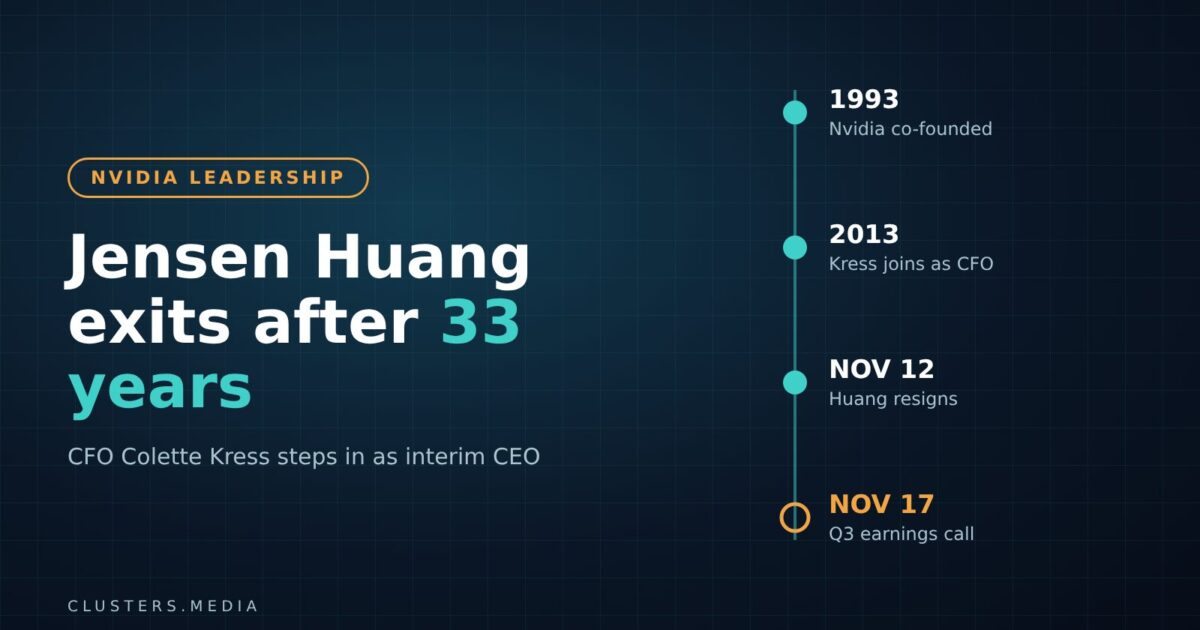
Jensen Huang has resigned as Nvidia’s chief executive, ending a 33-year run at the top of the company he co-founded and turned into the engine of the AI boom. Nvidia’s board announced on November 12 that Huang has stepped down as president, CEO and board member effective immediately, and that CFO Colette Kress will run the company on an interim basis while it searches for a permanent replacement.
The exit follows a week of reports about Huang’s personal relationships, including one with a woman US officials believe was working for Chinese intelligence. For developers, startups and AI labs that depend on Nvidia hardware and software, the immediate question is simpler: does anything change?
Key takeaways
- Jensen Huang resigned as Nvidia president, CEO and director; the board accepted the resignation on November 11, according to Nvidia’s 8-K filing.
- CFO Colette Kress, at Nvidia since 2013, is interim CEO and keeps her finance role until a permanent chief is named.
- Longtime director Harvey C. Jones becomes Nvidia’s first-ever board chair.
- The board says operations, customer commitments and the product roadmap will continue without interruption.
- The next big signal arrives on November 17, when Nvidia reports quarterly results as scheduled.
What happened
According to Nvidia’s regulatory filing, the board accepted Huang’s resignation on November 11 and announced the leadership change the next day. Huang leaves all three of his roles at once: president, chief executive and member of the board. The company did not give a reason in its statement, which thanked him for what it called immeasurable contributions to Nvidia and the wider industry.
The resignation came only days after the board said it would investigate whether Huang had been the target of a foreign intelligence effort. That probe followed reports that he had a close relationship with a businesswoman whom US officials believe passed information to Beijing, a story we covered in our earlier piece on the Jensen Huang spy report. Huang acknowledged in a message to employees that he had been unfaithful to his wife and apologised. CNN reports that the leadership change also came shortly after The New York Times reported a separate affair with an executive who reports to him.
China has denied that it targeted Huang. Congressional committees had already asked him to appear over the national security questions the reports raised, and CNBC’s live coverage says he has agreed to testify. No wrongdoing involving Nvidia technology has been publicly established, and the board’s investigation has not reported findings.
Markets reacted sharply. Yahoo Finance reported that Nvidia stock dropped more than 13% in early trading on Thursday before recovering part of the loss. Earlier in the week, the shares had already closed about 4% lower on the day the board opened its investigation.
Who is running Nvidia now
Colette Kress has been Nvidia’s executive vice president and CFO since September 2013. Before that she spent close to 25 years in finance roles at companies including Cisco and Microsoft. She has been the familiar second voice on Nvidia’s earnings calls for more than a decade, which gives investors and big customers a known face during an unsettled period. She will carry both jobs, CEO and CFO, until the board names a permanent leader.
The board also split the chair role out for the first time. Harvey C. Jones, a director since 1993 and a former CEO and executive chairman of chip-design software firm Synopsys, is now chair. Separating the chair from the CEO is a common governance move after a leadership crisis, because it puts an independent figure in charge of the succession process.
The search will consider internal and external candidates. Some analysts quoted by CNBC expect Kress to serve for around a year, but that is an outside estimate, not a company timeline.
Why it matters
Few founders are as tied to their company’s identity as Huang. He co-founded Nvidia in 1993, steered it from gaming graphics into general-purpose GPU computing, and spent years personally pitching CUDA to researchers and developers long before the AI boom made it essential. That software layer is a large part of why Nvidia chips became the default for training and running AI models, and why switching away from them is costly for most teams.
His departure removes the company’s main strategist and its most visible salesperson at a moment when AI labs, cloud providers and governments are making multi-year bets on compute. It also lands in the middle of a tense policy fight over AI chip exports to China, an area where Huang had been Nvidia’s leading public voice in Washington.
What it means for developers and AI businesses
In the short term, very little should change on the ground. Chips already in production, cloud capacity already contracted and software already shipped do not depend on who holds the CEO title. The board has stated plainly that it expects customer commitments and the product roadmap to continue without interruption, and Nvidia’s engineering organisation, CUDA libraries and developer programmes are run by large, long-standing teams.
Where it could matter is in direction over the next year or two. A few practical points for builders:
- No reason to rewrite your stack today. CUDA, cuDNN, TensorRT and the rest of the toolchain are not going anywhere because of a CEO change. Treat this as a governance story, not a platform risk, until the company signals otherwise.
- Watch pricing and allocation. A finance-led interim leadership may lean towards steady margins and predictable supply deals rather than bold new bets. That could affect GPU availability and pricing for smaller customers.
- Keep portability in mind. If you have been meaning to test your models on other accelerators or keep your code framework-level (PyTorch, JAX) rather than tightly bound to vendor-specific kernels, uncertainty at the top is a reasonable prompt to do it.
- Policy exposure. If your business depends on Nvidia hardware in markets affected by export rules, the company’s stance in Washington may shift without Huang as its advocate.
For AI labs and startups raising money on the strength of compute deals, the bigger effect may be on sentiment. Nvidia is widely treated as a bellwether for AI demand, so prolonged turmoil could weigh on how investors view the whole sector, even if order books stay full.
What to watch next
- November 17 earnings. Nvidia will report its third-quarter fiscal 2027 results at about 1:20 p.m. PT, with the call at 2 p.m. PT. Expect questions on demand, guidance and whether any customers have paused orders. Kress is expected to lead the call.
- The board’s investigation. Any findings about whether company information was exposed would matter far more to customers than the personal side of the story.
- Congressional testimony. Hearings could shape how lawmakers approach AI chip exports and oversight of US chipmakers more broadly.
- The permanent CEO pick. An engineer-founder style leader would signal continuity in Nvidia’s aggressive roadmap; an outside operator could point to a more conservative phase.
The AI industry runs on compute, and compute still largely runs on Nvidia. Huang’s departure does not change that overnight, but it does open the first real question in years about who sets the direction for the company at the centre of the AI stack. We will follow the earnings call and the CEO search as they develop. For more on how the big labs are shaping the market around that compute, see our coverage of the Anthropic IPO price range.