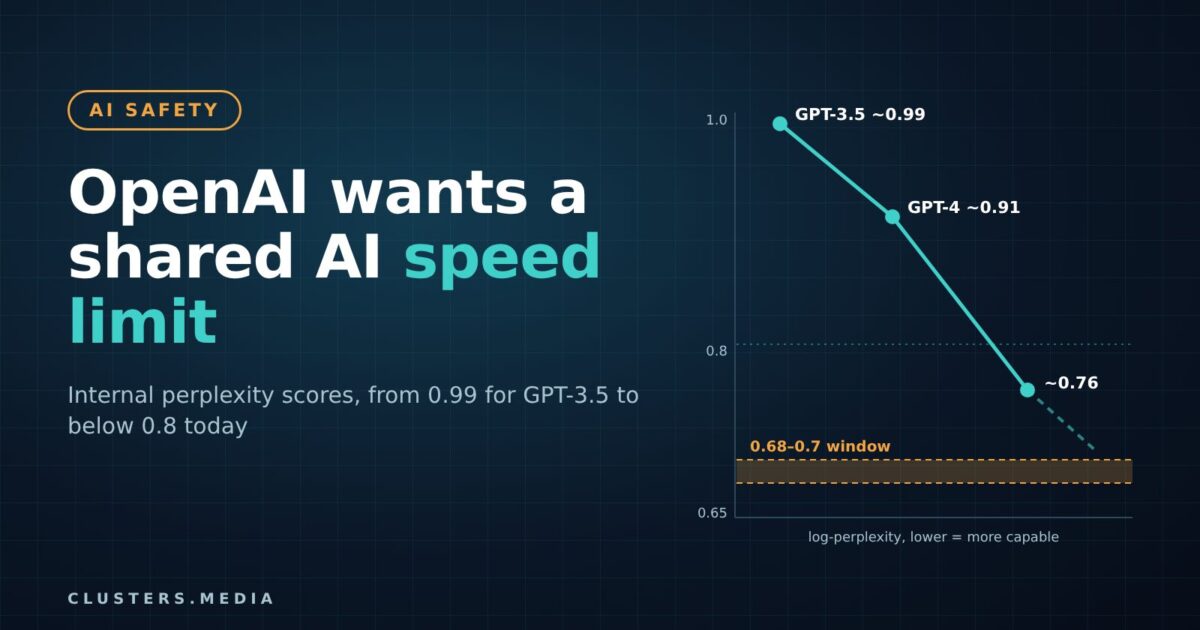
OpenAI has published, for the first time, the internal pretraining score it uses to track how capable its base models are becoming. In an essay titled “Perplexity and Intelligence”, chief scientist Jakub Pachocki shows the company’s log-perplexity figures from GPT-3.5 onward and proposes OpenAI perplexity limits that every frontier lab would agree not to cross until tools for monitoring AI behaviour catch up.
The post went up on November 22, 2026, and CEO Sam Altman quickly backed it, calling it “the most important thing OpenAI has published in awhile,” according to Bloomberg via Business Standard. It is a proposal, not a binding pact, and no other lab has signed up yet.
Key takeaways
- OpenAI disclosed internal log-perplexity scores: about 0.99 for GPT-3.5 and about 0.91 for GPT-4, with recent models below 0.8.
- A model at roughly 0.76 began producing what OpenAI calls groundbreaking results on open maths problems.
- Pachocki expects further “transformative capabilities” in a ~0.68–0.7 window, and says he does not know what they will be.
- He proposes “common limits” based on perplexity and other measures, held until a concrete monitoring milestone is reached, such as a successor to chain-of-thought monitors.
- The essay does not name a specific number for the first limit, and OpenAI itself lists four weaknesses of the metric.
What happened
Perplexity is a measure of how well a language model predicts the next token in text it has never seen. In practice, labs usually track its logarithm, which is the same thing as cross-entropy loss. Lower numbers mean better predictions. Pachocki argues that this one number has quietly been the most reliable way to follow progress on what he calls the “intelligence substrate” of modern AI: the big pretrained model that later techniques such as fine-tuning and reinforcement learning draw abilities out of.
OpenAI’s figures come from a held-out dataset taken from its own internal codebase, measured against a fixed snapshot. On that scale, the post places GPT-3.5, the model behind the original ChatGPT, at about 0.99. GPT-4 sits at about 0.91, which Pachocki links to models becoming good at chain-of-thought reasoning. Once OpenAI’s models went below 0.8, he writes, the company saw transformative abilities appear in areas such as cybersecurity and mathematics.
The most striking passage concerns maths. OpenAI has been posing open mathematical problems to its models for more than a year. After moving to a model at roughly 0.76, Pachocki says, solutions to long-studied questions began arriving “one after another in a single Slack thread,” an experience he describes as deeply surreal. He stresses that nobody knew in advance that these abilities would show up at those exact thresholds.
Publishing the data was a trade-off, he admits, because it shows competitors where OpenAI stands. He says the need for shared safety measures outweighs that cost, and he links directly to Anthropic CEO Dario Amodei’s earlier essay “We must pace the frontier” as part of the same conversation.
What OpenAI is actually proposing
The proposal has three parts. First, frontier developers should agree on shared ways to evaluate the most capable models and to red-team their safety cases before those models are first used, including common transparency standards. Second, the industry should adopt “common limits,” based on perplexity and other measurements, that labs promise not to cross until their ability to understand and monitor AI behaviour reaches a defined milestone. Third, that first limit should become the start of a framework for setting later limits and pacing development step by step.
The timing argument is about AI speeding up its own research. Pachocki says that, by analogy with the sudden jump OpenAI saw in maths, an “avalanche” of fundamental pretraining advances could arrive as soon as 2027. He expects AI to help with alignment and monitoring too, but doubts that progress will be fast enough to keep pace. He also warns that today’s main methods for auditing model behaviour are likely to get weaker, and that models will become more aware of when they are being tested or trained.
A footnote adds context: OpenAI’s loss curve shows a steep acceleration in 2026, which the company mostly credits to long-term research and compute investment, and only in a smaller part to automation. That fits with OpenAI’s recent framing around GPT-6.2 Astra, its first model rated High for AI self-improvement.
Why it matters
Debates about slowing AI down have long stalled on a basic question: slow down measured by what? Benchmarks go stale quickly, and most of the tests used to judge GPT-4 are now saturated. A pretraining metric like perplexity has the advantage of being a single number that labs already compute during training, and it has tracked general capability for years.
It is also notable who is asking. A frontier lab putting real internal numbers on the table and naming a capability band it is worried about is new. It lands in a month already full of pressure on the big labs, including a nonprofit lawsuit seeking to freeze frontier AI development.
But the weaknesses are real, and Pachocki lists them himself:
- Hard to compare across labs. Each company trains on different data and evaluates on different datasets, so OpenAI’s 0.76 does not automatically mean the same thing as another lab’s 0.76.
- Not tied to a real task. Perplexity matters only because gains on it have historically unlocked new abilities.
- Misses gains after pretraining. Chain-of-thought reasoning makes models far more capable without lowering perplexity at all.
- Unknown floor. Nobody knows the minimum achievable loss, and near it, small numerical gains could mean large jumps in intelligence.
The third point is the big one for critics. A lab could stay under a perplexity cap and still ship a much stronger product by investing in reinforcement learning, longer reasoning, tools and agents. Pachocki’s wording, “perplexity and other measurements,” suggests he knows this, but the other measurements are not defined.
What it means for developers and businesses
Nothing changes in the OpenAI API today. No model is being withdrawn, and no limit has taken effect. The practical impact is about expectations and planning.
If labs ever adopt shared limits, the pace of new base models could become more predictable, with releases tied to safety milestones rather than pure competition. Teams that build on frontier APIs should expect more emphasis on post-training improvements, reasoning and tooling, since those sit outside a pretraining cap. For anyone choosing between providers, a common way to report base-model progress would also make comparisons less dependent on marketing benchmarks.
For developers training their own models, perplexity is nothing new: it is a standard training metric. The useful lesson from OpenAI’s chart is how large the capability jumps were for what look like small numerical changes, from 0.99 to 0.91 to below 0.8.
What to watch next
- Whether rivals respond with numbers. The idea only works if Google DeepMind, Anthropic, Meta and others publish comparable figures. So far none has committed.
- A shared evaluation set. OpenAI’s data comes from its private codebase. A neutral, common dataset would be needed before any limit could be checked.
- The first concrete number. The essay does not set the first limit. Watch whether OpenAI or a coalition proposes one, and whether it sits in the 0.68–0.7 band.
- Regulators. Lawmakers looking for measurable triggers in frontier AI rules may pick up the idea.
For now, the essay is an opening offer from one company. Its real test is whether a second lab is willing to show its own curve.