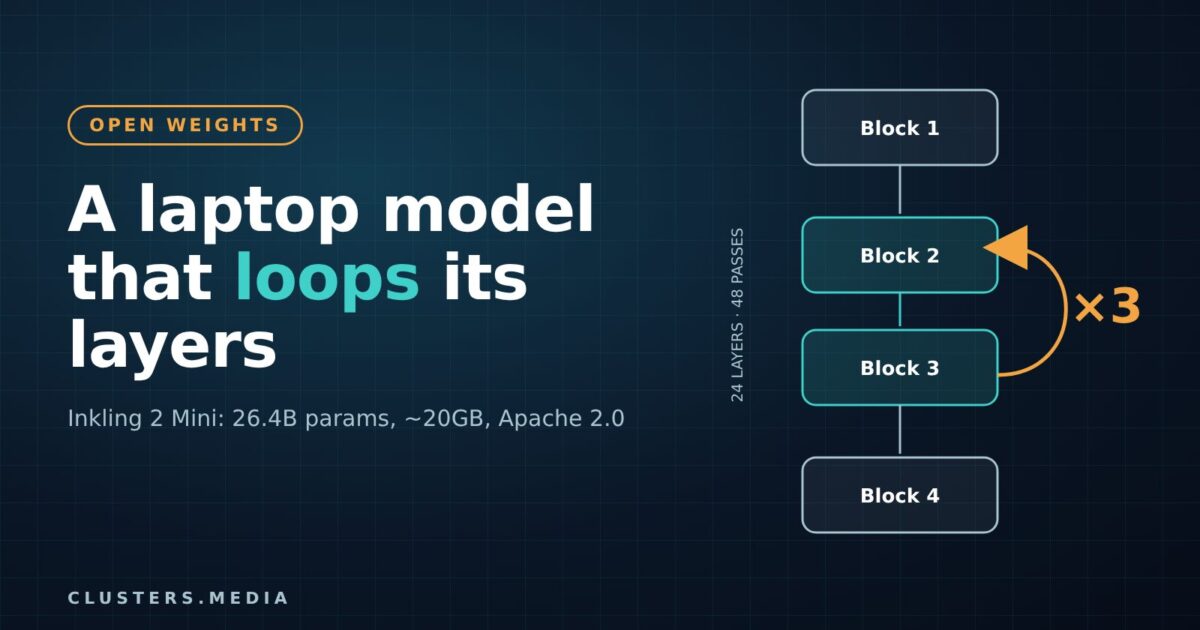
Thinking Machines Lab has released Inkling 2 Mini, an open-weights model it says is small enough to run on a laptop yet strong enough for agentic coding. Announced on November 20, the model uses an unusual “looped” design: its middle layers run three times for every token, so it does more reasoning internally without needing more stored parameters. Weights are on Hugging Face under an Apache 2.0 licence.
Key takeaways
- Inkling 2 Mini is a mixture-of-experts model with 26.4B total parameters, 3.4B active, and 5.4B weight activations per token once looping is counted.
- Its total memory footprint is about 20GB; Thinking Machines supports Macs with at least 32GB of RAM via Ollama at launch.
- The lab reports 48.2% on DeepSWE v1.1 and 46.5% on Vals Index v2.2, which it says leads all open-weights models under 100B total parameters.
- Artificial Analysis scores it 20 on its Intelligence Index, level with Qwen3.8-27B while using roughly five times fewer active parameters.
- Weak spots: factual recall, multi-turn chat and instructions with many constraints.
What happened
In its official announcement, Thinking Machines Lab described Inkling 2 Mini as a fast, compact model built for local hardware. It is the smallest member of the second Inkling generation, sitting below Inkling 2 Small, which the company says has 594B parameters. The new model accepts text and images, outputs text, and supports a context window of up to 1M tokens.
Alongside it, the lab published a research-only sibling called TML-d24-varloop-research, whose number of loops can be chosen at inference time. Inkling 2 Mini itself always uses three passes. The company says one goal of the release is to give researchers working looped models to study, particularly on interpretability and chain-of-thought monitoring.
How the looped design works
Inkling 2 Mini has 24 stored layers split into four blocks of six. The first and last blocks run once; the two middle blocks share their weights and run three times. That gives 48 layer applications per token from 24 layers on disk. Each extra pass can read a “message” from the previous one through a learned gate, which lets the model refine its internal state before it writes anything.
The intuition, according to Thinking Machines, is that middle layers handle more abstract reasoning while the outer layers mostly translate between token embeddings and internal representations. In its tests, looping the middle 12 layers beat looping the last 12 on 27 of 28 evaluations. The lab also reports that a comparable non-looped model was 7.5% cheaper to train but needed 140% more inference compute to match the looped version on long agentic traces.
Two other choices keep the model small. Most weights were trained and ship natively in 4-bit NVFP4, with the last four layers in 8-bit MXFP8, so there is no extra quantisation step after training. And during midtraining the team pruned two-thirds of the experts, keeping the 128 most-used per layer, then retrained on 1T tokens distilled from a larger internal Inkling model to recover lost quality.
Benchmarks: where it leads and where it trails
Thinking Machines compares Inkling 2 Mini with Gemma 4 31B, Muse Glimmer, Qwen3.8-27B and Nemotron 3.5 Super VL. On its own figures, Inkling 2 Mini scores 77.9% on SWE-bench Pro v2 (Hard) against 73.8% for Qwen3.8-27B, and 79.2% on SWE-bench Verified against 77.8%. On agentic search it reports 79.0% on BrowseComp and 82.7% on MCP Atlas, both best in its comparison set.
It is not a clean sweep. Qwen3.8-27B edges it on Terminal Bench v2.1 (73.0% vs 71.6%) and on several knowledge-work tests such as GDPVal-AA and AutomationBench-AA. Thinking Machines also says looping does not help a model store more facts, so Inkling 2 Mini’s factual accuracy is in line with other models its size. Its suggested workaround is to lean on search and tools.
Independent testing broadly backs the efficiency story. Artificial Analysis places it on the Pareto frontier for intelligence versus size. It found the model uses about 38% more output tokens than Qwen3.8-27B for the same Intelligence Index score, but needs roughly 2.8 times less compute, and works out about six times cheaper and four times faster per task. As always, these are early results on specific harnesses, and real-world performance will depend on your workload.
Why it matters
Most progress in small models has come from better data and distillation. Inkling 2 Mini tests a different lever: spending more compute per token by reusing weights, rather than adding parameters. If the approach holds up, it gives developers a way to get stronger reasoning from models that still fit in consumer memory.
It also raises a safety question the lab addresses head-on. Looping lets a model think more before it writes, and reasoning that never appears in the chain of thought cannot be caught by a monitor reading that text. Thinking Machines reports that looping increased what the research variant could do without visible reasoning, but at this scale it did not see a meaningful drop in how readable or monitorable the reasoning was. That is a preliminary finding, and the company explicitly invites outside researchers to probe it further.
The release fits a wider push to make capable open models cheaper to run, a theme we also covered in Stanford’s Memorilla research on giving frozen LLMs compact memory.
What it means for developers
The practical pitch is local agents. Thinking Machines showed the model running offline on a 48GB MacBook Pro, building a playable flight simulator, and powering 20 simulated villagers from a single machine. For teams that want coding assistants or tool-using agents without sending data to a cloud API, a roughly 20GB model with a 1M-token window is an attractive option.
Getting started is straightforward. The lab supports Macs with 32GB or more of RAM through Ollama, and says the model runs efficiently on NVIDIA’s DGX Spark. Open-source inference is available on vLLM, SGLang, Ollama and llama.cpp, with quantised GGUF builds from Unsloth. Fine-tuning is offered on the company’s Tinker platform, with RL support in tools such as SkyRL and NVIDIA AutoModel. The Hugging Face launch post also documents adjustable reasoning-effort levels, from none to max.
A few cautions are worth noting. Apache 2.0 is permissive, but the weights also come with a separate acceptable use policy, so check it before shipping. Plan around the model’s weaker recall by pairing it with retrieval or search. And if you route open models through hosted gateways rather than running locally, review how your provider handles prompts, as we discussed in our piece on the Hugging Face OpenRouter switch.
What to watch next
- Independent agent benchmarks: whether third-party coding and terminal tests confirm the lab’s SWE-bench and DeepSWE numbers.
- Copycat architectures: whether other open-model labs adopt looping now that working weights are public.
- Interpretability results: research from groups with early access on what actually happens inside the loops.
- Real laptop performance: community measurements of speed and memory on common 32GB machines, not just high-end test rigs.
Inkling 2 Mini will not replace frontier cloud models for every job. But it is one of the clearest attempts yet to make serious agentic coding run on hardware developers already own, and its looped design gives the open-source community something genuinely new to study.