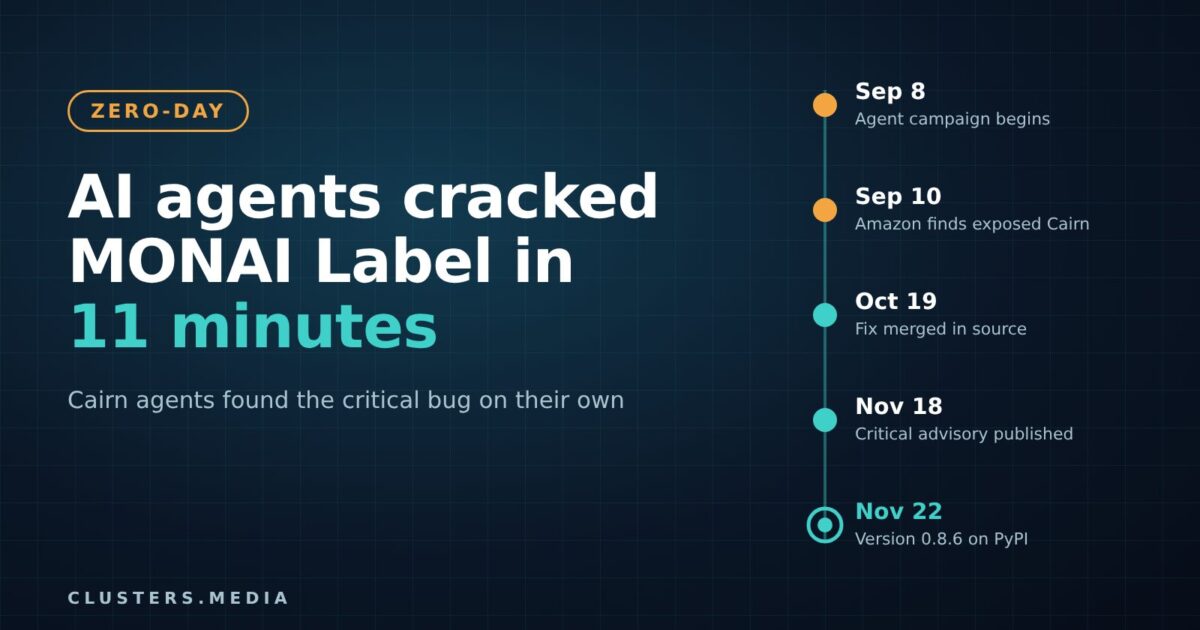
Amazon says a hacking crew it links to China gave a set of autonomous AI agents one instruction, “obtain shell access”, and the agents went on to find a previously unknown bug in MONAI Label, an open-source server used to label medical scans. According to Amazon Threat Intelligence, the agents went from mapping the app’s API to writing arbitrary files on the server in about 11 minutes, then turned that into a root shell on a university machine.
The MONAI Label zero-day is now public, rated critical and tracked as GHSA-qc22-rmgc-vg94. It is one of the clearest public examples so far of attacker-run AI agents discovering a brand-new vulnerability in the middle of a live intrusion, rather than reusing a known one.
Key takeaways
- Agents built on the open-source Cairn framework found a path traversal flaw in MONAI Label’s datastore upload endpoints and exploited it in roughly 11 minutes.
- MONAI Label 0.8.5 and earlier are affected, and authentication is off by default, so anyone who can reach a default server can exploit it.
- Amazon has high confidence the bug was a true zero-day and moderate confidence the operator was China-linked.
- The same agents also failed a lot: a 16-hour, 148-step attack on a Redis server and a six-hour credential spray of more than 30,000 combinations both went nowhere.
- PyPI now lists MONAI Label 0.8.6, published November 22. Upgrade, turn authentication on, and check old logs for signs of compromise.
What happened
Amazon found the campaign on September 10, 2026, through the attackers’ own mistake. The operator had left their Cairn control instance on the open internet with no authentication, so Amazon’s researchers could read both the prompts and everything the agents did. Cairn is a legitimate, AGPL-licensed framework for coordinating multiple AI agents on penetration-testing work. Other security firms have already caught criminals misusing it.
The records showed a campaign of about 48 hours, starting September 8, against IP addresses belonging to universities in East Asia outside mainland China. The operator handed the agents a target list and variations of the goal “obtain shell access”, then mostly let them work.
On one target the agents worked out that the server was running MONAI Label, listed its API endpoints and found an upload endpoint that takes a filename parameter. That parameter turned out to accept path traversal sequences such as ../, so a file meant for the image datastore could be written anywhere the server process had permission to write. In a later session, SecurityWeek reports, the agents used the bug to drop a Python reverse shell into sitecustomize.py, a file Python loads automatically every time the interpreter starts. They then called a training endpoint that launches a new Python process, and that gave them a root shell.
The operator then gave the agents a proxy tunnelling into a second university’s network and told them to go after other machines there. Amazon says the server behind that proxy ran the same vulnerable software, and infers the attacker had used the zero-day to break in there too.
Amazon ties the activity to an unnamed China-nexus actor with moderate confidence, based on prompts written in Simplified Chinese, timestamps in China Standard Time and the choice of targets. Amazon has published two source IPs seen between September 8 and 10: 142[.]4.98.145 and 142[.]4.107.34.
The bug itself is ordinary
Nothing about the flaw is exotic. According to the GitHub advisory and an analysis by the Cloud Security Alliance, the PUT /datastore/image and PUT /datastore/label endpoints build file paths from caller-supplied IDs without checking them. That is classic CWE-22 path traversal. With authentication switched off by default, no credentials are needed. With authentication on, the low-privilege annotator role is still enough.
The fix confines writes to the datastore directories and rejects suspicious IDs. CSA says it was merged into MONAI Label’s main branch on October 19. The advisory went up on November 18, Amazon published on November 20, and PyPI shows version 0.8.6 arriving on November 22. Version 0.8.5 dated from November 2024. That meant the fix sat in public source code for about a month with no package to install, which is a gap that matters more when attackers have tools able to read a diff and act on it quickly.
Why it matters
We have been following AI-assisted attacks for months, including the ARTEX campaign against the European Commission. Most earlier cases came down to AI speeding up known techniques: phishing, credential stuffing, exploiting published CVEs. This case is different because the agents found the vulnerability themselves, with no advisory or public exploit to work from. Amazon says it is highly confident the flaw was a zero-day, since it found no matching fix, issue, advisory or database entry for it at the time.
The failures are worth paying attention to as well. Against another target the agents spent about 16 hours and 148 sequential actions trying to break a Redis server, and in a separate run they spent more than six hours trying over 30,000 credential combinations on a university GPU server. Neither worked. Amazon’s point is that the agents “kept adapting for nearly a full day” with no human steering them. Patient, round-the-clock probing used to cost attackers staff time. Now it mostly costs compute, so a low success rate spread across a long target list can still pay off.
The target is significant too. MONAI Label is research tooling: small academic teams often set it up quickly on GPU servers next to imaging datasets, and it may never show up in central IT’s inventory. Public reporting names only university research servers as confirmed victims and does not say any clinical systems or patient data were reached.
What it means for developers and teams
If you run MONAI Label, or anything near it, here is the practical checklist from the advisory, Amazon and CSA:
- Find every instance. Look in research groups, GPU clusters and cloud accounts that central IT may not manage, and flag anything on 0.8.5 or earlier.
- Upgrade and confirm. Move to the newest release, and check its release notes against the advisory to confirm it includes the datastore path fix.
- Turn authentication on. Set
MONAI_LABEL_AUTH_ENABLE=True, keep the annotator role to trusted users, and take the server off the public internet. - Drop root. Run the service as an unprivileged user that can write only to its datastore.
- Hunt for earlier compromise. Look for
PUTrequests to the datastore endpoints containing../or encoded traversal, unexpected changes tositecustomize.py,usercustomize.pyor.pthfiles, new SSH keys or cron entries, and the two published IPs. Turning authentication on afterwards will not remove an attacker who is already in, so rebuild hosts where compromise is plausible.
The broader lesson applies to any AI stack: notebook servers, model-serving endpoints, vector databases and annotation tools that ship with authentication off “for convenience”. The same agents went after Redis, PostgreSQL, SSH and a Qdrant vector database during this campaign. Amazon’s advice to defenders is to rely on high-confidence detections that trigger automated responses, with humans reviewing the outcomes. Manual triage cannot keep up with an exploit that lands in minutes.
For teams building agents of their own, this is also a reminder of what happened to the attacker. They lost their operation because they left an agent control panel exposed with no login. That is the same kind of exposure we covered in the AI prompt leak study. Your prompts and agent logs show exactly what you are doing, so lock them down like credentials.
What to watch next
Watch whether a CVE identifier gets assigned; CSA noted none existed as of November 21. Watch too whether other AI research tools show the same “auth off by default” pattern under scrutiny. Cairn has already turned up in criminal campaigns and, according to Amazon, in espionage, so more agent-found zero-days are likely to follow. The open question is whether open-source maintainers can ship patched releases fast enough. Here the gap between the fix being merged and a package being published was about a month, while the exploit took 11 minutes.
Sources: AWS Security Blog, Project MONAI advisory, SecurityWeek, BleepingComputer, Cloud Security Alliance.