Entrepreneurship · Developer Tools · Solo Founders · May 2026
In 2019, 23.7% of new startups were solo-founded. By mid-2025, that figure had jumped to 36.3%. In Q1 2026, 34% of new micro-SaaS products were built by founders with no prior programming experience — some generating $5K–$50K in monthly recurring revenue. The developer-entrepreneur is no longer an outlier. They are a movement — and AI is what made it possible.
Something fundamental has shifted in what one person can build. The question used to be “when should I hire?” In 2026, serious founders are asking “why would I?” A $200/month AI stack now replaces functions that previously required a 10-person team. The economics of entrepreneurship have been permanently rewritten.
The Old Model Is Broken — Here’s What Replaced It
The traditional startup playbook was built around headcount. You needed a designer, a developer, a marketer, a customer success person, and an ops person before you could build a serious product. You needed funding to pay them. You needed management to coordinate them. And you needed to get very lucky to make it work.
That model is not dead — but it is no longer the only path. And for a growing number of builders, it is no longer the best path.
“The age of the solo developer making millions is here. AI handles what I used to hire people for.”
— Pieter Levels, solo founder · $3M+ ARR across multiple products · 2026Pieter Levels runs Nomad List, RemoteOK, PhotoAI, and several other products — generating over $3 million in annual recurring revenue — as a single operator. No employees. No office. No venture capital. Just a laptop, a lean tech stack, and AI tools doing what used to require a team. He is the most visible example of a model that hundreds of founders are now replicating at smaller but real scales.
What Changed — The Three Shifts That Made This Possible
1. AI Coding Tools Collapsed the Time-to-Ship
Before Cursor and Claude Code, shipping an MVP as a solo developer meant weeks of grinding through boilerplate, debugging sessions, and context-switching between building and thinking. A randomised controlled trial from 2025 found that AI coding tools produce approximately 26% faster development overall — with junior developers seeing even larger gains. But in practice, the indie hacker community reports something more dramatic: solo founders are shipping MVPs in days to weeks that would have taken 2–6 months before AI.
Pieter Levels built fly.pieter.com from idea to $1M ARR in 17 days using Cursor and Three.js. That is an extreme outlier — but the median is still 2–6× faster than 2023. The compounding effect of that acceleration is enormous: more products tested, more niches explored, more iterations completed before a competitor can respond.
2. Non-Developers Can Now Build
Cursor, the AI-native code editor, crossed 1 million monthly active users in early 2026, and Indie Hackers reports that 34% of new micro-SaaS products launched in Q1 2026 were built by founders with no prior programming experience, some generating $5K–$50K in monthly recurring revenue.
This is a structural shift in who can become a developer-entrepreneur. The category now includes product managers, marketers, consultants, and domain experts who understand a problem deeply but previously could not build the solution. Vibe coding tools — Lovable, Bolt, v0, Replit — generate usable products from natural language descriptions. The technical barrier is not gone, but it has been lowered dramatically.
3. The Full-Stack AI Business Became Possible
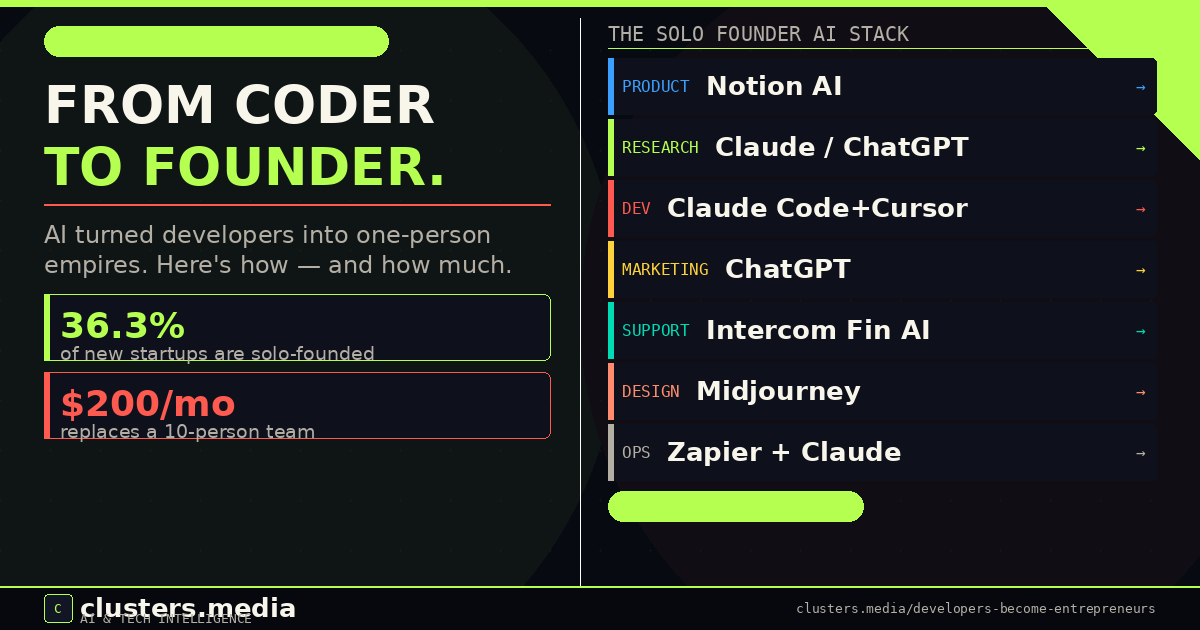
25 AI tools can replace a 10-person team for under $200 per month, covering marketing, sales, ops, support, content, dev, and strategy. This is not theoretical. Serious solo founders in 2026 have structured their AI tools as role-specific co-founders:
The Solo Founder’s AI Team — 2026
- Notion AI — Product manager: spec, roadmap, ticket backlog
- Claude / ChatGPT — Research analyst: competitor analysis, customer interview synthesis, deep research
- Claude Code + Cursor — Dev team: shipping features, debugging, architecture
- ChatGPT — Marketing team: copy, emails, social posts, ad variants
- Intercom / Fin AI — Customer success: support triage, onboarding, FAQs
- Midjourney / Flux — Design: brand assets, ad creative, product visuals
- Zapier / Make + Claude — Operations: automated workflows, reporting, invoicing
The deeper 2026 version of this is not just tool selection — it is context engineering. Founders who build structured information environments for their AI agents (CLAUDE.md files, MCP servers, RAG pipelines) get compounding advantages over those treating AI as a search engine. The AI stack becomes a proprietary system that gets better over time — a genuine competitive moat.
The Economics Are Fundamentally Different
This is where the developer-entrepreneur model becomes genuinely disruptive — not just to large companies, but to the entire startup investment paradigm.
Traditional Startup vs Solo Founder — 2026 Economics
- Traditional startup burn: 70–80% of funding goes to salaries. A 10-person team at market rate costs $1.5–2.5M per year before product exists.
- Solo founder burn: $200–500/month in AI tool subscriptions. No payroll. No office. No coordination overhead.
- Capital efficiency gap: A solo founder using AI operates 10–50× more capital-efficiently than a traditional startup team of equivalent output.
- Margin structure: When your cost base is $500/month and revenue is $10K MRR, you are profitable at a scale that would not even cover a single junior hire in a traditional model.
- Growth speed: No hiring process, no onboarding lag, no management overhead. The solo founder with AI deploys new capabilities by subscribing to a new tool, not posting a job req and waiting 3 months.
The economics of the one-person unicorn come down to a simple equation. Traditional startups burn 70–80% of their funding on salaries. A solo founder using AI replaces headcount with tool subscriptions costing $200–$500 per month. At that cost structure, profitability is achievable at monthly revenue levels that would not even sustain a single additional hire in the traditional model.
The Numbers Behind the Movement
The Solo Founder Economy — 2026 Data
- 36.3% of new startups are now solo-founded, up from 23.7% in 2019 (a 53% increase in 6 years)
- 41.8 million solopreneurs in the United States alone — contributing over $1.3 trillion to the economy
- The micro-SaaS market is projected to grow from $15.7B to $59.6B by 2030 — roughly 30% annual growth
- Solo founders routinely hit $5K–$50K+ MRR targeting niche pain points
- Most founders spend under $1K before first revenue using no-code tools and free tiers
- In 2024 alone, entrepreneurs filed 5.2 million new business applications
- Nearly 60% of US small businesses now use AI tools — more than double the rate in 2023
- Solo-founded startups received 14.7% of cash raised in priced equity rounds in 2024 — and that share is growing
What Kind of Developer Makes the Best Entrepreneur?
Not every developer is suited to the entrepreneur path — and not every path requires the same profile. The patterns from successful solo founders in 2026 reveal three distinct types:
The Technical Generalist
Comfortable with the full stack, strong at systems thinking, excellent at identifying the technical debt that makes a workflow painful. This person builds tools for other developers or for technical operations teams — niches they understand intimately. Examples: API wrappers, developer analytics tools, internal tooling for engineering teams. The technical generalist often builds products that are not visually impressive but are deeply functional and sticky.
The Domain Expert Who Learned to Code
The fastest-growing segment in 2026. These are former consultants, marketers, lawyers, or finance professionals who understand a problem better than any external developer could — and are now using AI coding tools to build the solution themselves. They have the customer empathy that technical founders often lack, and AI has given them the build capability they previously didn’t have. YC is signalling that AI-native companies with software margins can now be built by tiny teams, faster and cheaper than ever.
The Vibe Coder — Creator Turned Founder
Content creators, designers, and community builders who understand audience psychology and distribution. They use Lovable, Bolt, or v0 to ship simple but well-positioned tools, leverage their existing audience for instant distribution, and iterate based on real user feedback faster than any VC-backed startup could. Their advantage is not technical depth — it is the audience that makes their products visible the day they launch.
The Playbook — From Developer to Entrepreneur in 2026
Step 1: Find the Pain, Not the Feature
The most common mistake new developer-entrepreneurs make is building what interests them technically rather than what the market actually needs. Search subreddits like r/SaaS, r/Entrepreneur, and r/smallbusiness for phrases like “I wish there was a tool that…”, “is there software for…”, and “I’m paying someone to…”. When the same pain point surfaces 10+ times with no satisfying solution mentioned, you’ve found a candidate. Use Claude to synthesise complaint threads and identify the pattern. The research takes 2–3 hours. Skipping it costs you months.
Step 2: Validate Before Building
Validation takes 30 days: landing page, 20 sign-ups, 10–20 problem interviews. Use Lovable or v0 to build the landing page in an afternoon. Use Claude to write the interview script, synthesise responses, and identify whether the problem is real and the willingness to pay is genuine. Do not write a single line of backend code before validation is complete. This discipline is the difference between founders who ship products and founders who ship products people use.
Step 3: Build the Leanest Possible V1
Once validated, build the smallest version of the product that solves the core problem. Use Cursor + Claude Code for the backend. Use v0 or Lovable for the frontend if it is primarily informational. Use Stripe for payments. Use Resend or Postmark for email. Use Supabase or PlanetScale for the database. The first version of a $10K MRR product does not need to be impressive. It needs to work reliably for the specific use case that customers validated.
Step 4: Treat AI Tools as Co-Founders, Not Tools
The founders generating the best results in 2026 are not using AI for one-off tasks. They have built structured systems — CLAUDE.md files that encode their product’s conventions, MCP servers that connect Claude to their database and analytics, RAG pipelines that feed customer feedback into their research workflow. The AI stack becomes smarter about your specific business over time. That compound effect is the most underrated advantage available to solo founders right now.
Step 5: Distribution Before Scale
The graveyard of failed SaaS products is filled with technically excellent tools that nobody found. Build in public from day one. Post your revenue on X and Indie Hackers. Write the blog post explaining the problem your product solves before you launch it. Build the audience for the product while building the product. Pieter Levels’ products get traction immediately at launch because his audience is already warmed up. That is not luck. It is a strategy.
The Honest Risks — What Solo Founders Get Wrong
The Hard Truths — What the Success Stories Don’t Show
- The survivorship bias problem: The median solo founder earns $3,000/month (~$36K/year). The $1M+ founders are visible because of survivorship bias — the struggling ones are invisible. Know what distribution you are entering.
- Burnout at the bottleneck: Every solo founder eventually becomes the rate-limiting step. There is no delegation when something critical breaks at 2AM. Building systems that run without you is not optional — it is survival.
- AI-generated code has security debt: Moving fast with AI coding tools creates technical debt and security vulnerabilities that require dedicated review. 45% of AI-generated code contains vulnerabilities. Build security review into your workflow from the start.
- Customer support doesn’t scale like code: AI handles support triage, but complex customer problems still require human judgment. As you scale, support becomes the ceiling. Design your product to be self-serve from day one.
- Distribution is the real moat: Most technically impressive solo products fail not because they are bad but because nobody finds them. Building the product is now the easy part. Distribution is still genuinely hard.
The Verdict — The Best Time in History to Be a Developer-Entrepreneur
The data is unambiguous. The tools have never been better. The cost of starting has never been lower. The speed of shipping has never been faster. And the market for niche, AI-powered solutions has never been larger.
If you are a developer who has thought about building something — the friction that used to justify waiting has largely been removed. The question is no longer whether you have the technical capability to build. The question is whether you understand a problem well enough to build the right thing — and whether you have the distribution strategy to make sure people find it when you do.
The developer-entrepreneur is not a new category. But the ceiling on what one person can build, the speed at which they can build it, and the economics at which they can operate it — all of those have been permanently reset. The solo founder with a $200/month AI stack is competing directly with startups that raised $2 million. In 2026, that is no longer a disadvantage. In many niches, it is an advantage.
FAQ
Can a developer really build a startup alone with AI tools in 2026?
Yes — and thousands are doing it. 36.3% of new startups in 2025 were solo-founded, up from 23.7% in 2019. Solo founders routinely hit $5K–$50K MRR targeting niche problems. The median solo founder earns $3,000/month, which is modest — but the outliers are building $1M+ ARR businesses solo. AI tools have genuinely collapsed the minimum viable team size for most software products.
What AI tools does a solo developer-entrepreneur actually need?
The core 2026 stack: Claude Code + Cursor (development), Claude/ChatGPT (research, marketing, customer synthesis), Lovable/v0/Bolt (frontend), Supabase (database), Stripe (payments), Resend (email), and Notion AI (product management). Total cost: $150–300/month. This stack replaces functions that previously required a 5–10 person team.
Do you need to know how to code to build a SaaS in 2026?
Not necessarily. 34% of new micro-SaaS products in Q1 2026 were built by founders with no prior programming experience. Vibe coding tools like Lovable, Bolt, and v0 generate usable products from plain-language descriptions. However, some technical fluency — understanding how APIs work, basic debugging, reading code — makes you significantly more capable and less dependent on tools getting it right first time.
What is the best type of product for a solo developer to build?
Micro-SaaS targeting a specific niche with a painful, recurring problem. The winning formula in 2026: narrow enough that large companies ignore it, specific enough that users have no good alternative, and painful enough that they pay immediately when they find your solution. Search Reddit communities for “I wish there was a tool that…” — when the same complaint appears 10+ times with no good solution, you have a candidate.
How long does it take to build a micro-SaaS MVP in 2026?
With AI coding tools, most solo founders report shipping a functional MVP in days to weeks — compared to 2–6 months pre-AI. Pieter Levels’ fly.pieter.com went from idea to $1M ARR in 17 days (an extreme outlier, but illustrative). The median is 2–6× faster than 2023. Validation (landing page + interviews) takes 2–4 weeks. Building the V1 post-validation takes 1–4 weeks depending on complexity.
Sources: Taskade Blog (March 2026), EntrepreneurLoop (April 2026), FindSkill.ai (April 2026), NxCode (February 2026), Superframeworks (February 2026), Indie Hackers, Y Combinator Spring 2026 RFS · May 2026 · clusters.media