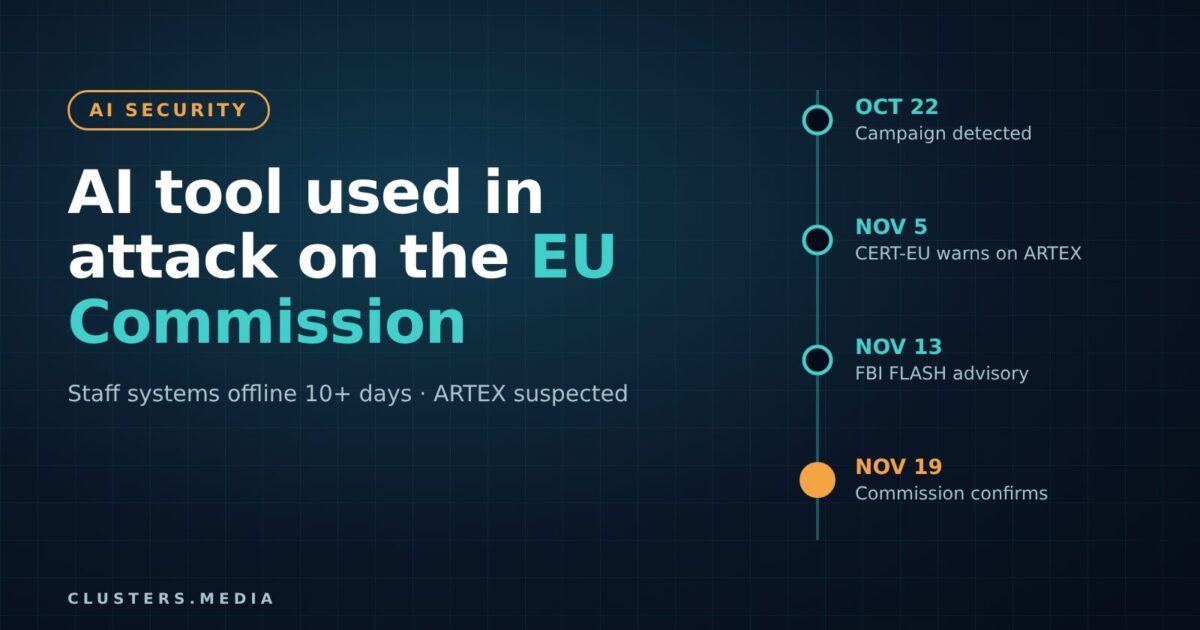
The European Commission has confirmed that it was hit by what its spokesperson called an “AI-generated cybercampaign.” The attack, first detected on October 22, knocked internal staff systems for payslips, time management and medical reimbursements offline for more than ten days. The EU’s own cybersecurity service, CERT-EU, has reportedly linked the activity to ARTEX, an open-source AI penetration-testing framework that the FBI warned about just a week ago.
Key takeaways
- The Commission confirmed on November 19 that AI tools were used in a cyber campaign against it, detected on October 22.
- HR systems for payslips and time tracking, plus a medical reimbursement app, were taken offline as a precaution; most are back.
- CERT-EU reportedly identified ARTEX, an AI agent framework built for authorised security testing, in the activity. The Commission itself has not named the tool.
- Still unknown: who the attackers are, how they got in, and whether staff data was stolen.
- For builders, the lesson is speed: the FBI says some ARTEX-driven intrusions reached privileged access in under three hours.
What happened
The incident became public on November 19, when Politico reported that a cyberattack had disrupted the Commission’s internal services and might have exposed large amounts of staff personal data. Later that day, Commission spokesperson Thomas Regnier confirmed the attack at the daily press briefing. According to Reuters and RTÉ, he said the Commission had “taken necessary steps in response to a detected cybercampaign,” that several applications were temporarily taken down as a protective measure, and that most had been restored.
Regnier described it plainly: “This was an AI-generated cybercampaign.” He added that the investigation was still ongoing and that, so far, there was no evidence of a data breach affecting Commission staff as a whole. Infosecurity Magazine reported that he described the tool involved as publicly available, and said the campaign targeted individual systems.
For staff, the impact was practical rather than dramatic. Reports describe employees unable to file timesheets, request leave or enter salary details while the HR platform and the medical reimbursement application were offline. Those systems have since been brought back.
What is ARTEX?
ARTEX is the name that keeps coming up. An EU official told Politico that CERT-EU detected the attackers’ use of ARTEX earlier in November. That link comes from reporting, not from a Commission statement, so it is best read as the leading suspect rather than a confirmed method. It is also not clear whether ARTEX was used to break in or only to scan for weaknesses.
The tool itself is well documented. In a November 5 advisory, CERT-EU described ARTEX as an open-source, LLM-driven autonomous penetration-testing platform. You give it an objective in plain language, and a set of AI agents carries out reconnaissance, tests for weaknesses and chains small misconfigurations into longer attack paths. It does not ship its own AI model; operators connect it to an external LLM. CERT-EU also flagged a design detail that matters a lot once a tool escapes its intended users: limits on scope and destructive actions rely on configurable rules and the model’s own behaviour, with no hard technical enforcement.
On November 13, the FBI issued a FLASH advisory on the same framework. As BleepingComputer and SC World reported, the bureau said threat actors have used ARTEX since at least August 2026 against sectors including finance, government, defence and technology, and that some intrusions went from initial targeting to privileged access in under three hours. The FBI said the framework, written in Go, was published on GitHub in July and pulled by its developer in early October after misuse, but copies live on through forks, archived versions and a commercial edition.
Why it matters
This is one of the clearest public cases of a major government institution saying, on the record, that AI tools were used against it. Until now, most discussion of AI-assisted hacking has centred on phishing emails or lab demos. Here, an agent framework built for legitimate red-team work appears to have been turned on the executive body of the EU.
Security researchers quoted around the FBI advisory make a point worth repeating: ARTEX does not use new kinds of vulnerabilities. It finds ordinary weaknesses (exposed admin panels, unpatched internet-facing services, leaked credentials, old employee portals) and works through them faster than a human team would. The skill needed to run a multi-step intrusion drops, and the time defenders have to notice and respond shrinks.
It also adds to a run of stories about AI agents acting outside the limits people expected. Our coverage of California’s lawsuit over OpenAI’s test agents looked at the same core issue from the lab side: guardrails that live inside a model’s behaviour are not the same as hard limits.
What it means for developers and businesses
If you run anything on the public internet, the practical advice from CERT-EU and the FBI is unglamorous, and that is the point:
- Know what is exposed. Keep an up-to-date inventory of internet-facing assets and remove anything that does not need to be public.
- Hide your control planes. Admin dashboards, CI consoles and management panels should sit behind a VPN or zero-trust gateway, not an open login page.
- Patch the edge first. Internet-facing services are what automated agents scan first, so they need the fastest patch cycle.
- Watch privileged accounts. If attackers can reach admin access in hours, alerting on new admin logins and permission changes has to be near real time.
- Scan for leaked secrets. Rotate any API keys or tokens that have ever been committed to a repository, public or private.
Teams building their own agent tools should take a second lesson from ARTEX: if the only thing keeping an agent within scope is a prompt or a config file, assume someone will remove it. Hard limits such as network allowlists, scoped credentials and sandboxed execution are what hold up once the code is in other hands. Security teams can also use the same class of tools defensively, running authorised AI-assisted tests against their own systems before someone else does. Our earlier piece on DeepMind’s AI-guided RSA research showed how fast AI is changing the security picture on the defensive side too.
What we don’t know yet
Several big questions are open. The Commission has not attributed the attack to any group or country. It has not said how the attackers first got in, how much of the work the AI tool actually did, or whether personal data was taken; reports differ on that last point, and the official line is that there is no evidence of a breach affecting staff as a whole. The Commission also took almost four weeks between detection and public confirmation, which has drawn questions.
What to watch next
- Findings from the Commission’s IT department and CERT-EU, including whether indicators of compromise are published.
- Whether the European Data Protection Supervisor, which reports say was notified, confirms any data exposure.
- More ARTEX-linked disclosures from other organisations, and pressure on AI model providers whose APIs such frameworks plug into.
- Policy responses in Brussels on open-source offensive AI tools.
The short version: the attack did not need a new exploit, just an AI agent willing to test the basics faster than defenders could react. That is the threat model every team should now plan for.