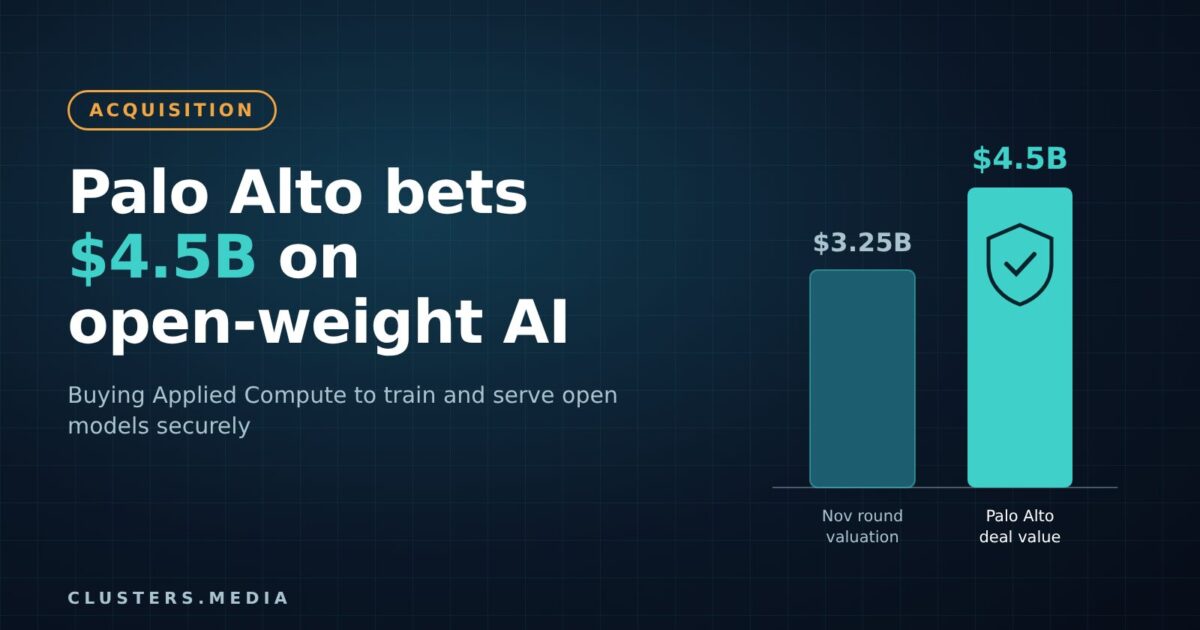
Palo Alto Networks has agreed to buy Applied Compute, a young startup that helps companies post-train and serve open-weight AI models, in an all-stock deal valued at $4.5 billion. The cybersecurity giant announced the agreement on November 18 alongside its quarterly results, framing it as a bet that most enterprises will end up running their own tuned open models next to closed frontier ones, and that someone needs to make that safe.
Key takeaways
- Palo Alto Networks will pay $4.5 billion in stock for Applied Compute, subject to adjustments and regulatory clearance.
- Applied Compute builds a platform to post-train (customise) and serve open-weight models on a company’s own data.
- The price is well above the $3.25 billion valuation Applied Compute raised at only weeks earlier.
- CEO Yash Patil will become Palo Alto Networks’ Co-Chief AI Officer once the deal closes, expected in the company’s fiscal Q3 2027.
- For builders, it signals that “secure open-weight AI” is turning into a product category that big vendors want to own.
What happened
According to the press release Palo Alto Networks filed with the SEC, the company signed a definitive agreement to acquire Applied Compute, which it describes as a platform for post-training and inference of open-weight AI models. The deal is paid entirely in Palo Alto Networks stock and is valued at $4.5 billion. It still needs customary approvals, including regulatory clearance, and is expected to close in Palo Alto Networks’ fiscal third quarter of 2027.
The whole Applied Compute team is joining, and co-founder and CEO Yash Patil is set to become Palo Alto Networks’ Co-Chief AI Officer after closing. Palo Alto says Applied Compute will keep serving its existing mix of AI-native startups, digital-native companies and large enterprises, while Palo Alto pushes the platform to its own base of more than 70,000 customers.
Chairman and CEO Nikesh Arora said Palo Alto first saw the product as a prospective customer, and that its Unit 42 team ran a security assessment on Applied Compute before the deal. His core argument is simple: every enterprise is going to run a mix of open and closed models, and each of those models needs to be secured. On the earnings call, as reported by CNBC, he went further and suggested that if the bet works it could eventually be bigger than Palo Alto’s cybersecurity business.
Who is Applied Compute?
Applied Compute is barely out of the startup stage. It was founded in 2025 in San Francisco by former OpenAI researchers, and its pitch is to make it practical for ordinary companies to take an open-weight model and retrain it, largely with reinforcement learning, on their own data and workflows, then serve the result in production.
Earlier this month the company said it had passed $100 million in annualised recurring revenue and raised $350 million at a $3.25 billion valuation, in a round led by Elad Gil with Nvidia participating. Palo Alto’s $4.5 billion offer lands roughly 40% above that number, which analysts at Futurum read as both a platform purchase and a talent acquisition.
Why it matters
Until now, most security vendors have positioned themselves around AI models: scanning prompts, filtering outputs, sitting in the gateway. Palo Alto itself has bought tools of that kind. This deal moves it underneath the model, into the training and serving layer where an enterprise’s data actually shapes the weights.
That matters because open-weight models are where enterprise control is often thinnest. Once anyone can download weights, risks such as tampered checkpoints, leaking sensitive training data and unclear provenance become the customer’s problem. Reuters noted exactly those concerns (model tampering, data leakage and misuse) when it reported the deal. Palo Alto’s claim is that no large provider currently delivers open-weight models with security built in, and that it can fill that gap in both public clouds and sovereign environments.
Investors liked the story. Palo Alto shares rose about 9% in after-hours trading on Wednesday, according to Reuters, helped by an earnings beat and a raised annual forecast released at the same time.
It also fits a wider pattern. The money and attention around open models keep growing, from new routing layers for open-model inference on Hugging Face to large rounds for agent tooling such as LangChain’s $300M Series C. Buying a post-training platform is a sign that the next fight is over who helps enterprises customise those models, not just who hosts them.
What it means for developers and businesses
If you are building on open-weight models today, a few practical points stand out:
- Fine-tuning is becoming a security decision. Expect procurement and security teams to ask harder questions about where your tuning data lives, who can change a checkpoint and how a model got into production.
- Existing Applied Compute customers should watch the roadmap. Palo Alto says the platform will keep serving current users, but integration with Palo Alto’s security products is the obvious next step. Contract terms, data handling and pricing could change after closing.
- Neutrality is an open question. Futurum points out that once a security vendor also trains and serves models, customers on rival platforms may wonder whether its security tools treat everyone equally.
- Competition gets tighter. Palo Alto now overlaps with hyperscalers, Databricks and open-model specialists such as Together AI, Fireworks AI and Baseten. More competition could mean better bundled security features for teams that tune their own models.
For businesses outside security, the takeaway is that a “hybrid” setup, with a closed frontier model for some tasks and a smaller tuned open model for others, is now mainstream enough that one of the largest security companies is paying billions to serve it.
What we don’t know yet
Palo Alto has not published product names, pricing or a timeline for combined offerings, and its release notes that unreleased features may not be delivered as expected. It also hasn’t said how much GPU capacity it will run itself. Training and inference are far more compute-hungry than typical security subscriptions, so the economics of this business will look different from Palo Alto’s core. The deal could also still face delays at the regulatory stage.
What to watch next
- Regulatory clearance and the closing date in Palo Alto’s fiscal Q3 2027.
- Product integration: whether Applied Compute’s platform shows up inside Palo Alto’s existing AI security offerings, and how quickly.
- Customer retention: whether AI-native startups already on Applied Compute stay once a large security vendor owns it.
- Copycat deals: other security and infrastructure companies may now look harder at buying open-model training or serving platforms.
Whatever happens with the integration, the message to builders is clear: customising open-weight models is no longer just an ML team’s experiment. It is becoming enterprise infrastructure, and security vendors want to be part of it from the first training run.