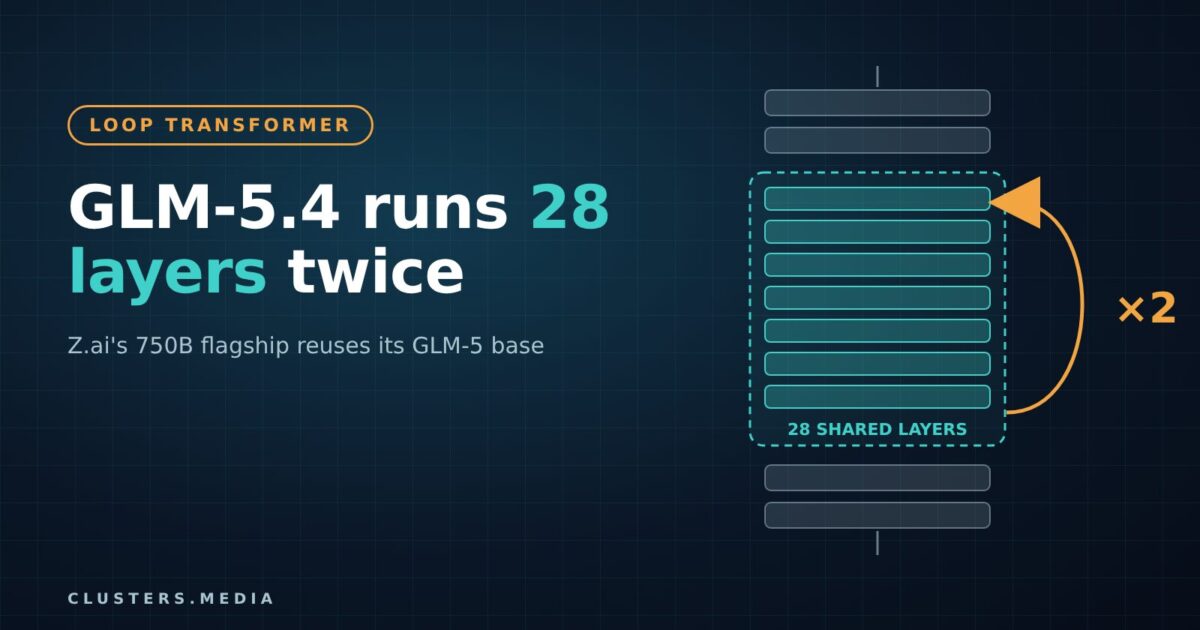
Z.ai, the Chinese lab also known as Zhipu AI, released GLM-5.4 on November 23, its first flagship model built on a Loop Transformer. Instead of training a bigger network, Z.ai took its existing GLM-5 base model, at roughly 750B parameters, and taught 28 of its layers to run twice for every token. The company says that makes the model as capable as one with 2 to 3 trillion parameters. For now it is only available inside Z.ai’s own coding products, and there are no published benchmark scores yet.
Key takeaways
- GLM-5.4 runs 28 layers of the GLM-5 base model for two passes per token, adding reasoning depth without adding parameters.
- Z.ai claims intelligence “comparable to 2T-3T parameter models” but has not yet published benchmark results for the model.
- It is live for all GLM Coding Plan users, in the ZCode app and in Z.ai Chat, with 50% more weekly quota than GLM-5.3.
- API access is due after a safety evaluation, and open weights are planned once safety hardening is complete. Neither has a date.
- The model adds vision input and supports Z.ai’s new “Generalized Coding” pitch: video, games, 3D shaders and CAD built through code.
What happened
In a normal Transformer, a token passes through each layer exactly once on its way to the output. In a Loop Transformer, a block of layers that share the same weights runs several times in a row, and each pass refines what the previous pass produced. You get a deeper network for roughly the same memory footprint, because the extra depth reuses parameters you already have.
According to Z.ai’s launch post and its developer documentation, GLM-5.4 loops a 28-layer block of the GLM-5 base model across two iterations. The rest of the layers still run once. Z.ai did not pre-train a looped model from scratch. It converted the already-trained GLM-5 base through continued training, because, as the company explains, looped models trained from zero still trail ordinary unshared models at the same compute budget.
Making that work at 750B scale took three engineering changes, which MarkTechPost and TestingCatalog also describe from the same post:
- Per-token gates. Each iteration has its own gate that decides how much of its update gets written back into the model’s residual stream, so a second pass can contribute a lot or very little depending on the token.
- A hybrid KV cache. A naive looped model would need a full key-value cache for every pass. In GLM-5.4 the second loop reuses the sparse cache entries picked in the first pass and keeps fresh entries only inside a local sliding window. The extra loop costs one sliding window of cache, not a second full one.
- Reused attention indices. GLM-5.4 uses sparse attention, which normally runs an indexer to pick which tokens to attend to. The second pass skips the indexer and reuses the first pass’s choices, which Z.ai says adds “zero indexing overhead” and performs nearly the same as recomputing.
Z.ai says GLM-5.4 serves at up to 200 tokens per second off-peak and holds 70 to 80 tokens per second at peak load.
Why it matters
For the last few years, the default way to make a model smarter has been to make it bigger and train it on more data. That gets expensive fast, both to train and to serve. Looping is a different bet: spend more compute per token at inference time by running the same weights again, rather than storing more weights.
The idea is not new, but GLM-5.4 is the largest public flagship we have seen built this way. It arrives in a week when looped designs are suddenly everywhere. Thinking Machines’ Inkling 2 Mini runs its middle layers three times per token at 26.4B parameters, small enough for a laptop. GLM-5.4 applies a similar trick roughly 28 times larger and aims it at frontier coding work.
Z.ai shared one early result that hints at why the approach is attractive. On a 30B test model given about 10% more training compute, looping produced its biggest gains in math, scientific reasoning and long-context tasks, and cut average output length by 10% to 14% on benchmarks such as GPQA-Diamond and MMLU-Pro. The company’s explanation is that part of the reasoning moves out of visible “thinking” tokens and into the hidden depth of the loop. Fewer output tokens means lower latency and lower cost for the same answer. Note that these figures come from the small test model, not from GLM-5.4 itself.
The big caveat is evidence. The “2T-3T class” claim is Z.ai’s own, and the company did not publish flagship benchmark scores with the launch. A Z.ai team member said scores will come later. Early testers on X have posted one-shot comparisons against much larger models, but those are anecdotes, not evaluations. Until independent results land, treat the claim as a hypothesis.
What it means for developers
If you already pay for the GLM Coding Plan, you can use GLM-5.4 today. Z.ai’s Zixuan Li said the model is set as glm-5.4[1m] inside Claude Code and glm-5.4 in other tools, and users with weekly quotas get 50% more GLM-5.4 usage than they had on GLM-5.3. It also works in ZCode, Z.ai’s desktop app, and in Z.ai Chat.
If you want to build on it through an API or host it yourself, you have to wait. Z.ai says API access opens after a safety evaluation and the weights will follow after safety hardening, with no dates for either. That matters for anyone who picked GLM because of its open lineage: GLM-5, released in February, shipped its 744B-parameter weights under an MIT license on Hugging Face. GLM-5.4 is, for now, a hosted-only product.
The release also adds native vision, so the model can read screenshots and UI mockups as part of coding tasks. Z.ai is using that to push what it calls “Generalized Coding”, the idea that code becomes the way to produce many kinds of output. Its demos include a self-narrated music video called “Hello World”, a six-axis robotic arm modeled in FreeCAD, a complete game with physics, maps, combat and art assets, and an interactive 3D bird-watching scene built from pure geometry and custom GLSL shaders.
Z.ai is also upfront about a weakness. The model can fall into very long “marathon thinking” sessions while it keeps correcting itself. Z.ai says the extra self-correction still improves accuracy, but if you run it in an agent loop with tight time or token budgets, watch latency on your hardest tasks and set limits accordingly.
A practical way to evaluate it now: run GLM-5.4 against your current model on a fixed set of your own repository tasks, and track three numbers per task. Did it pass, how long did it take, and how many tokens did it produce. If the shorter-output claim holds up on real work, it should show up in the last two.
What to watch next
- Benchmarks. Z.ai’s own scores, and then independent ones, will decide whether “2T-3T class” holds.
- API and weights. Watch for the end of the safety evaluation, API pricing and the licence attached to any weights.
- Adaptive compute. Z.ai says it is exploring how to give harder tokens more loop iterations automatically, instead of a fixed two.
- A bigger model. The company says it is scaling loop depth and model size together, and that a much larger model built on these lessons is close.
GLM-5.4 is an interesting test of whether depth through reuse can stand in for raw size at the frontier. Z.ai has made a strong architectural case. It has not yet made the empirical one. If the numbers arrive and match the claim, expect other labs to try looping their own existing models rather than training ever larger ones. For more on how agents are changing everyday developer workflows, see our coverage of Claude Ship.